
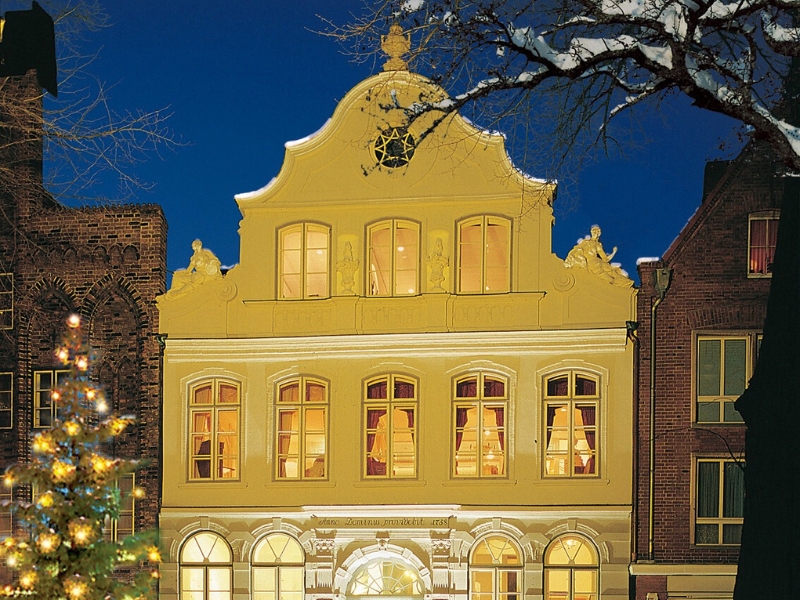
This guide follows four places that tell Lübeck's story from the city gate to the novel that made it famous: the Holstentor and its museum of Hanseatic trade, St Peter's Church with its viewing platform, the Buddenbrookhaus of the Mann family, and the St Annen museum quarter in a former convent. All four are stops on our scavenger hunt, and they can be linked in one walk across the old town island from west to south-east.
Holstentor and its museum
The Holstentor is the brick gate that guards the western side of the old town, and the picture most people have in mind when they think of Lübeck. It was begun in 1464 under the city's master builder Hinrich Helmstede and finished in 1478, as part of the outer fortifications. It stood on soft, marshy ground, and the towers began to sink and lean almost as soon as they were built; you can still see the tilt today. In 1863 the citizens voted by a majority of just one vote to keep the gate rather than pull it down, and it was restored over the following years.
Since 1950 the gate has housed a museum. Today's exhibition is about the power of trade in the Hanseatic period, with ship models, armour and weapons, and the goods that made Lübeck's merchants rich. The gate also became a national symbol: it appeared on the old 50 Deutschmark note and on a German two-euro coin issued in 2006.
- The Latin inscription on the field side, CONCORDIA DOMI FORIS PAX (harmony at home, peace abroad), added in 1871.
- The letters SPQL on the city side, for the Senate and People of Lübeck, modelled on Rome's SPQR.
- The lean of the two round towers, easiest to see if you stand back on the bridge or the lawn in front. Behind the gate, along the river, stand the old brick salt warehouses.
St Peter's Church (Petrikirche)
St Peter's is one of the five old churches of the town centre, first mentioned in 1170. A Romanesque hall church was built here in the 13th century and grew in the 15th century into a Gothic brick church with five aisles, one of the very few five-aisled churches anywhere. On Palm Sunday 1942 an air raid burned it out completely, with its roof, spire and furnishings. The tower was rebuilt in 1961, and in 1987 the interior was restored as a plain white space.
Unusually, St Peter's has no parish. It is used for exhibitions, concerts, cultural events and special services, which gives it a feel very different from the other churches in town. For most visitors the main reason to come is the tower: a viewing platform about 50 metres up, reached by lift, looks out over the roofs of the old town island.
- The view from the platform: the Holstentor, the salt warehouses, the river Trave and the seven spires of the old town's five main churches.
- The bright, empty interior, with modern pieces such as an altar cross by the Austrian artist Arnulf Rainer.
Buddenbrookhaus
The white Baroque house at Mengstraße 4, just below St Mary's Church, belonged to Thomas Mann's grandparents. Its facade carries the date 1758, when a merchant had the house rebuilt; Mann's grandfather Johann Siegmund Mann bought it in 1842. Thomas Mann, born in Lübeck in 1875, used it as the setting of his first novel, Buddenbrooks, published in 1901, the story of the decline of a merchant family. The novel was a major reason for the Nobel Prize in Literature he received in 1929, and the house has been known by the name of the fictional family ever since.
In the air raid of 1942 the house was destroyed except for its facade and the vaulted cellar, and it was rebuilt behind the old front. Since 1993 it has been the Heinrich and Thomas Mann Centre, dedicated to both writer brothers. The museum closed at the end of 2019 for a major rebuilding and extension and is not expected to reopen before about 2030; meanwhile visitor information and the shop are at Buddenbrooks am Markt, between the Town Hall and St Mary's.
- The facade with the date 1758 above the door: it survived the bombing and is what Mann's readers recognise.
- The Mengstraße itself, a street of merchants' houses running down from St Mary's towards the river, which gives a good idea of the world Mann described.
St Annen museum quarter (Museumsquartier St. Annen)
In the quiet south-east of the old town, the St Annen Museum fills a former Augustinian convent built between 1502 and 1515 in late Brick Gothic style. The nuns stayed only a short time: the last of them left in 1532, after the Reformation. From 1610 the buildings became a poorhouse, and parts were later used as a prison. The city turned the complex into a museum, which opened in 1915.
Its collection of medieval church art is the largest of its kind in Germany, with many winged altarpieces from Lübeck's churches. The best known is the Passion altarpiece by Hans Memling, dated 1491, which the Greverade family gave to Lübeck Cathedral. Upstairs, rooms show how Lübeck families lived from the Middle Ages to the 19th century. The Kunsthalle St. Annen, a modern art gallery built in the early 2000s around the remains of the convent church, completes the museum quarter, which stands next to the city's synagogue.
- Memling's Passion altarpiece, with dozens of small scenes from the Passion of Christ in one panoramic landscape.
- The convent's cloister and the walls of the burnt-out church, now part of the modern Kunsthalle.
How to see them in one walk
Start at the Holstentor on the western edge of the old town and cross the bridge onto the island. Walk up the hill to St Peter's Church and take the lift up the tower to see the whole route laid out below. From there it is a short walk north past the market square to St Mary's and down the Mengstraße to the Buddenbrookhaus. Then cross the old town towards the south-east, along the Königstraße or the side lanes, to finish at the St Annen museum quarter near the Aegidienkirche.
See Lübeck with World City Trail
Our Lübeck scavenger hunt turns the old town into a game you play on your phone. The route links 10 stops, from the Burgtor to Lübeck Cathedral, and the Museum Holstentor, St Peter's Church, the Buddenbrookhaus and the St Annen museum quarter are all stops, along with St Mary's Church, the Town Hall, Theater Lübeck and the Hospital of the Holy Spirit. At each stop you solve a puzzle and learn something about the place, at your own pace.
There is also a self-guided walking tour and an outdoor escape game in Lübeck, for people who prefer a different format.
Play the Lübeck scavenger hunt →
Take the self-guided walking tour of Lübeck →
Play the outdoor escape game in Lübeck →
Facts checked in October 2026.