
This guide follows six places across Ghent's old centre, from the river Leie to the castle: Saint Michael's Church, Saint Bavo's Cathedral with the Ghent Altarpiece, the graffiti alley of Werregarenstraatje, the Vrijdagmarkt, Sint-Jacobskerk and the Gravensteen. They range from a 12th-century castle to spray paint that changes every week, and together they make a walk through eight centuries of the city's churches, rebels and artists.
Saint Michael's Church
Saint Michael's Church (Sint-Michielskerk) stands on the west bank of the Leie, at the end of Saint Michael's Bridge. The present late Gothic church was probably begun in 1440, and its nave and transept were finished in 1528. Work on the tower stopped during the religious wars of the 16th century, Calvinists damaged the church in 1578, and building only resumed in 1623. In 1662 Lieven Cruyl drew a spire that would have made the tower 134 metres high, but it was never built, and in 1828 the stump was simply given a flat roof.
- The square, unfinished tower: compare it with the tall spires across the river to see what was planned.
- Inside, the painting Christ Dying on the Cross by Anthony van Dyck, and a statue of Saint Livinus by Laurent Delvaux.
Saint Bavo's Cathedral
Saint Bavo's Cathedral (Sint-Baafskathedraal) grew over three centuries. A chapel stood here in the 10th century, work on the Gothic church began around 1274, and the building was considered complete in 1569. Its tower is 89 metres high. The future emperor Charles V was baptised here in 1500, and traces of an older Romanesque church survive in the crypt.
The cathedral is best known for the Ghent Altarpiece, the Adoration of the Mystic Lamb, painted by Hubert and Jan van Eyck and completed in 1432. One of its panels, the Just Judges, was stolen in 1934 and has never been found; the panel you see is a copy by Jef Van der Veken. Since March 2021 the altarpiece has been shown in a climate-controlled glass case in one of the large chapels, and a visitor centre in the crypt tells its story with augmented-reality headsets before you go up to see the real thing.
- The lamb at the centre of the altarpiece: restorers removed 16th-century overpainting and uncovered its original, strikingly human face and eyes.
- The Rococo pulpit of oak, gilded wood and marble by Laurent Delvaux, made in the 1740s.
- The painting Saint Bavo Enters the Convent at Ghent by Peter Paul Rubens.
Graffiti Street (Werregarenstraatje)
Werregarenstraatje is a narrow lane between the Hoogpoort and the Onderstraat, a few steps from the City Hall. In 1995 Ghent made it the first legal graffiti alley in Belgium: instead of prosecuting graffiti writers, the city gave them a central place to paint. The Ghent street artist ROA was among the first to work here. Every surface is covered, and the pieces are painted over all the time, so no two visits look the same.
- The unwritten rule of the alley: you don't paint over a work that is better than your own. Look for layers of older pieces showing through at the edges of the newest ones.
Vrijdagmarkt
The Vrijdagmarkt (Friday Market) was for centuries the stage of Ghent's public life, with festivities, joyous entries of new rulers and also public executions; the last one took place in 1863. In the middle stands the statue of Jacob van Artevelde, put up in the same year. Van Artevelde led Ghent in the 14th century, during the Hundred Years' War, and kept the trade in English wool alive for the city's cloth makers; he was murdered in an uprising in 1345. A market is still held on the square on Fridays and Saturdays.
- Van Artevelde's outstretched arm. It points towards England; a local joke says that a quarter turn to the right would point you to the cafés instead.
- 't Toreken, the 15th-century building with a small tower on the corner, one of the very few buildings to have witnessed the square's old events. Most of the other houses date from the 19th century, and the early-20th-century socialist building of Bond Moyson has a rooster at its entrance, a symbol of a new dawn.
Sint-Jacobskerk
Sint-Jacobskerk (Saint James' Church) stands just off the Vrijdagmarkt. A wooden church dedicated to Saint James stood here in the 11th century and was replaced by a Romanesque church a century later; the building was enlarged and given Gothic features later, especially in the 15th century. Today it is used as a culture church for concerts and events, and its square, Bij Sint-Jacobs, hosts a weekend flea market and is one of the main centres of the Gentse Feesten, the city festival held each July.
- The Romanesque west front, a solid, simple survivor of the 12th-century church, against the Gothic tower at the east end.
- Inside, the tomb of Jan Palfijn, who invented the obstetric forceps, and near the main entrance a floor stone with a scallop shell, the symbol of the pilgrimage to Santiago de Compostela.
Gravensteen
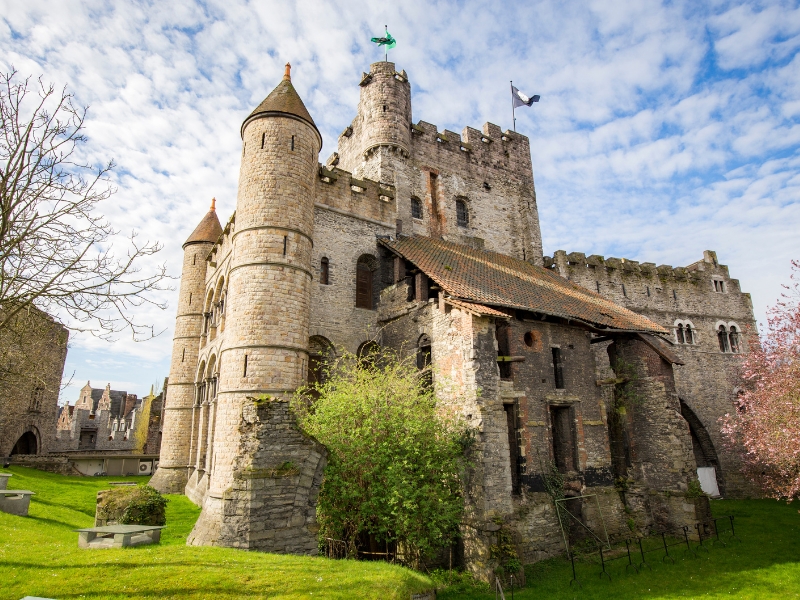
The Gravensteen (Castle of the Counts) was built in 1180 by Philip of Alsace, Count of Flanders, on the site of older fortifications. It may have been inspired by the crusader castles he had seen in the Holy Land, and it was meant as much to keep the proud citizens of Ghent in check as to defend them. The counts lived here until 1353. After that it served as a court and prison until the 18th century and, for a time, as the city's mint.
In the 19th century the castle became a cotton mill, and it was close to being demolished. The city restored it from 1893 under the architect Joseph De Waele, in a Gothic Revival spirit, so some parts, such as the flat roofs, are more 19th-century idea than medieval fact. In November 1949 students of Ghent University occupied the castle to protest against a new beer tax; the tax stayed, but none of them were prosecuted.
- The gatehouse and the massive keep, best seen from the Sint-Veerleplein in front of the castle.
- The walk along the battlements, which gives a view over the rooftops of the Patershol district and the towers of the old centre.
How to see them in one walk
Start at Saint Michael's Church on the Leie, then cross Saint Michael's Bridge and walk east past the Belfry to Saint Bavo's Cathedral. Allow time for the altarpiece. From the cathedral, head to the Hoogpoort and turn into Werregarenstraatje for the graffiti, which brings you out near the Vrijdagmarkt. Sint-Jacobskerk is just behind the square. Finish by following the streets west to the Gravensteen, and end the day with a walk round its battlements.
See Ghent with World City Trail
Our Ghent scavenger hunt turns the old town into a game you play on your phone. The route links 10 stops, starting at Saint Michael's Church and finishing at the Gravensteen, and Saint Bavo's Cathedral, the Vrijdagmarkt and Sint-Jacobskerk are also stops, along with the Belfry, the City Hall, Saint Nicholas' Church, the Korenmarkt and Saint Michael's Bridge. At each stop you solve a puzzle and hear a story, at your own pace.
There is also a self-guided walking tour and an outdoor escape game in Ghent, for people who prefer a different format.
Play the Ghent scavenger hunt →
Take the self-guided walking tour of Ghent →
Play the outdoor escape game in Ghent →
Facts checked in October 2026.