
The Hague is the seat of the Dutch government, the workplace of the king and a city of international courts, and this guide follows that thread through eight places: the Mauritshuis, Het Plein, Escher in Het Paleis, Noordeinde Palace, the Royal Stables, the Palace Garden, the Peace Palace and, out in the dunes, James Turrell's Celestial Vault. All but the last can be linked on foot in one walk through the centre.
The Mauritshuis
The Mauritshuis was built between 1636 and 1641 as a town house for John Maurice of Nassau-Siegen, then governor of the Dutch colony in Brazil, to designs by Jacob van Campen and Pieter Post. It is a textbook example of Dutch Classicism, a square, calm building with tall pilasters. Since 1822 it has housed the Royal Cabinet of Paintings, and it is known above all for Dutch and Flemish paintings of the 17th century. After a renovation it reopened in 2014 with a new wing across the street, linked by a passage under the road. It is one of the stops on our scavenger hunt.
- Johannes Vermeer's Girl with a Pearl Earring and his View of Delft, two of the best-known paintings in the country.
- The Goldfinch by Carel Fabritius, a small bird chained to its perch, and Rembrandt's Anatomy Lesson of Dr Nicolaes Tulp.
Het Plein
Het Plein, simply The Square, began as the kitchen garden of the Binnenhof, the castle of the counts of Holland, surrounded by canals and ditches. It was laid out as a town square in 1632. Today it is lined with café terraces on one side and government buildings on the other, with the entrance of the House of Representatives at Plein 2 and the Mauritshuis on the corner. It is a stop on our scavenger hunt.
- The statue of William of Orange in the middle, by Louis Royer, unveiled in 1848 and described as the oldest free-standing statue in The Hague. His left hand rests on the documents of the Union of Utrecht of 1579, and at his feet sits a little dog, a symbol of loyalty; a story says a dog once saved his life.
Escher in Het Paleis
Escher in Het Paleis shows the work of the Dutch graphic artist M. C. Escher in the Lange Voorhout Palace, an 18th-century mansion on the city's grandest avenue. Queen Emma bought it in 1896 and used it as her winter palace from 1901 until her death in 1934, and later queens kept their offices here until Queen Beatrix moved to Noordeinde Palace. The museum opened in the palace in 2002, and it is a stop on our scavenger hunt.
Inside you can see prints such as Sky and Water, Belvedere, Waterfall and Drawing Hands, and Metamorphosis, the longest version of which runs to about seven metres. The top floor is given over to optical illusions, including a room where adults look smaller than children. The city has approved plans to turn the former United States embassy, a building by Marcel Breuer on the same avenue, into a new home for the Escher collection, so the museum may move in the coming years.
- Look up at the fifteen chandeliers by the Rotterdam artist Hans van Bentem, made for the museum: one is a star, others take the form of a shark, a skull, spiders and a sea horse.
Noordeinde Palace
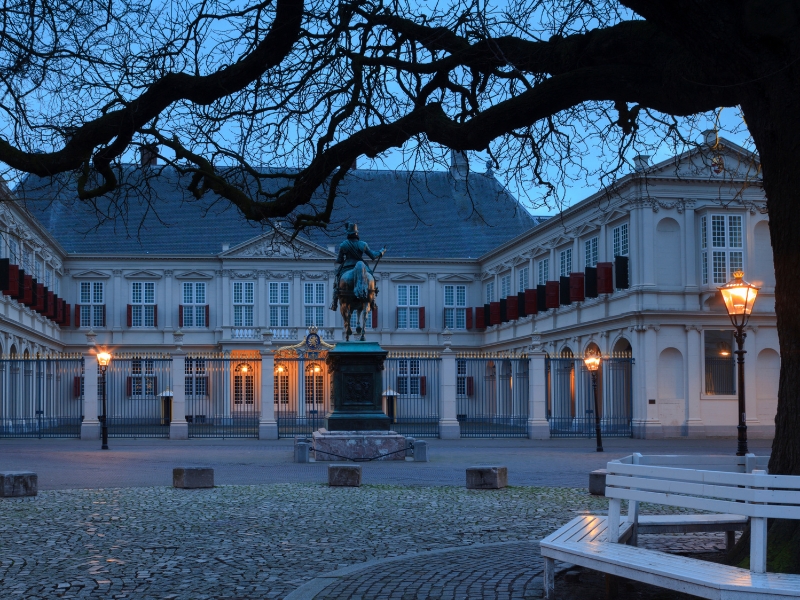
Noordeinde Palace is the working palace of the Dutch king, one of three official palaces of the royal family. It started as a farmhouse built in 1533. In 1595 the States of Holland bought it for Louise de Coligny, widow of William of Orange, and her son Frederick Henry enlarged it in 1640 with the architects Pieter Post and Jacob van Campen into the H-shaped classical building you see today. A fire destroyed the central part in 1948; after a long restoration it became the monarch's office again, and King Willem-Alexander has worked here since 2013. The palace is not open to visitors, but it is a stop on our scavenger hunt, and every year on Prinsjesdag, the state opening of parliament in September, the king's procession sets off from here.
- Look for the equestrian statue of William of Orange from 1845 in front of the palace, a different monument from the one on Het Plein.
The Royal Stables
Behind the palace, on the Hogewal, stand the Royal Stables, built between 1876 and 1879 to designs by Hugo Pieter Vogel and opened in 1881. They are still in use: the royal horses live here, and the stables look after the state carriages, including the Golden Coach and the Glass Coach, as well as the royal cars. The stables open to the public only on a few days a year, but the building is a stop on our scavenger hunt.
The Palace Garden
The Palace Garden, behind Noordeinde Palace and next to the Royal Stables, was laid out at the start of the 17th century by Frederick Henry for his mother, Louise de Coligny, and was long known as the Princesses' Garden. In the 20th century it was given to the city and became a public park, with lawns, ponds, fountains, hedges and old trees. The entrance is on the Prinsessewal, and it is the quietest place for a break on this walk. It is not on our scavenger hunt route.
The Peace Palace
The Peace Palace opened on 28 August 1913 to house the Permanent Court of Arbitration, created at the first Hague Peace Conference in 1899. The American industrialist Andrew Carnegie paid for it, and the French architect Louis Cordonnier designed it in a neo-Renaissance style, with the Dutch architect J. A. G. van der Steur. Since 1946 it has also been the seat of the International Court of Justice, the main court of the United Nations, and it holds the Peace Palace Library and the Hague Academy of International Law. Many countries gave materials and works of art for the interior. The Peace Palace is the final stop of our scavenger hunt, and the World Peace Flame by its gates is a stop too.
- The World Peace Flame next to the gates, installed in 2002, surrounded since 2004 by a ring of 196 stones from 196 countries, including rubble from the Berlin Wall and a rock from Robben Island.
- The gardens around the palace, designed by the English landscape architect Thomas Mawson; the courts are working institutions, so check in advance whether the building can be visited.
The Celestial Vault
The Celestial Vault (Hemels Gewelf) is a work of land art by the American artist James Turrell, made in 1996 in the dunes at Kijkduin, on the coast south-west of the centre. It is an elliptical bowl about 30 by 40 metres, sunk into the top of a dune and enclosed by an earth wall about five metres high. You reach it by wooden steps and a concrete passage.
In the middle lies a large stone bench where two people can lie back and look up. From there the rim of the bowl cuts off the world around you, and the sky seems to curve over you like a dome, which is the effect the title describes. A second bench on a higher dune looks out over the sea. The work is not on our scavenger hunt route and is best reached by public transport; go on a clear day or towards sunset.
How to see them in one walk
Start at the Mauritshuis and step round the corner onto Het Plein. From there walk north to the Lange Voorhout and Escher in Het Paleis, then follow the shopping streets west to Noordeinde Palace. Walk round the palace to the Royal Stables on the Hogewal and the Palace Garden behind it, then head north-west along the Zeestraat towards the Carnegieplein and the Peace Palace with the World Peace Flame at its gates. Keep the Celestial Vault for a trip to the coast at Kijkduin.
See The Hague with World City Trail
Our The Hague scavenger hunt turns the city centre into a game you play on your phone. The route links 10 stops, from Escher in Het Paleis to the Peace Palace, and the Mauritshuis, Het Plein, Escher in Het Paleis, Noordeinde Palace, the Royal Stables, the World Peace Flame and the Peace Palace are all stops, along with The Hague Historical Museum, the Binnenhof and the Gevangenpoort. At each stop you solve a puzzle and learn a story, at your own pace.
There is also a self-guided walking tour and an outdoor escape game in The Hague, for people who prefer a different format.
Play The Hague scavenger hunt →
Take the self-guided walking tour of The Hague →
Play the outdoor escape game in The Hague →
Facts checked in October 2026.