
This guide covers seven places that line up on one walk from downtown Montreal to the river: Place du Canada, Victoria Square, the MEM – Centre des mémoires montréalaises, the Pointe-à-Callière museum, Montreal City Hall, La Grande Roue and the Clock Tower. Between them they tell the city's story from the landing of the first French settlers in 1642 to the Old Port of today, and all seven are stops on our Montreal scavenger hunt.
Place du Canada
Place du Canada is the green square on René-Lévesque Boulevard, beside Mary, Queen of the World Cathedral. It began as the southern half of Dominion Square, inaugurated in 1872, and in 1967, Canada's centennial year, this half was renamed Place du Canada. The ground has a grimmer past: in the 19th century part of it was the Saint-Antoine Catholic Cemetery, and from 1854 the city moved the bodies to the Notre-Dame-des-Neiges Cemetery. In 1995, three days before the Quebec independence referendum, an estimated 100,000 people filled the square for the Unity Rally.
- The Montreal Cenotaph of 1924, a replica of the Cenotaph on Whitehall in London.
- Two cannons from 1889, offered by Queen Victoria.
- The stone canopy of the 1895 monument to John A. Macdonald, Canada's first prime minister.
Victoria Square
Victoria Square (Square Victoria) sits where downtown meets Old Montreal. By 1813 it was a hay market, and it was named after Queen Victoria in 1860, the year the Prince of Wales opened the Victoria Bridge. Over the years it has been a parking lot, an open space and a park; its present layout dates from 2002–2003, when it was redesigned as the centre of the Quartier international, the business district that surrounds it.
The square's most surprising object is the entrance to the Square-Victoria–OACI metro station: an original Art Nouveau entrance by Hector Guimard, given by the Paris transit authority, the RATP, in 1967, the year the station opened. It is the only original Guimard entrance installed in a city other than Paris. It was taken apart for restoration in 2008 and then put back.
- The statue of Queen Victoria by the sculptor Marshall Wood, unveiled by the Governor General, Lord Dufferin.
- The green cast-iron Guimard arch with its plant-like curves, the same design you see at metro stations in Paris.
The MEM, Montreal's city history museum
The MEM – Centre des mémoires montréalaises is Montreal's city history museum, built around the stories of Montrealers themselves. It took over from the Centre d'histoire de Montréal, created in 1983, which closed its old home on Place d'Youville in Old Montreal in 2020. The MEM opened in September 2023 in the Carré Saint-Laurent, a new building by the architects Provencher Roy, at the corner of Sainte-Catherine Street and Saint-Laurent Boulevard in the Quartier des spectacles.
On the ground floor, the permanent exhibition Montréal en cinq temps uses old maps, photographs, objects, film clips, songs and recorded voices to take you through the city's past. The two upper floors hold temporary exhibitions, so there is often something new even on a second visit.
Pointe-à-Callière
Pointe-à-Callière, Montreal's museum of archaeology and history, stands on the point of land where Paul de Chomedey de Maisonneuve, Jeanne Mance and the first French settlers landed in 1642 to found Ville-Marie, the settlement that grew into Montreal. The museum opened in 1992, for the city's 350th anniversary, and the site has been part of Montreal's Birthplace National Historic Site since 1924.
The museum is built over what it shows. Its main building, L'Éperon, stands on pilings that protect the archaeological finds underneath, and the complex links several sites: the remains of Montreal's first Catholic cemetery, the Old Custom House of 1836 and the William collector sewer, the city's first. Digs here have also uncovered the remains of Fort Ville-Marie and of the house of Governor Louis-Hector de Callière, whose name the point carries.
- The Old Custom House of 1836, now part of the museum.
- The exhibition on the Great Peace of Montreal of 1701, the peace treaty between New France and many First Nations.
Montreal City Hall
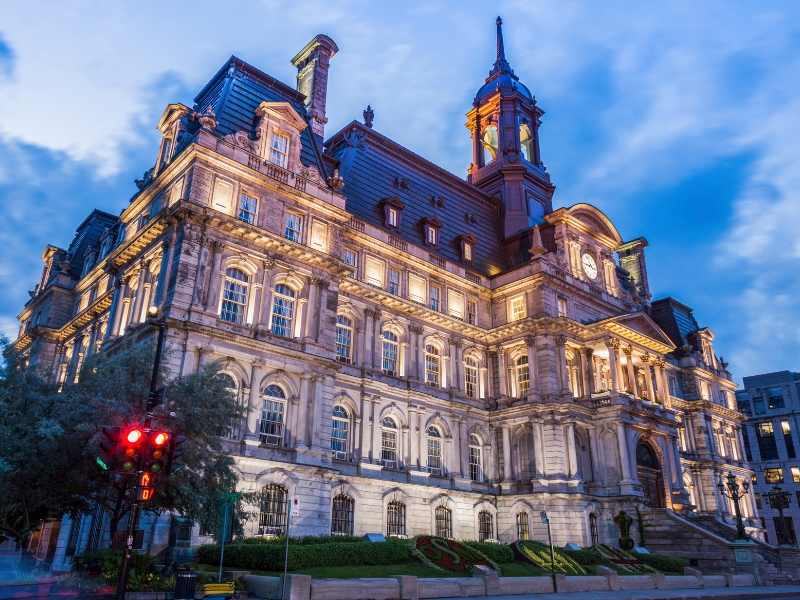
Montreal City Hall on Notre-Dame Street East was built between 1872 and 1878 by the architects Henri-Maurice Perrault and Alexander Cowper Hutchison, in the Second Empire style, with a mansard roof. It was the first city hall in Canada built only for city government. On 3 March 1922 a fire gutted the interior and left only the outer walls. Louis Parant rebuilt it inside the old shell with a steel frame, taking the city hall of Tours in France as his model, and it reopened in 1926 with a new copper-covered roof.
Its most famous moment came in 1967, when the French President Charles de Gaulle stepped onto the balcony and gave the speech in which he called out Vive le Québec libre. The building was renovated between 2019 and 2024 and has been a National Historic Site of Canada since 1984.
- The balcony on the main facade where de Gaulle spoke.
- Place Jacques-Cartier on one side and the Champ de Mars, an old parade ground, on the other.
La Grande Roue, the Old Port Ferris wheel
La Grande Roue de Montréal is the Ferris wheel on the Bassin Bonsecours in the Old Port. At 60 metres high, it is the largest in Canada. Its 42 cabins hold up to eight people each; they are air-conditioned, and the steel is rated for minus 40 degrees, so the wheel turns all year round, including in the Montreal winter.
From the top you look over the Old Port, the roofs and towers of Old Montreal and the St. Lawrence River, with the Jacques-Cartier Bridge upstream and the Clock Tower close by. It is the second-to-last stop on our scavenger hunt, which makes it a good place to take a break before the finish.
The Clock Tower
The Clock Tower stands on a wharf in the Old Port, looking out over the river. Built between 1919 and 1922, it is a memorial to the sailors who died in the First World War, and the Prince of Wales, the future Edward VIII, laid its first stone in 1919. The Montreal engineer Paul Leclaire designed it, and the clock mechanism comes from the English firm Gillett & Johnston, with a design similar to that of Big Ben.
The tower is 45 metres high, and you can climb its 192 steps, with three observation stops on the way, to a lookout near the top. Opposite it lies the Clock Tower Beach, an urban beach by the river. The tower is the last stop of our scavenger hunt.
How to see them in one walk
Follow the order of the scavenger hunt. Start at Place du Canada beside the cathedral, walk to Victoria Square and then north-east to the MEM at Saint-Laurent and Sainte-Catherine. From there head down into Old Montreal to Pointe-à-Callière, continue through Place d'Armes past Notre-Dame Basilica to City Hall, then walk down Place Jacques-Cartier to the Old Port for La Grande Roue and finish at the Clock Tower by the river. Allow extra time if you want to go inside the MEM and Pointe-à-Callière.
See Montreal with World City Trail
Our Montreal scavenger hunt turns the city into a game you play on your phone. The route links 10 stops, from Mary, Queen of the World Cathedral to the Clock Tower, and all seven places in this guide are stops, along with the cathedral itself, Notre-Dame Basilica and the Notre-Dame-de-Bon-Secours Chapel. At each stop you solve a puzzle and learn a story, at your own pace.
There is also a self-guided walking tour and an outdoor escape game in Montreal, for people who prefer a different format.
Play the Montreal scavenger hunt →
Take the self-guided walking tour of Montreal →
Play the outdoor escape game in Montreal →
Facts checked in October 2026.