
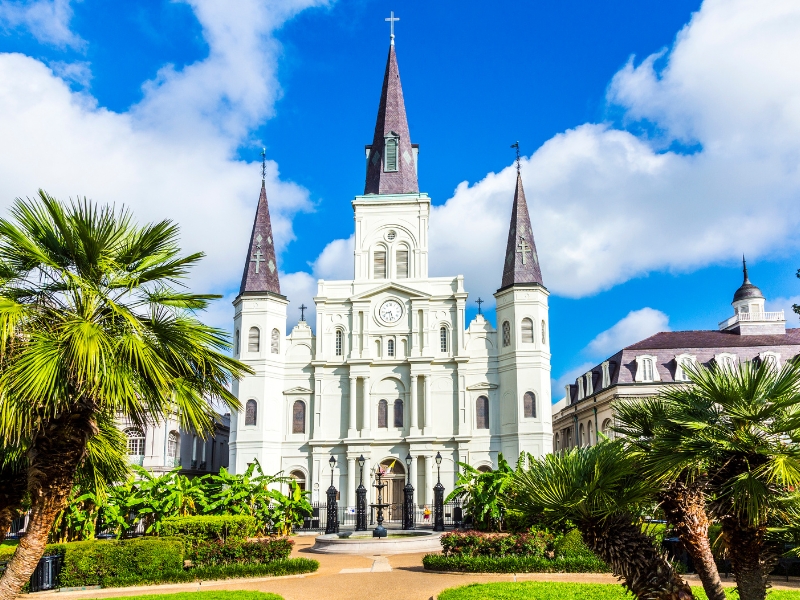
This guide covers seven places along the French Quarter and its riverfront: Jackson Square, St. Louis Cathedral, the French Market, Lafitte's Blacksmith Shop Bar, Woldenberg Park, the Audubon Aquarium and Caesars New Orleans. They sit within a short walk of each other, between Canal Street and Esplanade Avenue, and together they show the city's French and Spanish colonial past, its river trade and its modern riverfront.
Jackson Square
The square began as the Place d'Armes, a military parade ground in the French colonial town, and the Spanish called it the Plaza de Armas. In 1803 it was the stage for the ceremonies that handed Louisiana from Spain to France and then to the United States, the moment the Louisiana Purchase took effect. In 1851 it was renamed after Andrew Jackson, the general who won the Battle of New Orleans in 1815, and in 1856 his equestrian statue by Clark Mills was dedicated in the middle. It is one of four identical casts of the statue in the United States.
The square is framed by some of the most important buildings in Louisiana. On either side of the cathedral stand the Cabildo, the Spanish city hall rebuilt in 1795, where the final version of the Louisiana Purchase was signed, and the Presbytère, built to match it; both are now museums. Along the two long sides run the Pontalba Buildings, matching red-brick blocks put up in the 1840s by Micaela Almonester, Baroness de Pontalba. The streets around the square were closed to cars in 1971, and painters, musicians and street performers have worked here for about a century.
- The cast-iron balconies of the Pontalba Buildings; the apartments upstairs are said to be the oldest continuously rented apartments in North America.
- The flagpole in the square, a reminder of the transfers of Louisiana in 1803.
St. Louis Cathedral
A church has stood on this spot almost since the city was founded in 1718. The brick church finished in 1727 burned down in the Great New Orleans Fire on Good Friday, 21 March 1788. Its replacement was completed in 1794 under Spanish rule and became a cathedral in 1793, while still being built. In 1819 a central tower designed by Benjamin Henry Latrobe was added, with a clock and a bell named Victoire in honour of the 1815 victory; that bell still hangs in the building today.
The cathedral you see dates mainly from 1850, when it was enlarged and rebuilt to plans by Jacques Nicolas Bussière de Pouilly; during the work the central tower collapsed and the builders were replaced. Pope Paul VI made it a minor basilica in 1964, and Pope John Paul II visited in 1987, and the paved space in front of the cathedral now bears his name: Place John Paul II.
- The three spires facing the square, with the Cabildo on the left and the Presbytère on the right.
- St. Anthony's Garden behind the cathedral, with a marble statue of Jesus that lost a finger and thumb to Hurricane Katrina in 2005.
French Market
The French Market stretches for six blocks along the river downriver from Jackson Square, and it is often called the oldest market of its kind in the United States. Part of the site has been a market since 1791. It began as the meat market, the only place in the Quarter where meat could be sold, at the spot where Café du Monde stands today; the oldest surviving market buildings date from around 1813, and the market was largely rebuilt in the 1930s. Today the old open arcades hold shops, food stalls and restaurants.
- The flea market stalls at the far end, opposite the Old U.S. Mint, busiest at weekends.
Lafitte's Blacksmith Shop Bar
This small, weathered cottage at the corner of Bourbon Street and St. Philip Street is one of the oldest surviving buildings in New Orleans. It was most likely built as a house in the 1770s, during the Spanish colonial period, and it is a rare example of briquette-entre-poteaux construction: soft brick filled in between a frame of wooden posts. It was named a National Historic Landmark in 1970.
The name comes from a legend: the pirate and smuggler Jean Lafitte and his brother Pierre are said to have run a blacksmith shop here as a front for their business, but no document proves it. The building became a bar in the 1940s, and today it is one of the best-known bars on Bourbon Street.
Woldenberg Park
Woldenberg Park is the green strip along the Mississippi between Canal Street and Jackson Square. It opened in October 1989 on land once covered by wharves and warehouses, and it is named after Malcolm Woldenberg, a philanthropist who helped fund it. From the riverbank you can watch ships and ferries on the Mississippi, and the park hosts live music, especially during the French Quarter Festival.
- The New Orleans Holocaust Memorial by Yaacov Agam, a set of panels that show different images, including a Star of David and a menorah, depending on where you stand.
- The Monument to the Immigrant by Franco Alessandrini, installed in 1995, and the stainless-steel sculpture Ocean Song.
Audubon Aquarium
At the upriver end of Woldenberg Park, the Audubon Aquarium opened in 1990 and is run by the Audubon Nature Institute. After Hurricane Katrina in 2005 the power failed for days and most of its fish died, and it had to be restocked. It reopened in June 2023 after a large renovation that also brought the Audubon Insectarium under the same roof.
- Highlights include a walk-through tunnel under a Caribbean reef, a Gulf of Mexico tank with sharks and sea turtles, an Amazon section with macaws and piranhas, African penguins and a white alligator in the Mississippi River gallery.
Caesars New Orleans
The big casino at the foot of Canal Street is the only land-based casino in Louisiana, and state law allowed it on this one site, where the Rivergate Convention Center stood until 1995. Its start was troubled: a temporary casino opened in 1995 and soon closed, the company building the permanent one went bankrupt, and the casino only opened in 1999 as Harrah's New Orleans. A hotel tower across the street followed in 2006, and in May 2024 the complex was renamed Caesars New Orleans. You don't have to gamble to pass by: it marks the point where Canal Street, Poydras Street and the riverfront meet.
How to see them in one walk
Start at Caesars New Orleans at the foot of Canal Street and walk to the river beside the Audubon Aquarium. From there follow Woldenberg Park downriver until you reach Jackson Square. Visit St. Louis Cathedral, then walk along Decatur Street into the French Market and out to the flea market at its far end. From there, turn inland and walk up through the residential streets of the Quarter to Lafitte's Blacksmith Shop Bar on Bourbon Street, a good place to end the day.
See New Orleans with World City Trail
Our New Orleans scavenger hunt turns the French Quarter into a game you play on your phone. The route links 10 stops, from Spanish Plaza to Congo Square, and all seven places in this guide are stops: Caesars New Orleans, the Audubon Aquarium, Woldenberg Park, Jackson Square, St. Louis Cathedral, the French Market and Lafitte's Blacksmith Shop Bar, followed by Louis Armstrong Park and Congo Square. At each stop you solve a puzzle and learn a story, at your own pace.
There is also a self-guided walking tour and an outdoor escape game in New Orleans, for people who prefer a different format.
Play the New Orleans scavenger hunt →
Take the self-guided walking tour of New Orleans →
Play the outdoor escape game in New Orleans →
Facts checked in October 2026.