
This guide covers five places in Aachen's old town that tell the city's story from Charlemagne to the spa era and the 20th century: the Gothic City Hall on the market square, two bronze fountains with a sense of humour, the Puppenbrunnen and the Fischpüddelchen, the spa pavilion of the Elisenbrunnen and the Marienturm, a cannon tower of the old city wall. All of them lie within a short walk of the cathedral, so you can see them in one easy loop.
Aachen City Hall
Aachen's City Hall (Rathaus) stands on the north side of the market square, on the foundation walls of the Aula Regia, the great hall of Charlemagne's palace. The Gothic building was begun in 1330 under the mayor Gerhard Chorus and finished in 1349. Its eastern tower, the Granus Tower, goes back to Charlemagne's time: the citizens built it into their new town hall and raised it by about 14 metres, and over the centuries it held documents, weapons and ammunition, and at times served as a prison.
The upper floor is the Coronation Hall. After German kings were crowned in the cathedral next door, the coronation banquet was held here, up to 1531. The walls carry frescoes of the life and legends of Charlemagne by Alfred Rethel, finished in 1861. Air raids in 1943 and 1944 burned the roof and both towers, and the tower caps were only completed again in 1978. Today the hall is where the International Charlemagne Prize is awarded every year, and the building is still the seat of the mayor and the city council.
- The market facade with statues of 50 kings, added in the 19th-century restoration.
- Inside, the Rethel frescoes and a replica of the imperial regalia in the Coronation Hall.
Puppenbrunnen
The Puppenbrunnen (Doll Fountain) stands on Krämerstraße, the short street that links the cathedral with City Hall. The Aachen sculptor Bonifatius Stirnberg made it in 1975, and it was a gift from the Aachener Bank. Around a round bronze basin stand figures and masks whose parts can be moved, so you are invited to turn heads, arms and faces and change the fountain's look. It is one of the stops on our scavenger hunt.
- The rooster sitting on top of the figures, which is said to recall the years of French rule, and among the masks a sun with a face.
Fischpüddelchen
On the Fischmarkt, right in front of the baptistery of the cathedral, a small bronze boy stands on a stone ball and holds a fish in each hand, with a strained face, as if he is trying hard not to drop them. Water runs out of the fishes' mouths into two basins. The first version was made by the Berlin sculptor Hugo Lederer, who gave it to the city in 1911. It was a changed copy of a fountain by Ignatius Taschner that now stands in Munich.
The naked boy caused arguments: people moved and hid him several times, and in 1917 he was taken away. He came back to the Fischmarkt in 1933, only to be melted down for metal during the Second World War. The figure you see today was made in 1954 by Heinrich-Clemens Dick, who had no model of the original to work from; his seven-year-old son Georg posed for it.
Elisenbrunnen
The Elisenbrunnen is the neoclassical pavilion that sums up Aachen's history as a spa town. It was designed by Johann Peter Cremer, with plans reworked in 1823 by Karl Friedrich Schinkel, and it opened in 1827. A semicircular hall with columns joins two small pavilions. It was named after Elisabeth Ludovika of Bavaria, the Prussian crown princess and wife of the later King Frederick William IV.
Inside, two drinking fountains run with water from the Kaiserquelle spring at about 52 °C. It is rich in sulphur, which gives the whole hall its smell of rotten eggs. The water is classed as a medicine today, and signs say it is not drinking water. The building was almost destroyed in an air raid in July 1943 and rebuilt in its old form; it reopened in 1953. Behind it lies the Elisengarten, a small park. The Elisenbrunnen is the finish of our scavenger hunt.
- The marble plaques listing famous spa guests, among them Peter the Great, Frederick the Great, Casanova and Handel.
- The bust of Crown Princess Elise; the one on display is a copy, while the 1828 original by Christian Friedrich Tieck is in a museum.
Marienturm
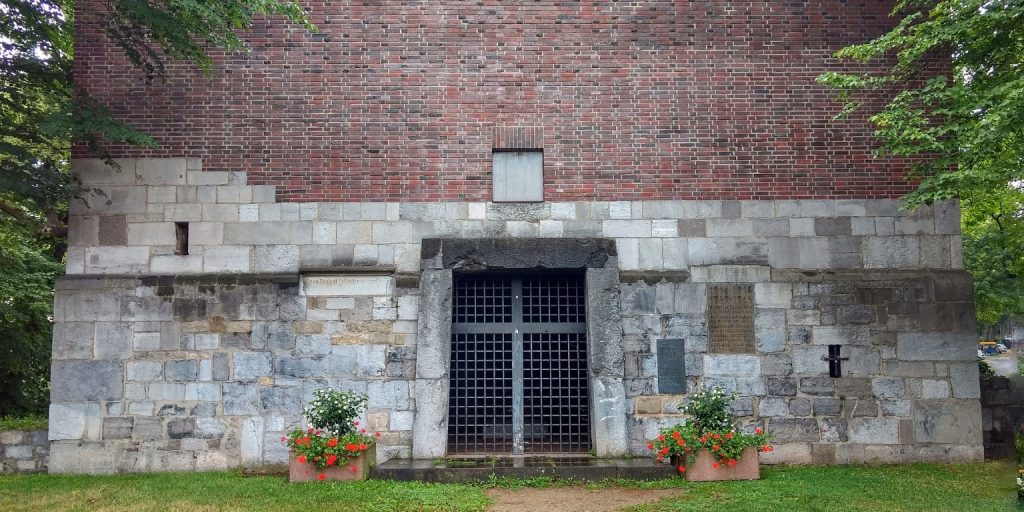
The Marienturm is a squat round tower of Aachen's outer city wall, just next to the Ponttor gate in the north of the old town. An inscription on a blue stone records that its foundation stone was laid on 14 August 1512. It replaced an older watchtower, because by then a lower, sturdier tower was more useful against cannon. Its walls are about four metres thick, and it has firing slits for cannon and guns.
In 1933 the ground floor became a memorial to the dead of the First World War, with a stone sarcophagus by Mathias C. Korr inside. The tower was badly damaged in 1944 and restored between 1950 and 1955. It stands in a small green space, the Veltmanplatz, laid out in 1908 as part of the green belt along the old wall.
- The dents left by cannonballs in 1638, still visible on the outer wall, and the old trees in the park around the tower.
How to see them in one walk
Start at the Elisenbrunnen and walk a few minutes north to the cathedral. On the Fischmarkt, in front of the baptistery, find the Fischpüddelchen. Then take Krämerstraße, with the Puppenbrunnen, up to the market square and City Hall. From the market, Pontstraße leads north to the Ponttor, and the Marienturm stands right beside it. If you want to go inside, plan time for the Coronation Hall in City Hall.
See Aachen with World City Trail
Our Aachen scavenger hunt turns the old town into a game you play on your phone. The route links 10 stops, from the Ponttor to the Elisenbrunnen, and City Hall, the Puppenbrunnen and the Elisenbrunnen are all stops, along with the cathedral, the Centre Charlemagne and the Couven Museum. The Fischpüddelchen and the Marienturm are not on the route, but both are only a few steps from it. At each stop you solve a puzzle and learn a story, at your own pace.
There is also a self-guided walking tour and an outdoor escape game in Aachen, for people who prefer a different format.
Play the Aachen scavenger hunt →
Take the self-guided walking tour of Aachen →
Play the outdoor escape game in Aachen →
Facts checked in October 2026.