
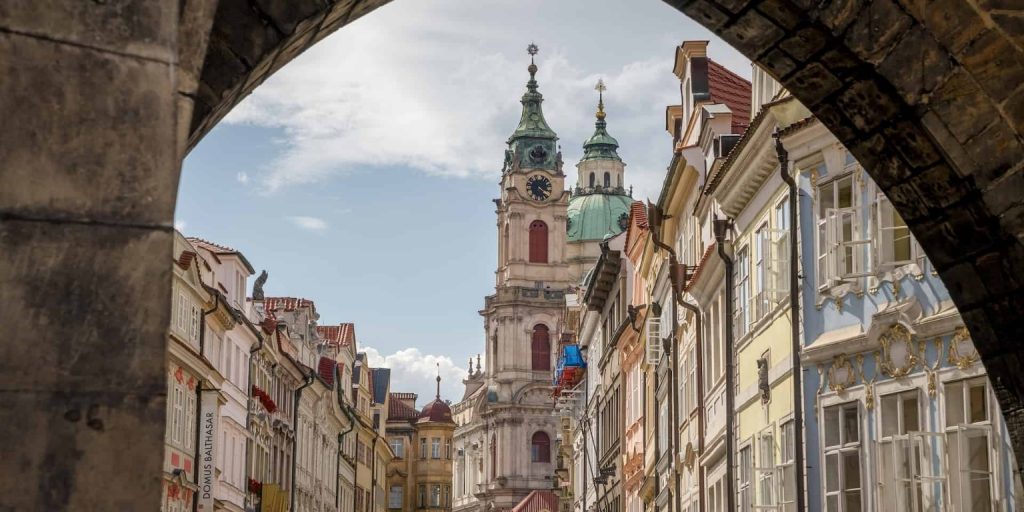
Most walks through Prague end the same way: across the river and up the hill to the castle. This guide follows that line through five places, from Henry's Tower in the New Town and the statue of Charles IV at the Old Town end of Charles Bridge, over to Malá Strana and its Holy Trinity Column, and up to Prague Castle itself. Together they tell the story of how the city grew around its kings.
Henry's Tower (Jindřišská věž)
In the New Town, a short way from Wenceslas Square, stands Henry's Tower, the free-standing Gothic bell tower of the nearby Church of St Henry (sv. Jindřich). It goes back to the 1470s: an exhibition inside shows original roof beams dated to 1475. Today the tower has ten floors open to visitors, with a small museum of Prague's towers, including a large map of the historic centre and a detailed 3D model of the city, an exhibition on the tower's own history with an original clock mechanism, and a restaurant and bar near the top with views over the centre. It is the first stop of our scavenger hunt.
- From the street, look up at the tall Gothic tower and its pointed roof, then look for the church it belongs to: the bell tower was built as a separate building.
The Charles IV Monument
On Křížovnické náměstí, the small square at the Old Town end of Charles Bridge, stands a Neo-Gothic bronze statue of Emperor Charles IV, the king who made Prague an imperial capital and founded its university in 1348. The statue was designed by the Dresden sculptor Ernst Hähnel and cast by Jacob Daniel Burgschmiet. It was meant to be unveiled in 1848, for the university's 500th anniversary, but the unrest of that revolutionary year delayed the ceremony until January 1851. It is one of the stops on the scavenger hunt route, listed there by its Italian name, Carlo Quarto.
- Charles holds the university's founding charter in his right hand, and the pedestal carries allegorical figures of the four faculties: theology, medicine, law and philosophy.
- Around the square: the Baroque Church of St Francis of the Knights of the Cross on one side, the facade of St Salvator, part of the huge Jesuit Clementinum, on another, and the Old Town Bridge Tower leading onto the bridge.
Malá Strana (the Lesser Town)
Across the river, below the castle, lies Malá Strana, literally the Little Side. King Ottokar II founded it in 1257 as a new town beneath the castle; after Charles IV founded the New Town in 1348 it became known as the Lesser Town of Prague. It was burned by the Hussites in 1419–1420, and a great fire in 1541 killed fifty people. The rebuilding that followed, and the palaces that nobles built here to be close to the court, gave the district the Baroque look it still has.
The centre of the district is Malostranské náměstí, a former market square split into an upper and a lower part by the Church of St Nicholas, designed by the father and son Christoph and Kilian Ignaz Dientzenhofer. Building began in 1703, and the decoration was only finished in the 1760s. From the square, Nerudova Street, named after the writer Jan Neruda, who was born and lived in the district, climbs towards the castle.
- The green dome and bell tower of St Nicholas, the landmark you see from Charles Bridge and from all over the district.
- The Wallenstein Palace, built for Albrecht von Wallenstein, general of Emperor Ferdinand II, with five courtyards and a formal garden.
- The Palais Lobkowicz, the West German embassy, where thousands of East German refugees gathered in 1989 before they were allowed to leave for the West.
The Holy Trinity Column
In the upper part of Malostranské náměstí stands the Holy Trinity Column, a plague column put up in thanks for the end of the plague epidemic of 1713. It was designed by Giovanni Battista Alliprandi in 1717, with sculptures by Jan Oldřich Mayer and Ferdinand Geiger; after the famine of 1772 the sculptor Ignác František Platzer added more figures. It is one of the stops on the scavenger hunt route.
- Walk round the column to see the saints on its base before you look up to the Holy Trinity at the top, with the Liechtenstein Palace on the west side of the square behind it.
Prague Castle
Prague Castle has been the seat of Bohemia's rulers for more than a thousand years: building began in 870 with the Church of the Virgin Mary, and today it is the official residence and workplace of the Czech president. Guinness World Records lists it as the largest ancient castle in the world, at almost 70,000 square metres. It is less a single building than a walled district of courtyards, palaces and churches, among them St Vitus Cathedral, finished only in 1929.
History has happened here more than once. On 23 May 1618, Protestant nobles threw two Catholic regents, Vilém Slavata and Jaroslav Bořita of Martinice, and their secretary Philip Fabricius out of a window of the Bohemian Chancellery, a fall of about 21 metres. All three survived: Catholics credited angels or the Virgin Mary, and the later story that they landed on a dung heap was probably invented in reply. The Defenestration of Prague led to the Battle of White Mountain in 1620 and the Thirty Years' War. After 1918, the Slovenian architect Jože Plečnik reshaped parts of the castle and its gardens for the new Czechoslovak republic.
- The Old Royal Palace with Vladislav Hall, added during a rebuilding under King Vladislaus II from 1485, a vast late-Gothic vaulted hall.
- St George's Basilica, the oldest surviving church building within the castle walls, with its two towers.
- Golden Lane, a row of tiny houses built in the 16th century for Rudolf II's castle guards and named after the goldsmiths who lived there in the 17th century. Franz Kafka wrote in number 22, which his sister rented, from 1916.
- The Bohemian Crown Jewels are kept in a hidden room inside the castle and are shown to the public only on rare occasions.
How to see them in one walk
Start at Henry's Tower and walk through the New Town into the Old Town and down to the river at Křížovnické náměstí and the Charles IV Monument. Cross Charles Bridge to Malá Strana, walk up to Malostranské náměstí for St Nicholas and the Holy Trinity Column, then climb Nerudova Street to Prague Castle.
See Prague with World City Trail
Our Prague scavenger hunt turns the old town into a game you play on your phone. The route links 10 stops, starting at Henry's Tower, and three of this guide's places are among them: Henry's Tower, the Charles IV Monument and the Holy Trinity Column. It also takes in the Municipal House, the Church of Our Lady before Týn, the Spanish Synagogue, St Nicholas' Church, the Astronomical Clock and Charles Bridge, and finishes at St Vitus Cathedral inside Prague Castle.
If you prefer a different format, there is also a self-guided walking tour and an outdoor escape game in Prague.
Play the Prague scavenger hunt →
Take the self-guided walking tour of Prague →
Play the outdoor escape game in Prague →
Facts checked in October 2026.