
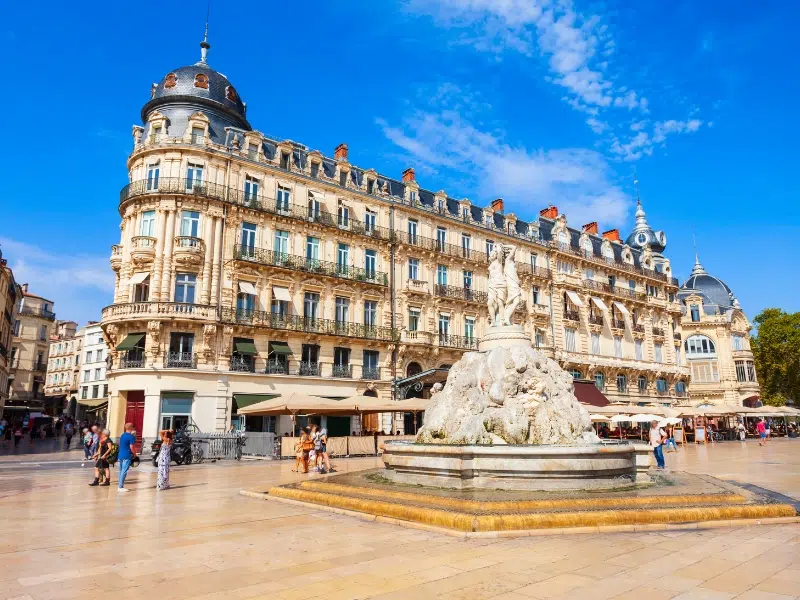
This guide covers four places at the two ends of Montpellier's old town, the Écusson: Place de la Comédie and its opera house on the eastern edge, and Place de la Canourgue and the Jardin des Plantes on the hill to the north-west. Between them they tell the city's story from a 12th-century lord's oratory and France's first botanical garden to a 19th-century opera and a large pedestrian square, and you can walk from one end to the other through the medieval lanes.
Place de la Comédie
Place de la Comédie is the city's main square, about 230 metres long and 50 metres wide, lined with tall 19th-century buildings in the Paris style. It took its name from the theatre that has stood at one end since the first square was laid out in 1755. For a long time it was a busy crossroads; after a road tunnel was opened beneath it in 1984, the square was turned in 1985 into a large pedestrian space designed by a team led by Alain Marguerit, and cars were gradually banned.
In the middle stands the Fountain of the Three Graces, made in the late 1790s by Étienne Dantoine, a sculptor from Carpentras. The original was taken indoors in 1989 and replaced by a copy. The oldest part of the paving, the oval once ringed by traffic, is still called l'Œuf, the egg, and you can still make it out by the colour of its smooth stones. Place de la Comédie is the first stop of our scavenger hunt.
- The Three Graces fountain, the centrepiece of the square, with the three goddesses standing above the water.
- The oval of l'Œuf, picked out in lighter stone in the paving around the fountain.
- To the north, the Esplanade Charles-de-Gaulle, a long tree-lined walk leading towards the Corum and the Citadelle.
Opéra Comédie
The opera house at the end of the square replaced earlier theatres lost to fire. The first, by Jacques Philippe Mareschal, opened in 1755 and was damaged by fire in 1785; it was rebuilt and reopened in 1788, and that building in turn was completely destroyed by another fire in 1881. The present theatre, designed by Joseph-Marie Cassien-Bernard, a pupil of Charles Garnier, opened in 1888 as a large Italian-style auditorium. Like Garnier's opera in Paris, it was built as a place to be seen as much as to see a show, with a marble staircase and rich decoration.
The main hall seats about 1,200 people, and a smaller hall, the Salle Molière, about 350. The building belongs to the Montpellier metropolitan authority and is home to the Opéra Orchestre national Montpellier Occitanie, which stages opera and concerts here. It was renovated in the early 2010s. The Opéra Comédie is one of the stops of our scavenger hunt.
- Inside, the crystal chandelier of the main hall under a dome painted by Jean-Baptiste Arnaud-Durbec, and in the grand foyer the ceiling painting La Voix Lactée (The Milky Way) by Ernest Michel, about 19 metres long.
- On the facade, the monumental clock by the sculptor Jean-Antoine Injalbert; the four statues of song, poetry, tragedy and comedy that once stood on the balustrade have been removed.
Place de la Canourgue
Place de la Canourgue is often called the oldest square in Montpellier. The hill it stands on was chosen in 1129 by Guilhem VI, lord of Montpellier, for a residence and an oratory, because of its commanding position and view; the oratory was destroyed in 1562 during the Wars of Religion. The name comes from the Occitan word for a chapter of canons, since the land belonged to the chapter of Saint-Pierre. Today it is a quiet rectangle of about 100 by 35 metres, shaded by plane trees and hackberries.
The square is also the site of a cathedral that was never built. Around 1623 Bishop Pierre de Fenouillet began a new cathedral here, and much of the neighbourhood was pulled down in 1626, but in 1629 Cardinal Richelieu ordered the work stopped and the old Saint-Pierre cathedral restored instead. Some of the foundations can still be seen. Place de la Canourgue is the last stop of our scavenger hunt.
- The Fountain of the Unicorns, designed in 1773 by Jacques Donnat and carved by Étienne Dantoine, the sculptor of the Three Graces. It honours the Marquis de Castries, the victor of the Battle of Clostercamp in 1760, shown in a relief below the rearing animals, and was moved to the square in 1863.
- The Hôtel Richer de Belleval, a late 17th-century mansion that served as Montpellier's town hall from 1816 to 1975.
- The Hôtel de Sarret, built in 1636, known for its coquille, a shell-shaped corner vault, and its Louis XIII courtyard.
Jardin des Plantes
The Jardin des Plantes is the oldest botanical garden in France. It was founded in 1593, when King Henri IV gave Pierre Richer de Belleval, a professor of botany and anatomy, the task of creating it. Richer de Belleval took the botanical garden of Padua, founded in 1545, as his model, and Montpellier's garden in turn inspired the Jardin des Plantes in Paris. It belongs to the state, is run by the Faculty of Medicine of the University of Montpellier and has been a listed historic monument since 1992.
The garden covers about 4.6 hectares on Boulevard Henri IV and holds around 2,680 species, about 500 of them native to the Mediterranean, including a section of some 250 medicinal plants. In the oldest part you can still see the Montagne de Richer, the 'mountain' named after the founder, next to a systematic garden where plants are arranged by botanical classification. The Jardin des Plantes is one of the stops of our scavenger hunt.
- The male ginkgo tree, planted in the late 18th century.
- The orangery, finished in 1804, and the Martins greenhouse of 1860, with its cacti and succulents.
- The English garden of 1859 with its pool, and the arboretum laid out in 1810.
How to see them in one walk
Start on Place de la Comédie at the Three Graces and look at the opera house before you head west into the Écusson. Climb through the old lanes towards the cathedral of Saint-Pierre; Place de la Canourgue lies just above it, a good place for a pause in the shade. From there walk north to the Jardin des Plantes, whose entrance is on Boulevard Henri IV, and finish among the trees. The Promenade du Peyrou, with its views and aqueduct, is only a few minutes' walk away if you still have time.
See Montpellier with World City Trail
Our Montpellier scavenger hunt turns the old town into a game you play on your phone. The route links 10 stops, from Place de la Comédie to Place de la Canourgue, and all four places in this guide are stops: Place de la Comédie, the Opéra Comédie, the Jardin des Plantes and Place de la Canourgue. In between, the route takes in the church of Saint-Roch, the Rue Arc en Ciel, the Arc de Triomphe, the Promenade du Peyrou, the Saint-Clément aqueduct and the cathedral. At each stop you solve a puzzle and learn a story, at your own pace.
There is also a self-guided walking tour and an outdoor escape game in Montpellier, for people who prefer a different format.
Play the Montpellier scavenger hunt →
Take the self-guided walking tour of Montpellier →
Play the outdoor escape game in Montpellier →
Facts checked in October 2026.