
This guide follows a line through Nantes from the castle of the Dukes of Brittany to the Loire: the Château des ducs de Bretagne, the Basilica of Saint-Nicolas, Place Royale, the Passage Pommeraye, the Memorial to the Abolition of Slavery and, across the river, the Great Elephant of the Machines de l'île. Together they cover the city's ducal past, its 18th- and 19th-century growth as a port, the darkest side of that wealth and the shipyards that have been turned into a playground.
Château des ducs de Bretagne
A castle stood here from the early 13th century, but what you see is mostly the work of Francis II, Duke of Brittany, who had it entirely rebuilt from 1466, with ducal architects including Mathurin Rodier. His daughter Anne of Brittany continued the work. From outside it looks like a fortress, with towers and curtain walls of schist and granite and a moat once fed by the Loire; inside the walls, the courtyard is lined with white tuffeau facades of a residential palace. The Edict of Nantes of 1598, by which Henri IV granted rights to Protestants, appears to have been signed here, although an older tradition places the signing in a house that no longer exists.
In 1800 a rotten ceiling in one of the towers collapsed onto stored gunpowder; the explosion destroyed the tower and much of the Grand Gouvernement, and sixty bodies were found. The army stayed until 1920, although the city had officially taken over the castle in 1915. After a long restoration, it reopened in 2007 with the Nantes History Museum inside, in 32 rooms that also deal frankly with the city's part in the Atlantic slave trade. The château is one of our scavenger hunt stops.
- The Grand Logis, the largest building, with tall Flamboyant dormer windows, some of which bore the monograms of Anne and Louis XII.
- The Tour de la Couronne d'Or, with rare Renaissance loggias; its name is said to come from the nearby well, whose ironwork looks like a crown.
- The walk along the ramparts, with views over the courtyard and the city.
Basilica of Saint-Nicolas
The Basilica of Saint-Nicolas, a few streets west of the château, was one of the first Neo-Gothic churches in France. It was designed by Jean-Baptiste Lassus, who worked with Viollet-le-Duc, and built of local granite and tuffeau from Touraine; the first stone was laid in 1844 and the church was blessed in 1869, the bell tower taking up the last fifteen years. The driving force was the parish priest Félix Fournier, later Bishop of Nantes, after whom the square in front is named. Pope Leo XIII made it a minor basilica. Allied bombing badly damaged it in 1943, and it was repaired between 1953 and 1974. It is a stop on our scavenger hunt.
Place Royale
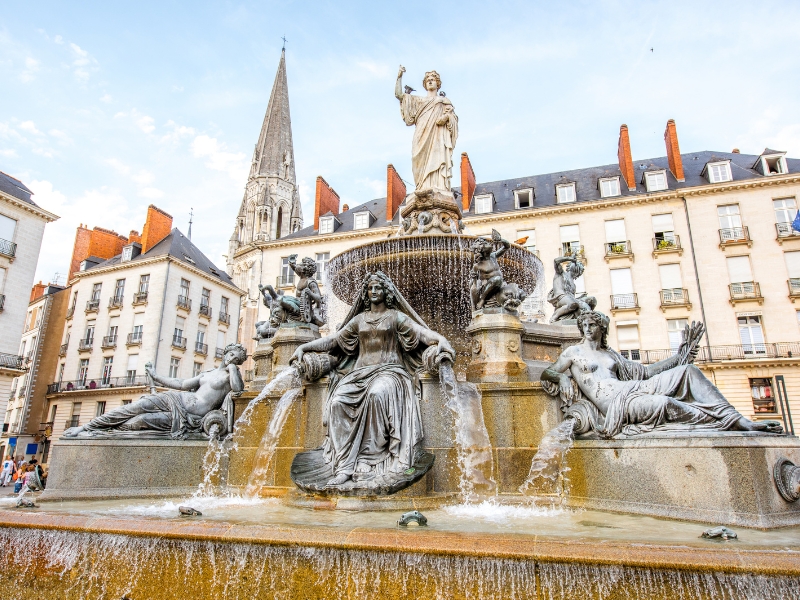
Place Royale was laid out by the architect Mathurin Crucy, who drew up the plan of the district in 1786 from sketches by Jean-Baptiste Ceineray; the square itself was created in 1790 after the old ramparts came down. It was planned as Place Louis XVI, then during the Revolution became the Field of Liberty and Place de l'Égalité, until 1806. In the bombing of 1943 eight of its nine buildings were destroyed, and the architect Michel Roux-Spitz rebuilt them in concrete to look as before. Place Royale is a stop on our scavenger hunt.
- The fountain of 1865, designed by Henri-Théodore Driollet: three granite basins one above the other, crowned by a statue of the city of Nantes by Daniel Ducommun du Locle.
- Around the fountain, figures of the Loire and of four of its tributaries, the Erdre, the Sèvre, the Cher and the Loiret.
Passage Pommeraye
The Passage Pommeraye is a covered shopping arcade that solves a problem of height: it links Rue de la Fosse, near the river, with Rue Santeuil, about nine metres higher, through three levels of galleries around a central staircase. It was the project of a notary, Louis Pommeraye, with the architects Jean-Baptiste Buron and Hippolyte Durand-Gasselin. Work began at the end of 1840 and it opened in June 1843, but the company behind it was ruined by the economic crisis of 1848 and wound up in 1849, and Pommeraye lost everything.
The arcade has a place in French culture. Jacques Demy, who grew up in Nantes, used it as a set in his 1961 film Lola, and the writer André Pieyre de Mandiargues set a short story in it. A restoration finished in 2015 brought back its 1843 look. It is a listed historic monument and a stop on our scavenger hunt.
- The terracotta statues by Jean-Baptiste Debay on the upper levels, allegories of Commerce, Industry, Agriculture, the Fine Arts, the Sciences and more.
- The two children representing Day and Night beside the clock, the wooden staircase with its wrought-iron railings and the glass roofs on iron frames.
Memorial to the Abolition of Slavery
Nantes was one of France's main slave-trading ports, and the Memorial to the Abolition of Slavery, opened on 25 March 2012, faces that history directly. Designed by the Polish artist Krzysztof Wodiczko and the Argentine-American architect Julian Bonder, it runs along Quai de la Fosse by the Loire, between the Anne-de-Bretagne bridge and the Victor-Schoelcher footbridge. Along the promenade about 2,000 glass plaques are set into the ground: 1,710 carry the names of slave ships with the dates they left Nantes, and the rest name ports in Africa, the Americas and the Indian Ocean.
Steps lead down to a space under the quay, close to the level of the river, which recalls the decks of the slave ships. Here the word freedom appears in 47 languages, with quotations from people who fought slavery, from the 17th century to today, and the memorial's epitaph is Article 4 of the Universal Declaration of Human Rights: no one shall be held in slavery or servitude. The memorial is the last stop of our scavenger hunt.
The Great Elephant (Machines de l'île)
Across the Loire on the Île de Nantes, in the former Dubigeon shipyard buildings, Les Machines de l'île is an art project created by François Delarozière and Pierre Orefice, inspired by the invented worlds of Jules Verne, the mechanical drawings of Leonardo da Vinci and the city's industrial past. Its best-known machine is the Great Elephant, built in 2007 from American tulipwood and steel, 12 metres high and 8 metres wide. It walks around the site with passengers on its back and sprays water at the people watching. The elephant is not on our scavenger hunt route, but it makes a good finale after the walk; rides may be suspended for maintenance, so check before you go.
How to see them in one walk
Start at the château and walk west through the old streets to the Basilica of Saint-Nicolas, then on to Place Royale just beyond it. From the square, Rue Crébillon and the streets around lead to the Passage Pommeraye; go through it downhill to Rue de la Fosse, and continue down to the river and the memorial on Quai de la Fosse. From there, cross the Victor-Schoelcher footbridge to the Île de Nantes for the Great Elephant.
See Nantes with World City Trail
Our Nantes scavenger hunt turns the city into a game you play on your phone. The route links 10 stops, from the Musée d'arts to the Memorial to the Abolition of Slavery; five places in this guide are stops: the château, the Basilica of Saint-Nicolas, Place Royale, the Passage Pommeraye and the memorial. The other stops are the Musée d'arts, the cathedral, Sainte-Croix Church, the Théâtre Graslin and the Natural History Museum. At each stop you solve a puzzle and learn a story, at your own pace.
There is also a self-guided walking tour and an outdoor escape game in Nantes, for people who prefer a different format.
Play the Nantes scavenger hunt →
Take the self-guided walking tour of Nantes →
Play the outdoor escape game in Nantes →
Facts checked in October 2026.