
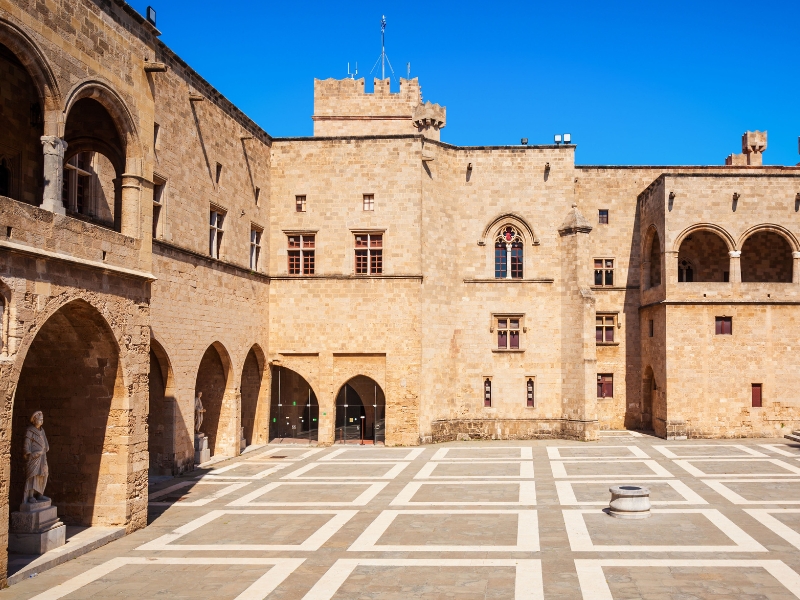
Most visitors to Rhodes spend their time inside the medieval walls, around the Palace of the Grand Master and the Street of the Knights. This guide looks at the other side of the town: an Ottoman mosque still in use in the old town, then, outside the walls, Mandraki harbour and its fort, the waterfront the Italians built in the 1920s, the aquarium at the northern tip and the ancient acropolis on Monte Smith. Together they show the Ottoman, Italian and ancient Greek layers of Rhodes that the knights' story often hides.
Ibrahim Pasha Mosque
In the lanes of the old town stands one of the oldest mosques in Rhodes. It was built in 1540–41, less than twenty years after the Ottomans took the island from the knights in 1522, during the reign of Sultan Suleiman the Magnificent. Of the seven mosques in the old town, this is the only one still open for worship: it received an official operating licence in 2019. Its minaret had decayed badly over the centuries and was restored in the 1930s, under Italian rule. It is one of the stops on our scavenger hunt.
- The slim cylindrical minaret with a single balcony, rising from a many-sided base at one corner of the roof. If you visit, remember that it is a working mosque: dress modestly and avoid prayer times.
Mandraki Harbour
Mandraki, just north of the walls, was the military harbour of the knights; the larger commercial harbour lies right next to it. Today it is full of yachts and excursion boats, and its long curved moles are the best place to look back at the walls and towers of the old town. Two columns stand at the narrow harbour entrance, each topped by a bronze deer.
Legend has it that the Colossus of Rhodes, the giant bronze statue of the sun god Helios, stood astride this harbour entrance with ships sailing between its legs. The statue was real: it was made under the direction of the sculptor Chares of Lindos, finished around 280 BC, and stood about 33 metres tall until an earthquake toppled it in 226 BC. But the image of it straddling the harbour comes from medieval imagination; a statue that size with its legs apart could not have stood, and nobody knows exactly where it was.
- The old stone windmills on the mole, survivors of a row of mills that once stood along the harbour.
Fort of Saint Nicholas
At the end of the long mole stands the round Fort of Saint Nicholas. It began as a tower built between 1464 and 1467 by Grand Master Pedro Ramón Zacosta to guard the entrance of Mandraki. After the great Ottoman siege of 1480, Grand Master Pierre d'Aubusson surrounded it with a bastion and turned it into a sea fortress. The walk along the mole past the windmills to the fort is one of the classic strolls in Rhodes.
- The view from the end of the mole: the harbour, the deer on their columns, and the walls of the old town rising behind the water.
The Italian waterfront
From 1912 to 1943 Rhodes was under Italian rule, and the Italians gave the town outside the walls a new face. A city plan of 1923 by the architect Florestano Di Fausto placed the main public buildings along the sea promenade facing Mandraki, in a mix of styles borrowed from Venice, the knights and the East.
The most striking is the former Governor's Palace, built in 1926–27, with Venetian Gothic arcades and a facade of white and pink stone that recalls the Doge's Palace in Venice. It now houses the regional administration. Next to it stands the Church of the Annunciation (Evangelismos), designed by Di Fausto and Rodolfo Petracco and modelled on the knights' lost Church of Saint John. It was built as a Catholic cathedral in 1924–25 and is now a Greek Orthodox church.
Across the road from the harbour is the Nea Agora, the New Market, also by Di Fausto: a many-sided building designed with a clearly Oriental look. Further north along the shore, the former Grand Hotel delle Rose was built in 1925–27 and is now the town's casino.
- The Governor's Palace seen from the harbour side, with its pointed arches and two-coloured stone.
- The Gothic lines of the Church of the Annunciation, a 20th-century copy of the church the knights once worshipped in.
Aquarium of Rhodes
At the northern tip of the town stands an Art Deco building designed by the Italian architect Armando Bernabiti. It was built in 1934–35 and opened in 1937 as a royal biological research institute. Since 1963 it has been the Hydrobiological Station of Rhodes, run today by the Hellenic Centre for Marine Research, and its tanks of Mediterranean sea life are open to visitors.
Acropolis of Rhodes
On Monte Smith, the hill to the south-west of the modern town, lie the remains of the acropolis of ancient Rhodes. The site goes back to the 5th century BC, but most of what you see is Hellenistic, from the 3rd and 2nd centuries BC. Italian archaeologists excavated the site from 1912 to 1945, and the Greek Archaeological Service continued the work afterwards.
Unlike the acropolis of Lindos, this one is not a fortified rock but an open hilltop: a scatter of temples, a stadium and a small theatre, with the Temple of Athena Polias and Zeus Polieus at the northern end and views over the sea to the west, which makes it a good place to be at sunset.
- The three standing columns of the Temple of Pythian Apollo, partly reconstructed after the Second World War and visible from far away.
- The stadium from the 3rd century BC, about 210 metres long, and the small odeon nearby, which held around 800 spectators and has been heavily reconstructed.
How to see them in one walk
Start at the Ibrahim Pasha Mosque in the old town, then walk north through the lanes and leave by the gates near the Palace of the Grand Master. Cross over to the Nea Agora and Mandraki, walk out along the mole past the windmills to the Fort of Saint Nicholas, and come back to follow the promenade past the Church of the Annunciation and the Governor's Palace to the aquarium at the northern tip. Monte Smith is a separate outing uphill from the New Town; many people go by bus or taxi and stay for the sunset.
See Rhodes with World City Trail
Our Rhodes scavenger hunt turns the old town into a game you play on your phone. The route links 10 stops, from the Gate of Amboise to the Medieval Clock Tower, and the Ibrahim Pasha Mosque is one of them, along with Saint Anthony's Gate, the Palace of the Grand Master, the Street of the Knights and Hippocrates Square. The places outside the walls in this guide are not on the route, so they make a good second walk. At each stop you solve a puzzle and learn a story, at your own pace.
There is also a self-guided walking tour and an outdoor escape game in Rhodes, for people who prefer a different format.
Play the Rhodes scavenger hunt →
Take the self-guided walking tour of Rhodes →
Play the outdoor escape game in Rhodes →
Facts checked in October 2026.