
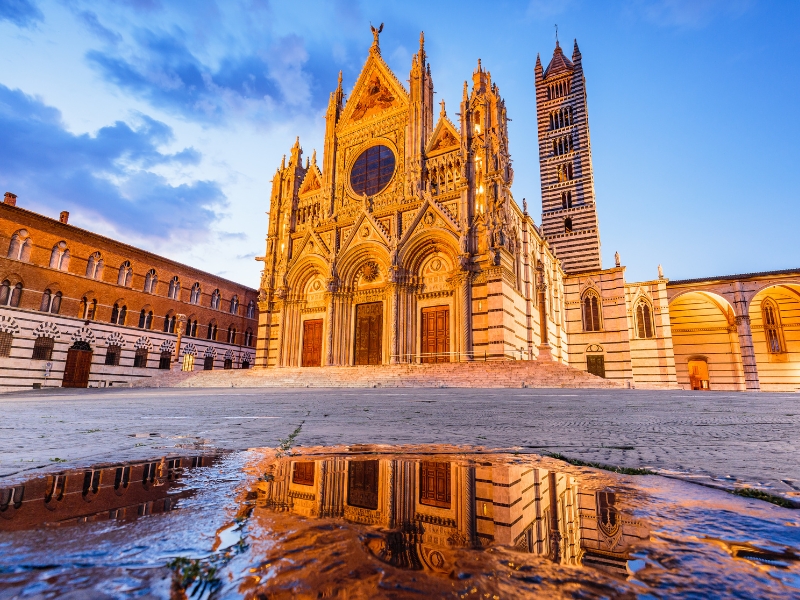
Medieval Siena was run by two powers that faced each other across a few streets: the Church, with its striped cathedral on the hill, and the city government, with its town hall and tower on the shell-shaped Piazza del Campo. This guide covers five places that tell that story: Siena Cathedral, the Palazzo Pubblico, the Torre del Mangia, the Pinacoteca Nazionale and the Loggia del Papa. They all lie inside the old town, close enough to link in one walk.
Siena Cathedral
The cathedral was built mainly in the 13th century, and its dome was finished in 1264. Its walls, inside and out, are striped in black and white marble, the civic colours of Siena; according to legend they recall the black and white horses of Senius and Aschius, the sons of Remus who are said to have founded the city. Giovanni Pisano designed the lower part of the west front from around 1284, and the upper part followed in the second half of the 14th century.
In 1339 the city decided to build a far larger cathedral, with the existing church as only its transept. The Black Death of 1348 stopped the work, and the plan was abandoned in 1355. The unfinished walls still stand south of the cathedral; the tall, empty front, known as the Facciatone, can be climbed for a view over the city. Below the choir, the Baptistery of San Giovanni has a hexagonal font with bronze reliefs by Jacopo della Quercia, Lorenzo Ghiberti and Donatello.
- The marble floor: 56 inlaid panels made from the 14th to the 16th century by about forty artists. Most of it is covered to protect it and is fully shown only for a few weeks a year, usually including September.
- The pulpit by Nicola Pisano and his workshop, carved between 1265 and 1268, with crowded reliefs of the life of Christ.
- The Piccolomini Library, with bright frescoes by Pinturicchio on the life of Pope Pius II, painted between 1502 and 1507.
Palazzo Pubblico
The town hall on Piazza del Campo was built roughly between 1297 and 1310 for the Nine, the merchant government that ruled the Republic of Siena, and they moved in in 1310. Its brick front curves slightly inwards, following the curve of the square. In front of it stands the Cappella di Piazza, a stone chapel added in 1352 to thank the Virgin for the end of the Black Death.
The first floor is now the Museo Civico, set up in the 1930s. In the Sala dei Nove, Ambrogio Lorenzetti painted the frescoes of Good and Bad Government in 1338 and 1339: on one wall a well-run city and countryside at work in peace, on the other a ruined town ruled by Tyranny. It is one of the largest non-religious painting cycles of the Middle Ages, and it was meant to remind the rulers who met in the room of their duty.
- In the Sala del Mappamondo, the Maestà by Simone Martini, the Virgin enthroned among saints, painted in the 1310s.
- On the opposite wall, the horseman Guidoriccio da Fogliano riding past a besieged castle, traditionally given to Simone Martini, though experts still debate it.
Torre del Mangia
The slim brick tower next to the town hall was built in the first half of the 14th century and finished in the 1340s, with a stone top designed, probably, by the painter Lippo Memmi. At about 102 metres it was meant to rise higher than the towers of rival Florence. It takes its name from its first bell-ringer, Giovanni di Balduccio, nicknamed Mangiaguadagni, 'profit eater', perhaps because of how he spent his money.
- The Cortile del Podestà, the brick courtyard with arcades on all four sides, where the stairs up the tower begin.
- The great bell at the top, called Sunto after the Assumption of the Virgin, and the view down onto the fan of the Campo.
Pinacoteca Nazionale
Siena's national picture gallery opened in 1932 in two old palaces on Via San Pietro, Palazzo Brigidi from the 14th century and Palazzo Buonsignori from the 15th. It has one of the largest collections of Sienese paintings on gold ground, from the 13th to the 16th century, and walking through it in order is the best way to see how the Sienese school grew.
Highlights include works by Guido da Siena, Duccio di Buoninsegna, Simone Martini, Pietro and Ambrogio Lorenzetti and Sassetta, and later paintings by Il Sodoma and Domenico Beccafumi. A restoration in 2022 found that the Buonsignori facade, long thought to be a 19th-century imitation of Gothic, is in fact mostly original.
- Ambrogio Lorenzetti's Annunciation of around 1344, and in the later rooms Beccafumi's St Michael driving out the rebel angels.
Loggia del Papa
This small Renaissance loggia off Banchi di Sotto was built in 1462 for Pope Pius II, born Enea Silvio Piccolomini, as a gift to his family; the design is attributed to Antonio Federighi. Its three round arches look very different from the Gothic brick around it, and it stands next to the family's Palazzo Piccolomini and the baroque church of San Martino.
- The Latin inscription on the frieze, Gentilibus suis Picolomineis, dedicating it to the Piccolomini family, and the family arms with five crescent moons on a cross.
How to see them in one walk
Start at the Pinacoteca on Via San Pietro, then walk up to the cathedral square, with the old hospital of Santa Maria della Scala opposite the cathedral. See the cathedral and the Piccolomini Library, climb the Facciatone if you have the energy, and go down the steps behind the cathedral to the Baptistery. From there make your way down to Piazza del Campo for the Palazzo Pubblico and the Torre del Mangia, and finish a short walk east at the Loggia del Papa and Palazzo Piccolomini. The tower and the cathedral floor are popular, so book ahead when you can.
See Siena with World City Trail
Our Siena scavenger hunt turns the old town into a game you play on your phone. The route links 10 stops, from the Pinacoteca Nazionale to Palazzo Piccolomini, and all five places in this guide are stops, along with Santa Maria della Scala, the Facciatone, the Baptistery and Piazza del Campo. At each stop you solve a puzzle and learn a story, at your own pace.
There is also a self-guided walking tour and an outdoor escape game in Siena, for people who prefer a different format.
Play the Siena scavenger hunt →
Take the self-guided walking tour of Siena →
Play the outdoor escape game in Siena →
Facts checked in October 2026.