
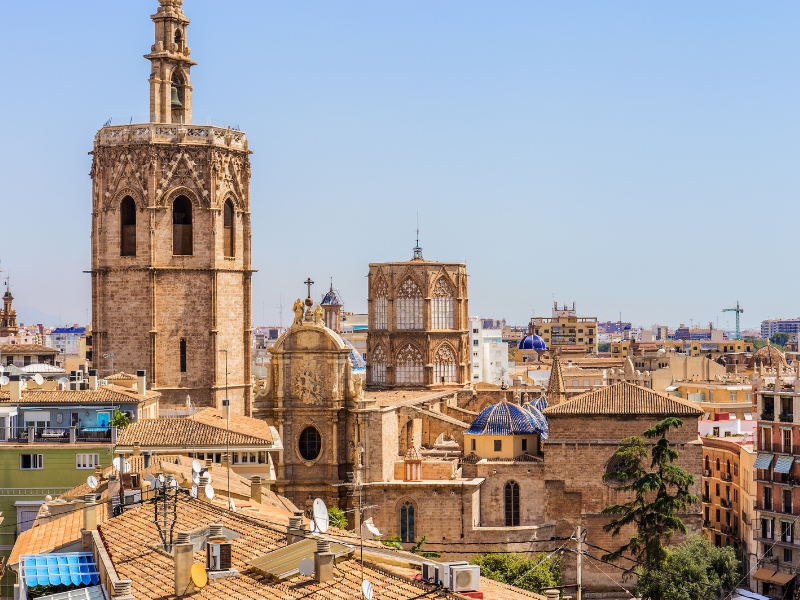
This guide follows a line across Valencia, from the bullring by the North Station through the old town to the green bed of the Turia: the Plaça de Bous, the Mercado Central, La Lonja de la Seda, the cathedral, the old university of La Nau, the Parterre gardens, the Mercat de Colón and the Pont de les Flors. Together they show the city's medieval trade, its faith and learning, and the confident building of the early 20th century, and all eight lie on one walk.
Plaça de Bous
Valencia's bullring stands on Carrer de Xàtiva, right next to the Estació del Nord. It was built in the 1850s to plans by Sebastián Monleón and opened in 1859. Its neoclassical design borrows from Roman amphitheatres such as the Colosseum and the arena of Nîmes: four storeys of brick arcades wrapped around a ring of about 47.5 metres. The main bullfighting fair takes place during the Fallas in March, and the bullring also hosts concerts and other events.
- The bullfighting museum, opened in 1929 and one of the oldest in Spain, with more than 3,000 objects, of which only a small part is on show.
Mercado Central
The Central Market was begun in 1914 and finished in January 1928. Francesc Guàrdia i Vial and Alexandre Soler i March drew the first project, and after changes the work passed to Enrique Viedma and Ángel Romaní. The style is Valencian modernisme with a Gothic flavour: iron, glass, domes and slender columns over more than two hundred stalls selling fish, meat, fruit, vegetables and spices. It remains a working food market, used by locals as much as by visitors.
- The large central dome with a weathervane on top, and the coloured glass and tiles that light the hall.
La Lonja de la Seda
Opposite the market stands the Silk Exchange, built between 1482 and 1533, when Valencia was one of the richest trading cities of the Mediterranean. Pere Compte built its main hall, the Sala de Contratación, in about fifteen years, from 1483 to 1498. It is a masterwork of late Valencian Gothic and became a UNESCO World Heritage Site in 1996.
The side wing housed the Consolat de Mar, a merchant court that settled disputes over sea trade. A golden inscription on a blue band runs around the walls of the main hall: in Latin, the building says it was built in fifteen years and reminds merchants that honest trade is blessed, that they should not deceive, and that they should not lend money at interest.
- The twisted columns in the Sala de Contratación, which spread into the ribs of the vault like palm trees.
- The walled Orange Garden courtyard, and the gargoyles along the outer walls.
Valencia Cathedral
Work on the cathedral began on 22 June 1262, after the Christian conquest of the city, on the site of the former mosque, which had itself replaced the Visigothic cathedral; their remains can be seen in the excavations of L'Almoina next door. It has three doors in three styles: the Romanesque Almoina door, the oldest; the Gothic Apostles' Door, finished by 1354; and the baroque Iron Gate on Plaza de la Reina, begun in 1703.
The bell tower, the Micalet, was begun in 1381 and finished in 1425; it was once free-standing and was joined to the church in the 15th century. Every Thursday at noon the Water Tribunal meets at the foot of the Apostles' Door, as it has for centuries, to settle disputes over irrigation water in the farmland around the city.
- The chapel of the Holy Chalice, with a cup of red chalcedony believed by many to be the cup of the Last Supper, given to the cathedral by King Alfonso the Magnanimous in the 15th century. Its origin cannot be proved, but the stone cup is dated to the 1st century.
- The Renaissance frescoes of angel musicians, painted around 1474 and found by chance in 2004, hidden under a later baroque vault.
- Two paintings by Goya from 1788 in the chapel of St Francis Borgia.
Centre Cultural La Nau
The University of Valencia was founded in 1499, and its first home was a house with patios and gardens that the city had bought in 1493 on the site of today's La Nau building. The university has since moved most of its teaching elsewhere, and the building is now a cultural centre with exhibitions and the university's historic library. The library keeps manuscripts, incunabula and printed books from the 16th century onwards; most of its founding collection was lost in a fire caused by a bomb during the Peninsular War.
El Parterre
The Parterre is a small formal garden on Plaça d'Alfons el Magnànim, a green stop between the old university and the shopping streets of the Eixample. In the middle stands an equestrian statue of King James I of Aragon, who took Valencia from its Muslim rulers in 1238 and founded the Christian kingdom of Valencia, the event that started the building of the cathedral. Big old trees shade the paths, and it is a pleasant place for a rest on a hot day.
Mercat de Colón
Built between 1914 and 1916 by the Valencian architect Francisco Mora Berenguer and opened on 24 December 1916, this market in the Eixample is one of the finest works of Valencian modernisme. Demetrio Ribes designed its iron roof. After a full restoration between 2003 and 2009 it no longer sells food in the old way: it is now a covered square with cafés, restaurants, a horchata bar, a florist and a few of the original shops.
- The ceramic and mosaic decoration of the main facades, with fruit of the Valencian huerta such as oranges, lemons, figs and pomegranates.
Pont de les Flors
This bridge across the Turia Gardens opened in 2002, designed by the engineer Manuel Biedma. Its sides are planted with flowers that are changed several times a year with the seasons and festivals, which gives the bridge its name. In 2023 the city council renamed it after the former mayor Rita Barberá, so its full name is now Pont de les Flors – Alcaldessa Rita Barberá.
How to see them in one walk
Start at the Plaça de Bous next to the North Station and walk up past the City Hall square to the Mercado Central and La Lonja, which face each other. Continue through the old streets to the Plaça de la Verge and the cathedral, then head south-east to La Nau and on to the Parterre. From there cross into the Eixample for the Mercat de Colón, and finish by walking down to the Turia Gardens and the Pont de les Flors. Visit the Mercado Central in the morning, when the stalls are busiest.
See Valencia with World City Trail
Our Valencia scavenger hunt turns the city into a game you play on your phone. The route links 10 stops, from the Plaça de Bous to the Pont de les Flors, and all eight places in this guide are stops, along with the City Hall and the Plaça de la Verge. At each stop you solve a puzzle and learn a story, at your own pace.
There is also a self-guided walking tour and an outdoor escape game in Valencia, for people who prefer a different format.
Play the Valencia scavenger hunt →
Take the self-guided walking tour of Valencia →
Play the outdoor escape game in Valencia →
Facts checked in October 2026.