
This guide follows five places from the modern city into Ortigia, the island where Syracuse began: the war memorial church of San Tommaso al Pantheon, the green Foro Siracusano on the site of the ancient agora, the Temple of Apollo, the Fountain of Diana on Piazza Archimede and the cathedral built inside a Greek temple. Together they cover more than two and a half thousand years, from the Greek city to the First World War, along one easy walk.
San Tommaso al Pantheon
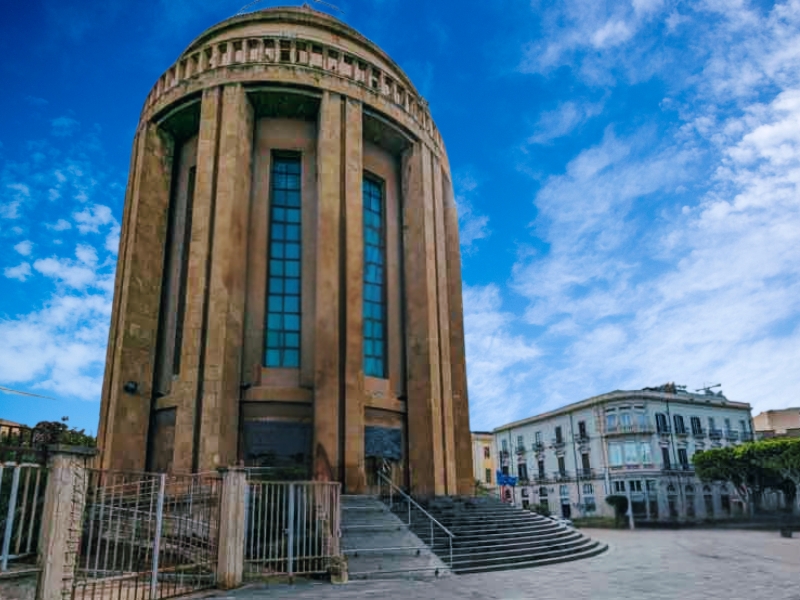
This round church on the edge of the Foro Siracusano is the city's main memorial to the soldiers of Syracuse who died in the First World War, and it holds their remains. Work on it began in 1919 to a design by the architect Gaetano Rapisardi, who gave it a modern circular plan and a cylindrical body, which is why it is called the Pantheon. Inside, a single round nave is lined with memorial plaques, and King Victor Emmanuel III visited it during an official visit to the city in 1939.
- The large bronze entrance door, with commemorative plaques on either side.
- The circular nave lined with memorial plaques, a quiet contrast to the busy streets outside.
Foro Siracusano
The Foro Siracusano, between Piazzale Marconi and Corso Umberto I, was the agora of the Greek city and later the Roman forum, the place where Syracusans met to trade, vote and argue. After 1910 it was turned into a public garden to a plan by the architect Luigi Mauceri, and locals still call it i villini. Today it is a public park with ancient remains among the trees.
Little of the ancient square is left above ground, but what survives is worth a look. Three restored marble columns from a portico of the Roman imperial period are the only direct remains of the forum itself, and excavations have also found a stretch of paved Roman road and blocks thought to belong to the council house. Several marble statues found here are now in the Paolo Orsi archaeological museum.
- The three marble columns, the last standing piece of the Roman forum.
- The view of the round Pantheon church from the garden, a reminder that the two sights sit side by side.
Temple of Apollo
Just over the bridge onto Ortigia, in front of Piazza Pancali, lie the remains of the Temple of Apollo, built in the 6th century BC and one of the oldest Doric temples in Sicily. It is a ruin rather than a standing temple: a row of heavy column stumps and the stepped base, open to view from the square. On the top step of the east side there is an unusual inscription dedicated to Apollo, celebrating the building of the temple.
Its later history explains why it survived at all. The temple became a Byzantine church, then a mosque under Arab rule, then a Norman church again, and in the 16th century it was swallowed by a Spanish barracks and by private houses. It was only rediscovered inside the barracks at the end of the 19th century and later excavated.
- The heavy, closely set column stumps typical of early Doric temples.
- The inscription to Apollo on the top step of the east side.
Fountain of Diana
The fountain in the middle of Piazza Archimede was made in 1906 and 1907 by the sculptor Giulio Moschetti, helped by his son Mario. It tells a story from Greek myth that belongs to Ortigia. Diana, the goddess of the hunt, known to the Greeks as Artemis and the protector of the island, stands at the top with her bow and a dog. At her feet the nymph Arethusa is turning into a spring to escape the river god Alpheus, who looks on in astonishment. According to the myth, the spring came up on Ortigia, where the Fonte Aretusa still flows today.
- Diana with her bow and hunting dog at the top of the fountain.
- Arethusa stretching out as she changes into water, and Alpheus beside her.
- The four tritons in the basin, riding sea horses and sea monsters through the waves.
Syracuse Cathedral
From the outside the cathedral on Piazza Duomo looks like a Baroque church, but it is built inside a Greek temple. The Doric Temple of Athena was raised here in the 5th century BC by Gelon, the tyrant of Syracuse, to celebrate a victory, traditionally linked to the battle of Himera. When it became a church, the spaces between the columns were walled up, and the old columns are still part of the building, inside and out.
The Norman facade fell in the earthquake of 1693, and the architect Andrea Palma designed the new one, finished in 1753. The statues on it are by Ignazio Marabitti and show Saints Peter and Paul, Saint Marcian, Saint Lucy, the city's patron saint, and the Immaculate Virgin at the centre. Inside, the chapel of Saint Lucy keeps a silver statue of the saint made by Pietro Rizzo in 1599 and 1600.
- The Doric columns of the temple built into the outer side wall of the church.
- Nine columns from one side of the temple and two from the front of its inner room, visible inside the nave.
- The Baroque facade and Marabitti's statues, best seen from the far side of Piazza Duomo.
How to see them in one walk
Start at San Tommaso al Pantheon and walk through the Foro Siracusano garden to the columns. Follow Corso Umberto I to the bridge and cross onto Ortigia, where the Temple of Apollo is the first thing you see. Walk past the old market and up Corso Matteotti to Piazza Archimede and the Fountain of Diana, then continue to Piazza Duomo for the cathedral. From there it is a few minutes downhill to the Fonte Aretusa on the waterfront, and the tip of the island with Castello Maniace makes a good finish.
See Syracuse with World City Trail
Our Syracuse scavenger hunt turns the old town into a game you play on your phone. The route links 10 stops, from San Tommaso al Pantheon to Castello Maniace, and all five places in this guide are stops: San Tommaso al Pantheon, the Foro Siracusano, the Temple of Apollo, the Fountain of Diana and the cathedral. Along the way you also pass the statue of Archimedes, the old market of Ortigia, the Archimedes and Leonardo da Vinci museum and the Fonte Aretusa, solving a puzzle at each stop at your own pace.
There is also a self-guided walking tour and an outdoor escape game in Syracuse, for people who prefer a different format.
Play the Syracuse scavenger hunt →
Take the self-guided walking tour of Syracuse →
Play the outdoor escape game in Syracuse →
Facts checked in October 2026.