What is the Syracuse self-guided walking tour?
The Syracuse self-guided walking tour is a walk on which your phone does the guiding: the World City Trail app maps the route and narrates the history, legends and curious facts of every stop, with no group and no fixed start. The whole thing takes around 3 hours, 36 minutes of them walking, over 2.6 km and 10 stops. Most of the route lies on the island of Ortigia, where Greek temples, baroque squares and the sea are never more than a few minutes apart.
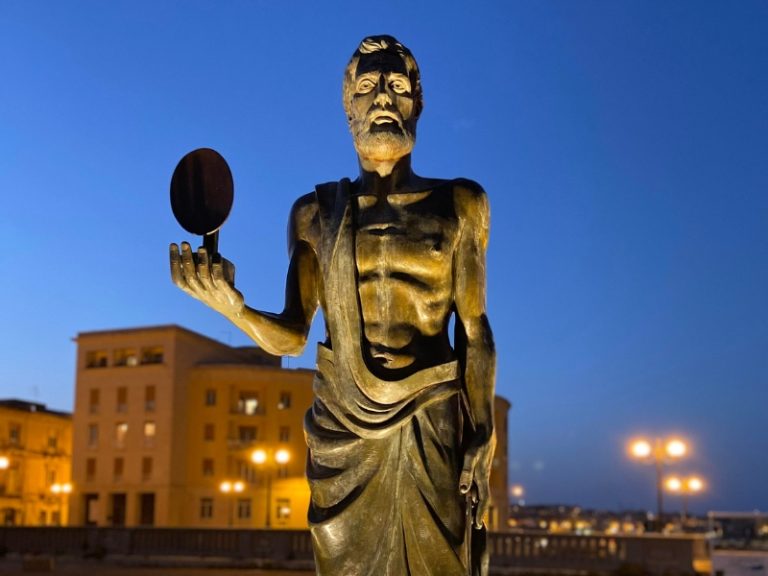
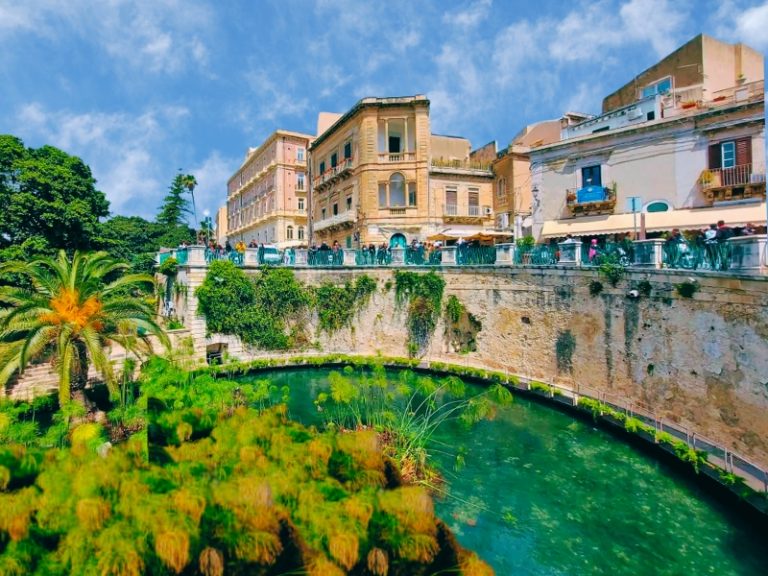
By the bridge to Ortigia the narration explains why Archimedes is shown holding a mirror, and at the Temple of Apollo it points you to the name of the builder Kleomenes carved on the top step. On Piazza Archimede you hear the myth behind the Fountain of Diana, in which the nymph Arethusa turns into a spring to escape the river god Alpheus, and at the cathedral you see the Doric columns of a temple to Athena still standing in its walls. Later the same myth returns at the Fountain of Arethusa, where papyrus grows right beside the sea.
- Durationabout 3 hours
- Walkingabout 36 min · 2.6 km
- Stops10
- LanguagesEnglish, German, French, Italian, Spanish, Dutch
What the walk looks like
Arrive and listen
When you reach a stop, the narration begins: who built it, what happened there, the legend attached to it and a detail worth looking for. If you prefer, read the same chapter as text instead.
Walk on
The way to each next stop appears in Google Maps. Over the full 2.6 km you walk for about 36 minutes, at whatever speed feels right.
Break it up
A long lunch, a museum or simply a bench in the sun: close the app and pick up where you left off, the same day or another one.
Use the local tips
Suggestions for places to eat and local shops near the route come with the walk. Prefer a different first stop, or another sequence? The app handles that too.
See the route and attractions →
How it works
- Book online Choose the number of people. Your booking reference arrives by email straight away.
- Get the app Download the World City Trail app from the App Store or Google Play and enter your booking reference.
- Walk when you like Start whenever you are ready, walk at your own pace and pause any time. No guide, no fixed schedule.
Is this walk for you?
People who ask why
If you want to know who built a gate, or how a street got its name, the narration has the answer.
Families and couples
Legends for the children, history for the adults, and everyone moves at the same relaxed speed.
Back for another visit
Familiar streets look different once you know the stories behind them.
Good to know
- Bring a charged smartphone with mobile data; a power bank helps.
- No entry tickets needed: everything happens outside the buildings. Going inside is optional and paid separately.
- Family friendly; children must be accompanied by an adult.
- Not suitable for wheelchair users and difficult with strollers.
- Groups of up to 5 work best; larger groups split up, one ticket per person.
- Every purchase helps support stray cats and dogs in Greece.
From the mainland to the tip of Ortigia, stop by stop
10 stops · about 36 min walking · start: Church of San Tommaso al Pantheon · finish: Castello Maniace
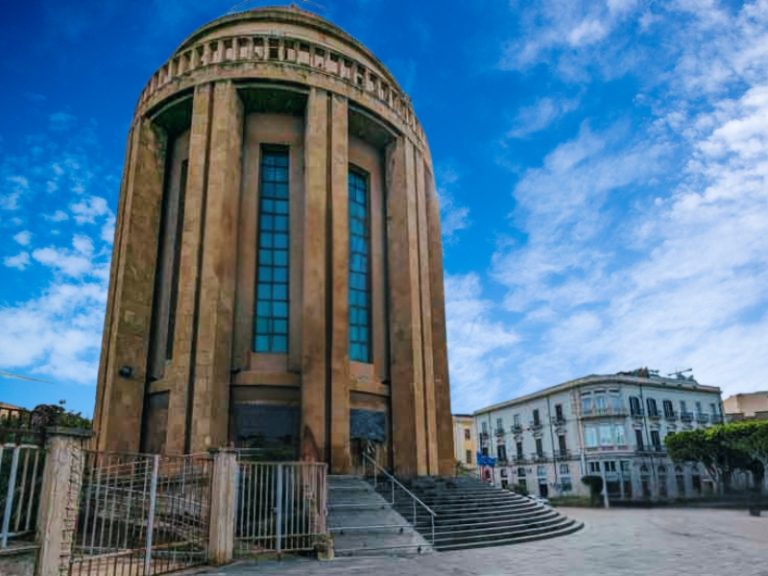
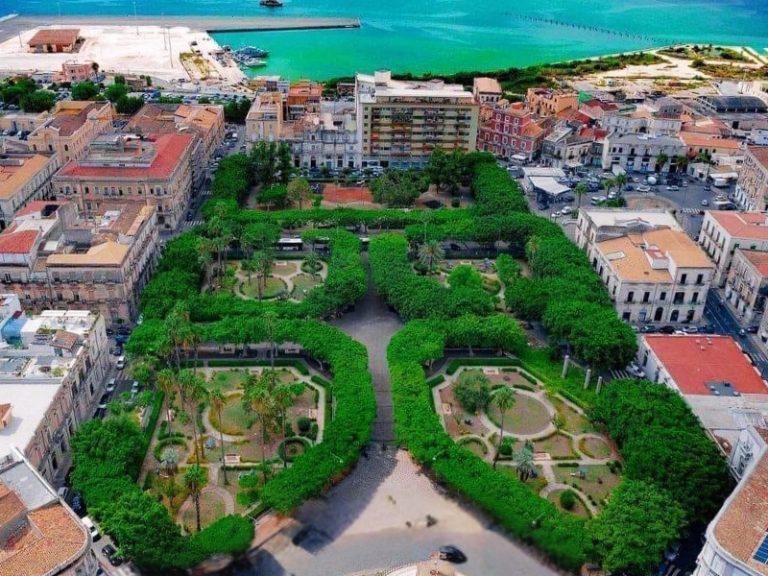
The walk opens at the domed church of San Tommaso al Pantheon, a First World War memorial on the mainland, and crosses the gardens of the Foro Siracusano, where the Greek agora once lay. The statue of Archimedes marks the way onto Ortigia; on the island the morning market and the Temple of Apollo come first, followed by the Archimedes and Leonardo da Vinci Museum and the Fountain of Diana. The cathedral and the Fountain of Arethusa lead to Castello Maniace, the last stop on the southern tip. The app lets you change the order, and no stop needs a ticket.
Open the route map ↗
1Church of San Tommaso al PantheonStart
This round church with a large dome, known in Syracuse simply as the Pantheon, was built in the 1930s as a shrine to the local soldiers who died in the First World War. Its plan and dome deliberately recall the Pantheon in Rome.
2Foro Siracusano
This large square with gardens on the mainland side of Syracuse covers part of the area of the ancient agora, the main public square of the Greek city. Remains of ancient buildings have been found here, and today palms, benches and wide paths make it a meeting point just before the bridges to Ortigia.
3Statue of Archimedes
Archimedes, the mathematician and inventor, was born in Syracuse around 287 BC and died when the Romans took the city in 212 BC. This modern bronze near the bridge to Ortigia shows him holding a mirror, a nod to the legend that he set Roman ships on fire with focused sunlight.
Read the full story →
4Ortigia Market
Ortigia's street market fills the lanes near the Temple of Apollo with stalls of fresh fish, fruit, vegetables, cheese, olives and spices. It is a morning market where traders still call out their goods, and a good place to see what Sicilian kitchens use, from swordfish and sardines to citrus fruit.
Read the full story →
5Temple of Apollo
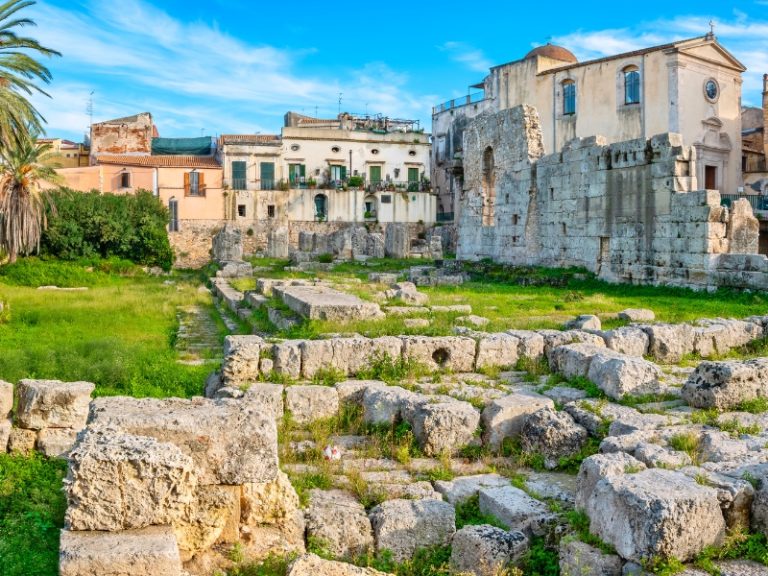
Built in the early 6th century BC, this is one of the oldest Doric temples in Sicily. Only the base, parts of the walls and the stumps of its heavy columns survive, and an inscription carved on the top step names the builder Kleomenes. Over the centuries it was turned into a church and later a mosque.
Read the full story →
6Archimedes and Leonardo da Vinci Museum
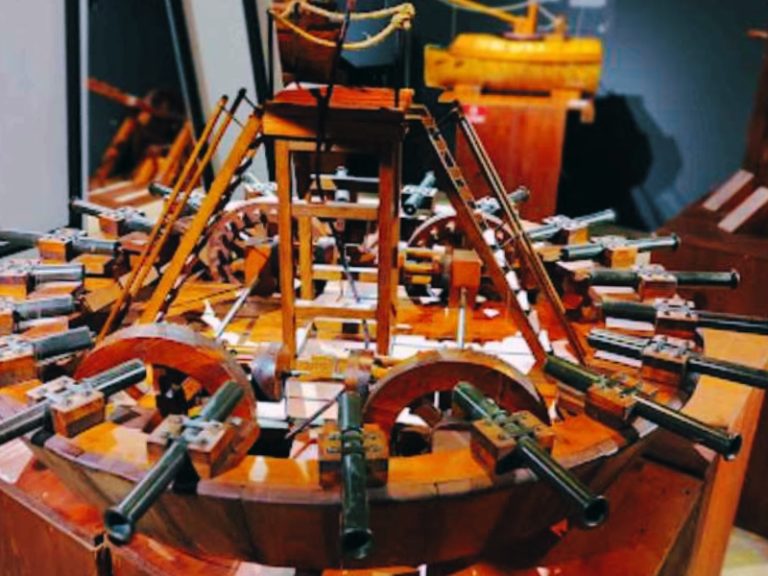
This small museum shows working models of machines inspired by two great inventors, Archimedes of Syracuse and Leonardo da Vinci. Its exhibits include devices such as the Archimedes screw for lifting water and reconstructions of the war machines said to have defended Syracuse against the Romans.
Read the full story →
7Fountain of Diana
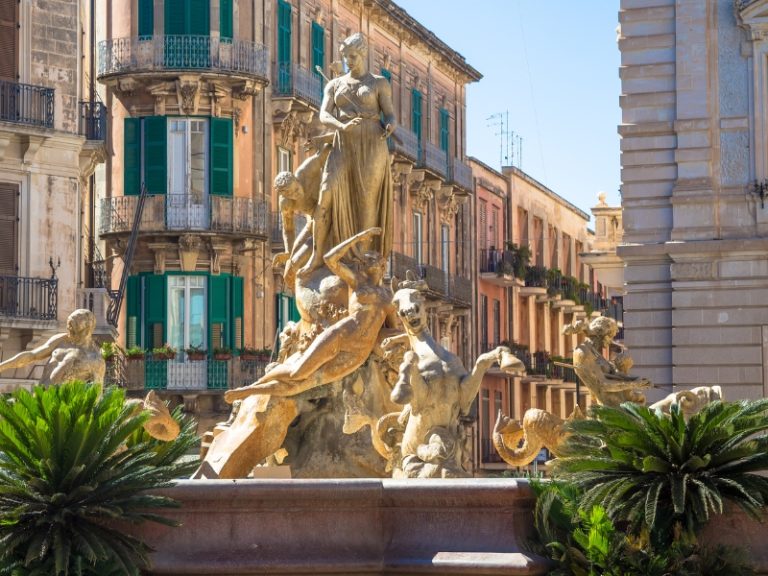
The Fountain of Diana stands in the middle of Piazza Archimede, the main square of Ortigia, and was made by the sculptor Giulio Moschetti in the early 20th century. Above the basin the goddess Diana watches as the nymph Arethusa turns into a spring to escape the river god Alpheus, surrounded by tritons and sea creatures.
Read the full story →
8Syracuse Cathedral
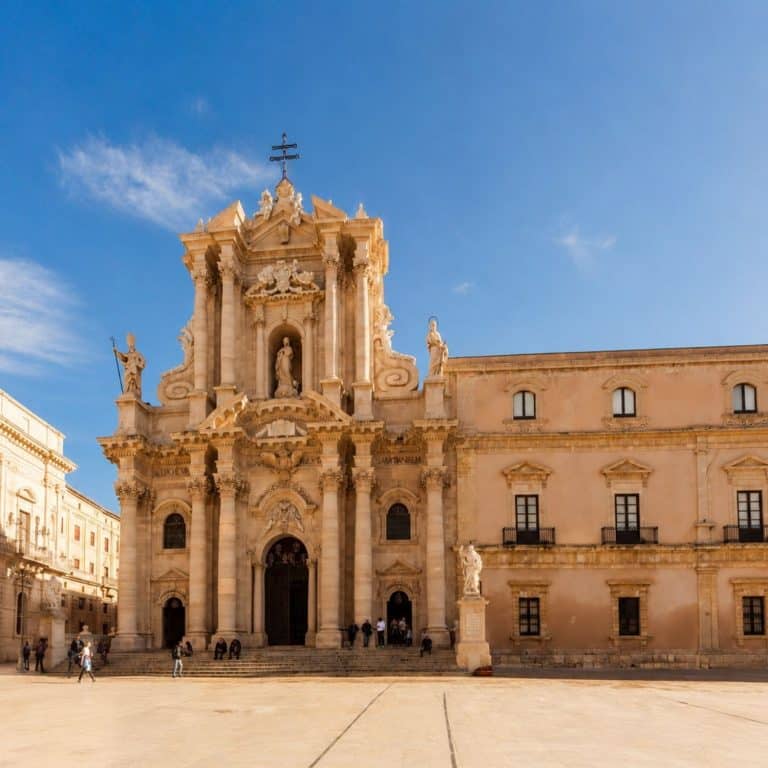
Syracuse Cathedral was built into the Doric Temple of Athena, erected in the 5th century BC after the Greek victory over Carthage at Himera. Ancient columns still stand in its side walls and inside the nave, while the baroque façade on Piazza Duomo was added after the earthquake of 1693.
9Fountain of Arethusa
This freshwater pool lies right beside the sea on the western shore of Ortigia, and papyrus grows in it alongside ducks and fish. According to myth, the nymph Arethusa fled the river god Alpheus from Greece and was turned into this spring by Artemis, but Alpheus followed her under the sea.
Read the full story →
10Castello ManiaceFinish
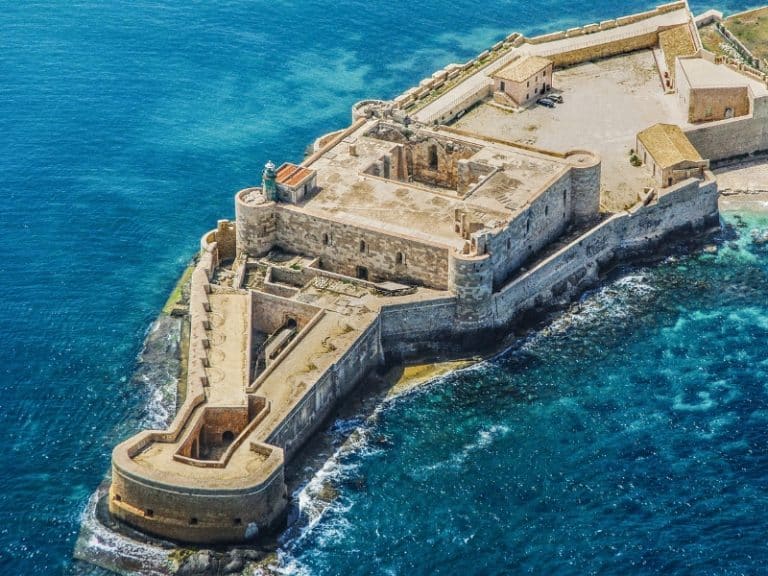
This fortress on the southern tip of Ortigia was built for Emperor Frederick II between about 1232 and 1240. It is named after George Maniakes, the Byzantine general who briefly retook Syracuse from the Arabs in 1038, and its square plan with round corner towers guards the entrance to the harbour.
Read the full story →
Only logged in customers who have purchased this product may leave a review.





Spain –
Collected on GetYourGuide
Todos!
Emma– Germany –
Collected on GetYourGuide
Interessante Fakten über die Sehenswürdigkeiten, die Stadt und die Insel. Nicht zu viele und nicht zu wenig Informationen. Gute Wegbeschreibung durch Verbindung der App mit Googlemaps.
Italy –
Collected on GetYourGuide
Ottima guida per chi vuole muoversi liberamente e in autonomia nell’isola di Ortigia! Abbiamo potuto fare altre tappe oltre a quelle indicate e prenderci tutto il tempo necessario. Spiegazioni chiare ed esaurienti, molto interessanti anche le curiosità raccontate.