
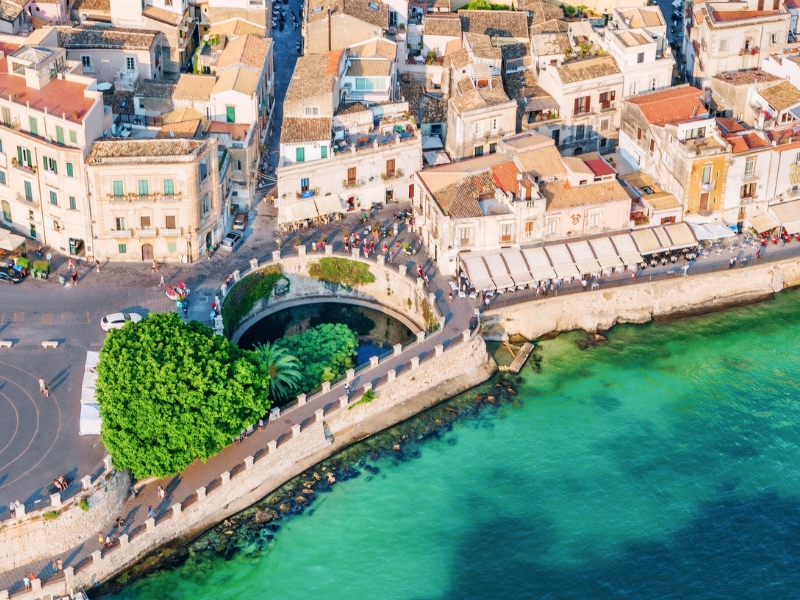
The Fountain of Arethusa (Fonte Aretusa) is a freshwater spring on the seafront of Ortygia, the island at the historic core of Syracuse, just a few metres from the sea. Greek myth says it is the nymph Arethusa herself, who escaped from Greece under the sea and came up here. Today it is a round pool full of papyrus, ducks and fish, and the papyrus is one of the very few wild stands in Europe.
The Fountain of Arethusa at a glance
- Where: on the western shore of Ortygia, overlooking the Great Harbour (Porto Grande), at the southern end of the Foro Italico promenade.
- Created: a natural spring, known since Greek times; it took its present shape in 1847, when it was freed from the city's fortifications.
- What it is today: a public pool and viewpoint inside the UNESCO World Heritage area, and a favourite meeting place for locals.
- Time needed: 10–20 minutes, longer if you stay for sunset over the harbour.
From sacred spring to city symbol
For the Greeks who founded Syracuse in the 8th century BC, the spring was a sacred place. Ancient writers such as Pausanias tell how the founder, Archias, was sent by the oracle at Delphi to an island where the waters of Alpheus mixed with the spring of Arethusa. The nymph became the emblem of the city: her head, surrounded by dolphins, appears on the famous silver coins of Syracuse, some of them signed by the engravers Kimon and Euainetos. Poets from Virgil and Ovid to Milton and Pope wrote about her spring.
The spring has changed shape many times. In the 16th century its water was divided into channels used by tanners. In 1540, when Charles V strengthened the defences of Ortygia, it was enclosed inside a bastion, and it was only released in 1847, when the pool took its present form; the terrace above it is what is left of the old bastion. In June 1798 Horatio Nelson took on water and supplies at Syracuse before the Battle of the Nile and linked the spring to his coming victory. In recent years drought has reduced the flow of water and worried those who look after the papyrus.
What to look for
- The papyrus plants growing in the pool: together with stands near Syracuse and in the province of Catania, they are among the only places in Europe where papyrus grows wild.
- The ducks and fish that live in the pool, which is why locals sometimes call it the duck fountain.
- The double ring of the pool, a round basin with an inner circle, built in the 19th century.
- The view from the terrace above, the remains of the Spanish bastion, over the Great Harbour.
- Arethusa on Syracusan coins, which you can see in the city's archaeological museum or on souvenirs around Ortygia.
The legend of Arethusa and Alpheus
According to the myth, Arethusa was a nymph who bathed in the river Alpheus in Greece. The river god fell in love with her and chased her. She prayed to the goddess Artemis, who turned her into a stream that flowed under the sea all the way to Ortygia, where she rose as this spring. Alpheus did not give up: he too flowed under the sea, so that, the story says, his waters still mingle with hers. It is a legend, but it explains why freshwater rises right beside the salt sea.
Tips for your visit
- Come at sunset, when the light falls over the harbour and the promenade fills with people on their evening stroll.
- Look down from the railing rather than leaning over: the pool sits well below street level.
- Combine it with a walk along the Foro Italico, the tree-lined seafront promenade beside the harbour.
Nearby
- Piazza Duomo: the long, pale square of Ortygia, with a cathedral built into a Greek temple of Athena, a few minutes' walk away.
- Castello Maniace: the medieval fortress at the southern tip of Ortygia, built under Frederick II.
- Temple of Apollo: the ruins of one of the oldest Doric temples in Sicily, near the bridge to the mainland.
- Foro Italico: the seafront promenade running north from the fountain along the Great Harbour.
See Syracuse with World City Trail
Our Syracuse scavenger hunt turns the old town into a game you play on your phone. The route links 10 stops and takes around two hours, with about 36 minutes of walking. It includes places such as the island of Ortygia, the church of San Tommaso al Pantheon, the Foro Siracusano and the Archimedes monument.
If you prefer a different format, Syracuse also has a self-guided walking tour and an outdoor escape game.
Play the Syracuse scavenger hunt →
Take the self-guided walking tour of Syracuse →
Play the outdoor escape game in Syracuse →
Facts checked in October 2026.