
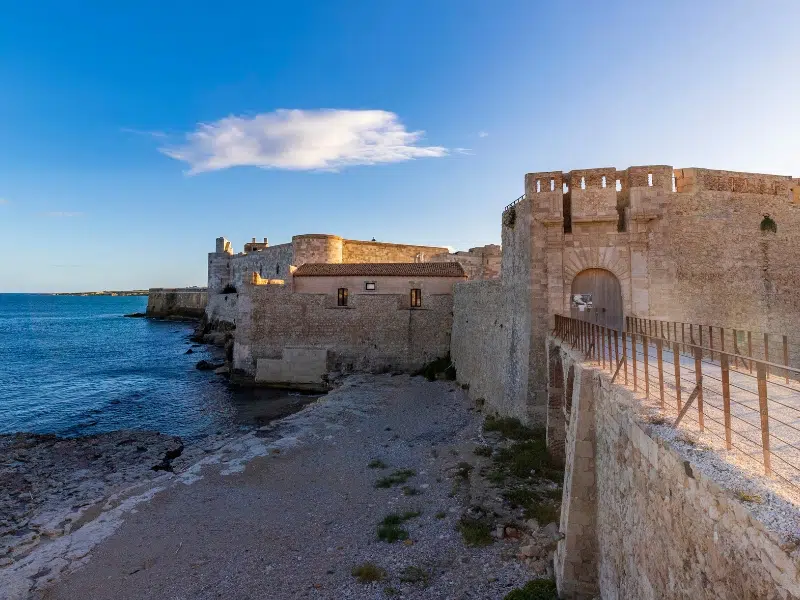
Castello Maniace is the square stone castle at the very tip of Ortigia, the island that forms the old centre of Syracuse, with the sea on three sides. The Holy Roman Emperor Frederick II had it built in the 1230s, and inside it hides a vaulted hall of columns that is closer to a palace than to a barracks.
Castello Maniace at a glance
- Where: the southern point of the island of Ortigia, at the end of the promontory beyond Piazza Federico di Svevia.
- Built: 1232–1240, on the site of an earlier fort traditionally linked to 1038.
- By: Riccardo da Lentini, the architect of Emperor Frederick II, who ruled as King of Sicily.
- What it is today: a monument open to the public, with the restored hall of columns, small exhibition rooms and a walk along the walls with views over the sea and the harbour.
- Time needed: 45–60 minutes.
From Byzantine fort to emperor's castle
The castle takes its name from George Maniakes, the Byzantine general who took Syracuse from the Arabs in 1038 for Emperor Michael IV; tradition says he built the first fort on the point. Two centuries later Frederick II of Hohenstaufen, emperor and King of Sicily, had his architect Riccardo da Lentini build the present castle in 1232–1240. It is a near-perfect square with a round tower at each corner, each tower holding a spiral staircase, and it was entered by a bridge over a moat that has since been filled in.
The castle's later life was mostly military. In 1288 King Peter III of Aragon lived here with his family, and during the War of the Sicilian Vespers it held out against an assault in 1298. From 1305 to 1536 it was one of the residences of the queens of Sicily, in the 15th century it served as a prison, and in the 16th century it was built into the harbour defences under Charles V. On 5 November 1704 the powder magazine exploded and destroyed most of the great hall; it was rebuilt for artillery and stayed in military hands until well into the 20th century. After a long restoration it is now open to visitors.
What to look for
- The portal: a Gothic doorway framed in polychrome marble, the most decorated part of the outside walls.
- The two empty brackets beside the portal, which once held a pair of Greek bronze rams from the 3rd century BC. The surviving ram is in the Antonino Salinas Archaeological Museum in Palermo; reproductions are shown inside the castle.
- The hall of columns: some 800 square metres of cross vaults on stone columns. It was once divided into 25 vaulted bays; the 1704 explosion destroyed 15 of them, and the lost bays are now an open courtyard with the outlines of the old column bases marked in the floor.
- The corner towers: round and solid, each with a spiral staircase inside that led up to the upper level and the walls.
- The walls: walk along the ramparts for views of the open sea, the Great Harbour of Syracuse and the seafront of Ortigia.
The bronze rams
The bronze rams are the castle's most famous lost treasure. They are thought to have decorated a royal building of ancient Syracuse in the early 3rd century BC, and in the Middle Ages they were set up on either side of the castle portal. According to the traditional account, one was destroyed in the unrest of the 19th century; sources disagree on whether it was in 1820 or 1848. The other was given to the museum in Palermo in 1866 and has been on permanent display at the Salinas museum since 2016.
Tips for your visit
- Come in the late afternoon, when the low sun warms the stone and the light on the sea is softer for photos from the walls.
- There is little shade in the courtyard and on the walls in summer: bring water and a hat.
- The castle sometimes hosts events and performances, so parts may be closed; check before you go.
Nearby
- Fonte Aretusa: the freshwater spring by the sea where papyrus grows, a pleasant walk back along the waterfront.
- Lungomare Alfeo: the promenade along Ortigia's western shore, good for a sunset walk after the castle.
- Syracuse Cathedral: on Piazza Duomo, built into a Greek Doric temple of Athena from the 5th century BC, whose columns you can still see in its walls.
See Syracuse with World City Trail
Our Syracuse scavenger hunt turns the old town into a game you play on your phone. The route links 10 stops and takes around 2 hours, with about 36 minutes of walking. It includes Ortigia, the Archimedes monument and the Foro Siracusano.
If you prefer a different format, there is also a self-guided walking tour and an outdoor escape game in Syracuse.
Play the Syracuse scavenger hunt →
Take the self-guided walking tour of Syracuse →
Play the outdoor escape game in Syracuse →
Facts checked in October 2026.