
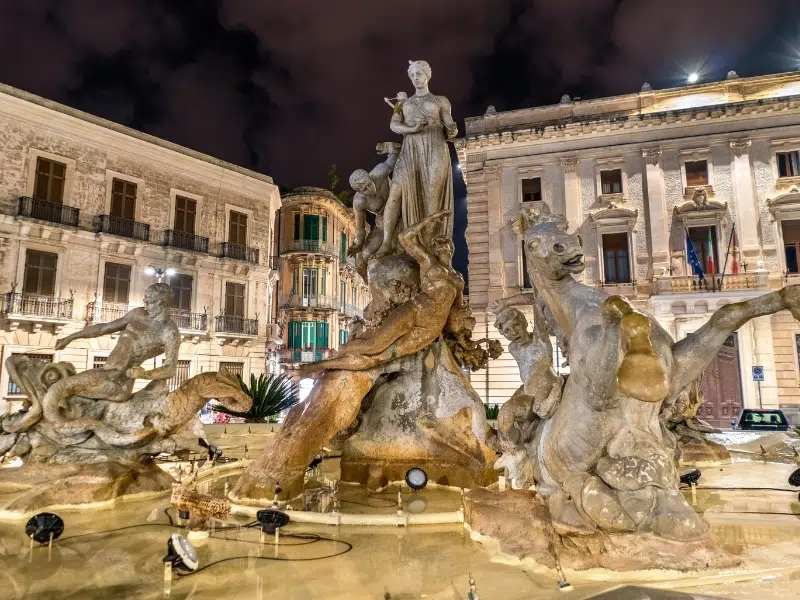
The Fountain of Diana stands in the middle of Piazza Archimede, the main square of Ortigia, the island that forms the old town of Syracuse. It was made in 1906–1907 by the sculptor Giulio Moschetti, and it does more than show the goddess of the hunt: it tells a local myth, the moment the nymph Arethusa is turned into the spring that still flows at the edge of Ortigia, a few minutes away.
The Fountain of Diana at a glance
- Where: the centre of Piazza Archimede in Ortigia, the old town of Syracuse, at the end of Corso Matteotti.
- Created: 1906–1907; the contract with the city was signed on 28 June 1906 and the fountain was completed in 1907.
- By: Giulio Moschetti, helped by his son Mario Moschetti.
- What it is today: a working public fountain and the centrepiece of Ortigia's main square, lit by LED lights at night.
- Time needed: 10–15 minutes, longer if you stop for a coffee on the square.
From a street lamp to a fountain of myth
Piazza Archimede was opened in the late 19th century, and most of the palazzi around it were rebuilt in the same period, which is why the square looks so uniform. At first a large street lamp stood in the middle. When the city decided to replace it with a fountain, the designs were judged by a panel that included the archaeologist Paolo Orsi, and Moschetti won the commission largely thanks to his earlier Fountain of Proserpina in Catania. The work was finished in 1907.
The fountain has needed care since. In 2020 two tourists who climbed into the basin broke a toe off the statue of Diana, a story that made the national news in Italy. A later restoration repaired damaged parts of the figures, renewed the water system and the greenery, and added LED lighting that can be coloured for special occasions.
What to look for
- Diana at the top: the goddess stands on a tall base shaped like a rock, with her bow, her quiver and her hunting dog. According to the story, Moschetti modelled her features on a Syracusan woman.
- Arethusa at Diana's feet: the nymph is shown at the very moment of her transformation, about to slip into the water below.
- Alpheus: the river god lunges towards Arethusa from behind the goddess, arms outstretched, too late to catch her.
- The sea creatures: on the tier below, two pairs of tritons ride sea monsters and sea horses, a reminder of the sea that Arethusa crossed to reach Sicily.
- The basin: a large basin of red granite grit, with coats of arms and masks on each of its four sides.
- The material: the figures were modelled using lava sand from the quarries of Nicolosi, on the slopes of Etna.
The myth behind the fountain
The story, best known from Ovid's Metamorphoses, begins in Greece. Arethusa, a nymph who served Diana (Artemis to the Greeks), was bathing in the river Alpheus in the Peloponnese when the river god fell in love with her and chased her. Diana saved her by turning her into water, which ran under the sea and came up again on Ortigia. Alpheus did not give up: he became a river once more and crossed the sea to mix his waters with hers. The fountain freezes the moment Diana shields Arethusa from him. It is a legend, of course, but Syracusans have told it for more than two thousand years, and the spring it explains is real.
Tips for your visit
- Come back in the evening: the fountain is lit after dark, and the square fills with people out for a stroll.
- Walk all the way round the basin. Alpheus and Arethusa are easy to miss if you only look at Diana from the front.
- Look, but do not climb in or sit on the basin: the figures are fragile and have already been damaged that way.
- See the myth in stone first, then walk down to the Fonte Aretusa to see the spring it is about.
Nearby
- Fonte Aretusa: the freshwater spring at the edge of the sea where, in the myth, Arethusa came up again, with papyrus growing in the pool. A few minutes' walk.
- Piazza Duomo and the cathedral: the cathedral was built into a Greek temple of Athena from the 5th century BC, and its Doric columns are still visible in the walls.
- Palazzo Montalto: a Gothic palace from 1397 at the end of a short street off the square, with paired and triple arched windows.
- Temple of Apollo: the remains of one of the oldest Doric temples in Sicily, at the entrance to Ortigia, next to the morning market.
See Syracuse with World City Trail
Our Syracuse scavenger hunt turns Ortigia and the streets around it into a game you play on your phone. The route links 10 stops and takes around 2 hours, with about 36 minutes of walking. It includes the Archimedes monument, the church of San Tommaso al Pantheon and the Foro Siracusano.
If you prefer a different format, there is also a self-guided walking tour and an outdoor escape game in Syracuse.
Play the Syracuse scavenger hunt →
Take the self-guided walking tour of Syracuse →
Play the outdoor escape game in Syracuse →
Facts checked in October 2026.