
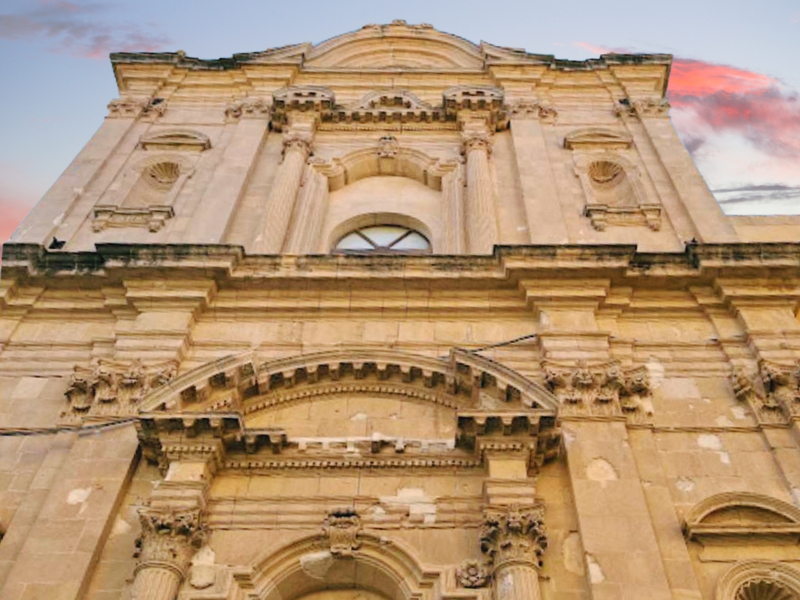
The Leonardo and Archimedes Museum is a small hands-on museum in Ortigia, the island old town of Syracuse, that pairs the city's most famous son with Leonardo da Vinci. Its rooms are filled with models of their machines, many of which still work, from Archimedes' war machines to Leonardo's room of mirrors. It is one of the few places where you can see how the ancient accounts of the siege of Syracuse might have looked in wood and rope.
The museum at a glance
- Where: Via Vincenzo Mirabella 31, in an 18th-century building in the middle of Ortigia.
- What it is today: a private museum of models and reconstructions, about 50 works in all, many of them working, run by the association behind it.
- Built: the collection was thoroughly renewed from 2023, with new models handmade by Sicilian craftsmen in Lebanon cedar.
- Time needed: about an hour; longer with children who want to try everything.
Two inventors, one city
Archimedes was born in Syracuse around 287 BC and spent most of his life here, under King Hiero II. Ancient writers credit him with devices that defended the city when the Romans laid siege to it, among them a crane-like 'iron hand' that could seize the bows of enemy ships and overturn them. He also gave his name to the water screw used to lift water, and he is said to have overseen the building of the Syrakosia, an enormous ship made for Hiero. Syracuse fell to Rome in 212 BC and Archimedes died in the sack of the city.
Leonardo da Vinci never worked in Syracuse, but like Archimedes he filled notebooks with machines, many of which were never built in his lifetime. The museum puts the two side by side, showing how ideas about levers, gears, balance and water were taken up again nearly two thousand years later. The models are based on ancient texts and Leonardo's drawings, turned into 3D designs and then built by hand in wood, with technical advice from specialists in historical machines.
What to look for
- The manus ferrea, the 'iron hand' or claw of Archimedes, the crane that ancient writers say plucked Roman ships out of the water.
- Archimedes' screw, the rotating spiral that raises water, a device still used today in pumps and irrigation.
- The model of the Syrakosia, the giant ship associated with Hiero II and Archimedes, one of the favourite photo spots in the museum.
- Leonardo's room of mirrors, an enclosed space lined with mirrors that multiplies your reflection endlessly.
- Archimedes' balance, lever and catapult, and a section with studies of anatomy inspired by Leonardo's drawings.
Legend or history?
Some of the best-known Archimedes stories are legends written down long after his death. The tale of the burning mirrors, which supposedly set the Roman fleet alight with focused sunlight, appears only in much later writers, and whether it could ever have worked is still debated. The claw, by contrast, is described by ancient historians such as Polybius and Plutarch. The museum's models show the principles; whether a wooden claw really lifted a warship is for you to decide.
Tips for your visit
- Come on a hot afternoon or a rainy morning, when an indoor visit is welcome after the bright streets of Ortigia.
- Touch where it is allowed: many models are made to be turned and lifted, and the hands-on space at the end of the visit is aimed at children.
- Visit the bronze Archimedes monument at the entrance to Ortigia before or after, to connect the machines with the man.
- Ask the staff to demonstrate the models; a short explanation makes the levers and gears much easier to follow.
Nearby
- Piazza Archimede: the square named after the mathematician in the centre of Ortigia, with the Fountain of Diana.
- Temple of Apollo: the ruins of one of the oldest Doric temples in Sicily, at the northern end of the island.
- Piazza Duomo: the long Baroque square with the cathedral, built around the columns of a Greek temple of Athena.
- Fountain of Arethusa: the freshwater spring with papyrus plants by the sea, at the southern end of the old town.
See Syracuse with World City Trail
Our Syracuse scavenger hunt turns the old town into a game you play on your phone. The route links 10 stops and takes around 2 hours, with about 36 minutes of walking. It includes the Archimedes monument, the Foro Siracusano, San Tommaso al Pantheon and Ortigia.
If you prefer a different format, there is also a self-guided walking tour and an outdoor escape game in Syracuse.
Play the Syracuse scavenger hunt →
Take the self-guided walking tour of Syracuse →
Play the outdoor escape game in Syracuse →
Facts checked in October 2026.