
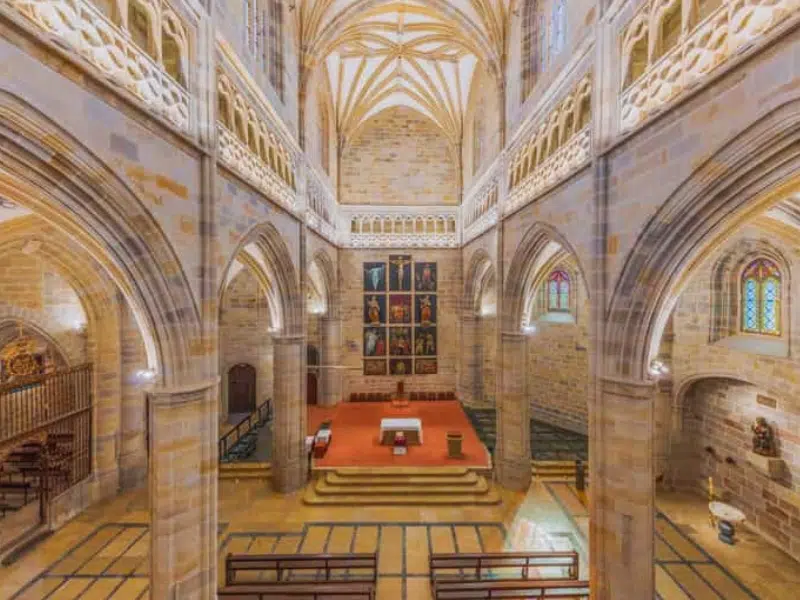
The Church of San Antón (San Anton eliza in Basque) is the Gothic church at the river end of Bilbao's old town, right beside the San Antón bridge over the estuary. Church and bridge together are so much a part of the city's identity that both appear on Bilbao's coat of arms, flanked by two wolves. It stands on the site of the medieval town fortress, and its story is one of floods, rebuilding and a Baroque bell tower added three centuries after the nave.
San Antón Church at a glance
- Where: Bilbao's Casco Viejo (old town), on the riverbank next to the San Antón bridge and the Ribera market.
- Built: the first church was finished in 1433; the present Gothic body around 1510, the Renaissance portal in 1546–48 and the bell tower in 1775.
- By: the main portal was designed by Juan de Garita; the medieval builders of the church are not recorded.
- What it is today: a Catholic parish church, protected as a national monument since 1984.
- Time needed: 15–20 minutes for the outside and a look inside.
From town fortress to parish church
In the early 14th century, soon after Bilbao was founded, a fortress and a stretch of town wall stood on this spot by the river, guarding the only bridge across the estuary. The first church of San Antón was built here and completed in 1433, and the Gothic church you see today, with three naves of four bays ending in a flat apse, took shape around 1510. Excavations in 2002 uncovered foundations of the old fortifications and of that first church beneath the building.
Later centuries added to the Gothic core. The main portal was built in 1546–48 in the Renaissance style, with the sculptor Guiot de Beaugrant among those working on it. The octagonal Baroque bell tower, topped with a dome and a weathervane, followed in 1775, and a neo-Gothic side porch and sacristy in 1902. Being so close to the water has been hard on the church: floods have damaged it many times, most recently in August 1983, when the river swept away doors and much of its furnishings. That is why most of what you see inside is modern.
What to look for
- The coat of arms view: from the riverbank by the market, the church and the bridge line up exactly as they appear on Bilbao's coat of arms.
- The Renaissance portal: the main doorway, with classical columns and carving, sits on an otherwise Gothic building.
- The bell tower: octagonal, Baroque and much later than the rest, with a small dome and a weathervane on top.
- The main altarpiece: instead of a large carved retablo, it is made up of twelve pieces, seven paintings by the Bilbao artist Ignacio García Ergüin and five sculptures.
- The Pietà altarpiece: a Plateresque retablo of the Piedad, one of the few older works to survive the floods.
The church on the coat of arms
Bilbao's coat of arms shows a silver field with the church of San Antón above a two-arched bridge over the river, and two black wolves beside it. The wolves come from the arms of Diego López de Haro, the lord of Biscay who founded the town and granted its charter in 1300. The old medieval bridge on the shield was for centuries the only crossing of the estuary; it was rebuilt after repeated floods, blown up during the Spanish Civil War and rebuilt again in 1937. The same bridge also appears on the crest of Athletic Club, the city's football team.
Tips for your visit
- For the classic photo, cross to the far side of the estuary and look back at the church, the bridge and the market together.
- It is a working parish church: dress respectfully and keep quiet if a service is going on.
- Come in the morning and combine it with the Ribera market next door, when the stalls are at their busiest.
Nearby
- Mercado de la Ribera: the large covered market hall on the riverbank next to the church, dating from 1929, with food stalls and bars.
- The Siete Calles: the seven parallel streets that formed medieval Bilbao, full of pintxo bars, starting just behind the church.
- Santiago Cathedral: Bilbao's Gothic cathedral in the middle of the old town, a few minutes' walk away.
- Teatro Arriaga: the neo-Baroque opera house on the river, opened in 1890, a short walk downstream.
See Bilbao with World City Trail
Our Bilbao scavenger hunt turns the old town into a game you play on your phone. The route links 10 stops and takes around 3 hours, with about 52 minutes of walking. It includes the Guggenheim Museum, the Zubizuri bridge and Doña Casilda Iturrizar Park. You can play in English, German, French, Italian, Spanish and Dutch.
If you prefer a different format, there is also a self-guided walking tour and an outdoor escape game in Bilbao.
Play the Bilbao scavenger hunt →
Take the self-guided walking tour of Bilbao →
Play the outdoor escape game in Bilbao →
Facts checked in October 2026.