
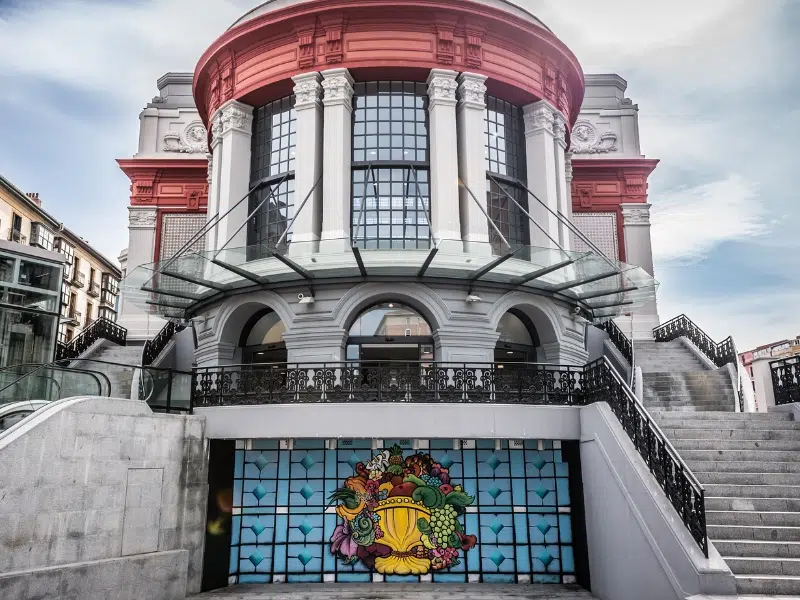
The Mercado de la Ribera is Bilbao's great food market, a long Art Deco hall on the riverbank at the edge of the Casco Viejo, the old town. With around 10,000 square metres of floor space it is one of the largest covered markets in Europe, and in 1990 the Guinness Book of Records listed it as the most complete municipal food market. People have been trading on this spot since the 14th century.
Mercado de la Ribera at a glance
- Where: on Calle de la Ribera (Erribera), along the Nervión estuary, next to the Church of San Antón and the San Antón bridge.
- Built: opened on 22 August 1929; largely rebuilt between 2009 and the early 2010s while the market kept trading.
- By: the municipal architect Pedro de Ispizua designed the 1929 building; the renovation was led by the architect Emilio Puertas.
- What it is today: a working market for fish, meat, cheese, fruit and vegetables, with a pintxos and food-hall area and stalls for produce from local farms.
- Time needed: 30–60 minutes to browse, longer if you stop for pintxos.
From the old square to a concrete market hall
In the 14th century Bilbao's market was held on the old main square beside San Antón church, then the centre of town life. In the 19th century the stalls were gradually roofed over, and an iron-and-glass hall followed, which became so hot in summer that its roof had to be sprayed with water. In 1928 the city decided to build something bigger, and Pedro de Ispizua designed a reinforced-concrete market with open floors free of interior columns, good ventilation and plenty of daylight, opened in 1929 during Bilbao's summer fiestas.
The market has had a hard time since. When the wholesale trade moved to Mercabilbao in 1971, La Ribera became a market for local shoppers. The floods of August 1983 badly damaged the building. In 2008 engineers found serious structural damage: the original concrete had been made with beach sand, whose salt had rusted the steel reinforcement. Much of the building was rebuilt from 2009, with the promise that the market would not close for a single day.
What to look for
- The riverside façade, best seen from the opposite bank or from the footbridge, with its long rhythm of windows reflected in the estuary.
- The large stained-glass windows and translucent panels that bring daylight down through the floors, a key part of Ispizua's design.
- The fish stalls: Cantabrian hake, anchovies and shellfish laid out on ice, and specialist sellers of salt cod, a Basque staple.
- The stalls of the baserritarras, small local farmers selling their own vegetables, eggs and cheese.
- The neighbouring Church of San Antón, which together with its bridge appears on Bilbao's coat of arms.
Salt cod and pintxos
Bacalao, dried and salted cod, has been central to Basque cooking for centuries, and La Ribera still has stalls that sell nothing else, with different cuts for different dishes. The market is also a good place to start a pintxo crawl: its food-hall area serves small bites and local txakoli wine, and the bars of the Siete Calles, the seven original streets of the old town, begin right behind it.
Tips for your visit
- Come in the morning, when the fish and produce stalls are busiest and best stocked; many stalls wind down after lunchtime.
- Respect the traders: ask before taking close-up photos of stalls, and don't handle produce you are not buying.
- Walk out onto the river side or the nearby footbridge for the classic view of the market and San Antón church together.
- Combine it with a stroll through the Siete Calles and Plaza Nueva, both a few minutes' walk away.
Nearby
- Church of San Antón: the Gothic church right next to the market, a symbol of the city.
- Siete Calles: the seven medieval streets of the Casco Viejo, packed with shops and pintxo bars.
- Plaza Nueva: the 19th-century arcaded square, one of the best places in Bilbao for pintxos.
- Santiago Cathedral: Bilbao's Gothic cathedral, a short walk into the old town.
See Bilbao with World City Trail
Our Bilbao scavenger hunt turns the city into a game you play on your phone. The route links 10 stops and takes around 3 hours, with about 52 minutes of walking. The Mercado de la Ribera is not one of the stops, but the route includes the Guggenheim Museum, the Zubizuri bridge and Doña Casilda Iturrizar Park. You can play in English, German, French, Italian, Spanish and Dutch.
If you prefer a different format, there is also a self-guided walking tour and an outdoor escape game in Bilbao.
Play the Bilbao scavenger hunt →
Take the self-guided walking tour of Bilbao →
Play the outdoor escape game in Bilbao →
Facts checked in October 2026.