
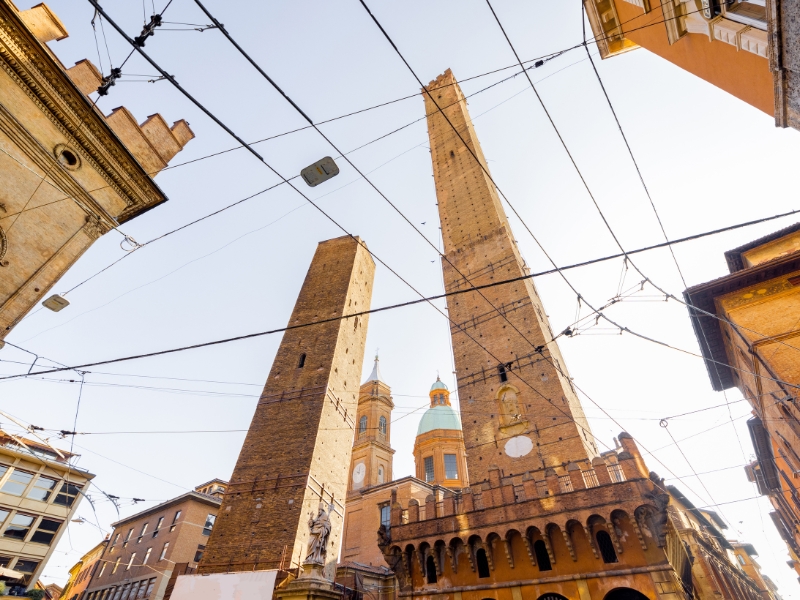
The Two Towers, the Asinelli and the Garisenda, stand side by side on Piazza di Porta Ravegnana, where the old Via Emilia entered the centre of Bologna. Both were built in the early 12th century and both lean. The shorter Garisenda leans so far, about 3 metres out of plumb, that it was cut down in the Middle Ages and has been fenced off for stabilisation since 2023.
The Two Towers at a glance
- Where: Piazza di Porta Ravegnana, at the eastern end of Via Rizzoli, where streets fan out towards the gates of the old city walls.
- Built: early 12th century; the Asinelli tower is dated to 1109–1119, the Garisenda to about the same years.
- By: the Asinelli and Garisenda families, who built them as private towers.
- What it is today: the symbol of Bologna. Both towers have been closed to visitors since October 2023 while the Garisenda is stabilised, and the works are expected to last until at least 2028.
- Time needed: 10–15 minutes from the outside.
A city of a hundred towers
In the 12th and 13th centuries Bologna bristled with towers. Historians estimate there were at least a hundred, put up by noble families for defence, for signalling and above all for prestige; fewer than twenty survive. The Asinelli, about 97 metres tall and climbed by 498 wooden steps, is the tallest of them and passed to the city in the following century. It leans too, by about 2.2 metres, which makes it one of the tallest leaning towers in Italy.
The Garisenda had a harder life. The ground and foundations beneath it subsided, and in the 14th century, after an earthquake and out of fear that it would collapse, it was lowered by more than 12 metres to its present height of about 48 metres. Dante saw it at its full height and used it in the Inferno. In late 2023, sensors recorded unusual movement: the square was fenced off, both towers were closed and nearby streets were shut to traffic. The city plans to stabilise the Garisenda with steel tie structures borrowed from the Leaning Tower of Pisa, in a project costing around 20 million euros, about 5 million of it from donations by citizens and businesses.
What to look for
- The difference in lean: stand at the start of Via Rizzoli and compare. The Garisenda's tilt is obvious, while the Asinelli's lean is hard to spot from below.
- The difference in height: the Asinelli is roughly twice as tall as its neighbour, a reminder of how high the Garisenda once rose before it was cut down.
- Dante's lines: a marble plaque on the Garisenda quotes Canto XXXI of the Inferno. With the fencing in place you may only catch a glimpse of it.
- The crossroads: from the foot of the towers, look down the streets that branch off towards the old city gates, among them Strada Maggiore, Via San Vitale, Via Zamboni and Via Santo Stefano.
- The fenced building site around the base, part of one of the most closely watched restoration projects in Italy.
Dante's cloud and the students' superstition
In Canto XXXI Dante describes the giant Antaeus bending down to pick him up, and compares the sight to looking up at the Garisenda from the side it leans towards as a cloud drifts over it: the tower seems to fall towards you. Bologna also has a more recent superstition. Students are told that if they climb the Asinelli before their final exams, they will never graduate. It is only a joke passed between generations, and for now nobody can climb the tower anyway.
Tips for your visit
- For a photo of both towers with the lean clearly visible, step back along Via Rizzoli or Strada Maggiore rather than standing at their foot.
- You cannot go up the Asinelli at the moment. For a view over the red roofs, the Clock Tower in Palazzo d'Accursio on Piazza Maggiore is the usual alternative; check the current status of both before you plan around a climb.
- Come early in the morning, before buses and shoppers fill Via Rizzoli, and combine the towers with the market lanes of the Quadrilatero just to the west.
Nearby
- Palazzo della Mercanzia: the Gothic merchants' hall of the late 14th century, with its brick loggia, just behind the towers.
- Basilica of Santo Stefano: a cluster of linked churches known as the Seven Churches, a few minutes' walk down Via Santo Stefano.
- Quadrilatero: the medieval grid of narrow streets between the towers and Piazza Maggiore, lined with delicatessens, fishmongers and fruit stalls.
- Piazza Maggiore and the Fountain of Neptune: Bologna's main square, about ten minutes' walk along Via Rizzoli.
See Bologna with World City Trail
Our Bologna scavenger hunt turns the old town into a game you play on your phone. The route links 10 stops and takes around 2 hours, with about 33 minutes of walking. The Two Towers are one of the stops, along with the Biblioteca Salaborsa.
If you prefer a different format, there is also a self-guided walking tour and an outdoor escape game in Bologna.
Play the Bologna scavenger hunt →
Take the self-guided walking tour of Bologna →
Play the outdoor escape game in Bologna →
Facts checked in October 2026.