
Leipzig grew rich on trade fairs, books and music, and in 1989 its citizens helped bring down the East German regime without firing a shot. The city where Bach wrote his cantatas and Goethe studied law is also one of Germany's fastest-changing, with old arcades and courtyards next to bold buildings from the 1920s and the GDR era. Here are the facts and stories that make Leipzig special.
10 curiosità su Lipsia
- A fair city for over 850 years: the town charter of around 1165 already mentions Leipzig's markets. In 1497 King Maximilian I confirmed its fair privileges, and in 1895 Leipzig held the world's first sample fair, where traders ordered goods from samples instead of buying stock on the spot.
- The world's first daily newspaper: on 1 July 1650 the printer Timotheus Ritzsch launched the Einkommende Zeitungen in Leipzig, regarded as the first daily newspaper in the world.
- Un’antica università con uno studente famoso: l’Università di Lipsia fu fondata nel 1409 ed è una delle più antiche della Germania. Johann Wolfgang von Goethe vi arrivò nel 1765 per studiare legge.
- Una cantina nella letteratura mondiale: Goethe ambientò una scena del Faust nell’Auerbachs Keller, un locale sotto la galleria Mädlerpassage. All’ingresso ci sono le statue in bronzo di Faust, Mefistofele e degli studenti stregati.
- Bach's city: Johann Sebastian Bach was cantor of St Thomas Church from 1723 until his death in 1750 and wrote much of his church music here. Since 1950 his grave has been inside the church.
- Una delle più antiche orchestre civiche: l’Orchestra del Gewandhaus risale al 1743, quando alcuni mercanti fondarono una società di concerti. Felix Mendelssohn ne divenne direttore nel 1835.
- Bellmen on the roof: the Krochhochhaus on Augustusplatz, opened in 1928, was Leipzig's first high-rise. On top, two bronze bellmen 3.3 metres tall strike the bells, modelled on St Mark's Clocktower in Venice, above the motto Omnia vincit labor, work conquers all.
- Palme in una chiesa: alla fine del Settecento la chiesa di San Nicola ricevette un interno classicista, con colonne chiare che in cima si aprono in foglie di palma.
- Un monumento a una battaglia gigantesca: il Monumento alla Battaglia delle Nazioni, alto 91 metri, fu completato nel 1913, un secolo dopo la sconfitta di Napoleone davanti a Lipsia nell’ottobre 1813, una delle più grandi battaglie della storia prima del Novecento.
- Una stazione per una città di fiere: la stazione centrale di Lipsia aprì nel 1915 ed è una delle più grandi d’Europa per superficie.
9 ottobre 1989: la sera in cui Lipsia scelse la libertà
From 1982 people met for peace prayers every Monday in St Nicholas Church, and in autumn 1989 the crowds leaving the church began marching around the inner-city ring road. On 9 October, two days after the GDR celebrated its 40th anniversary, the state had police, troops and hospitals on standby, and many feared a bloodbath. About 70,000 people walked the ring anyway, carrying candles and chanting 'We are the people'. Nobody gave the order to shoot. A month later the Berlin Wall fell, and the Monday Demonstrations are remembered as a turning point of the Peaceful Revolution.
Augustusplatz in breve
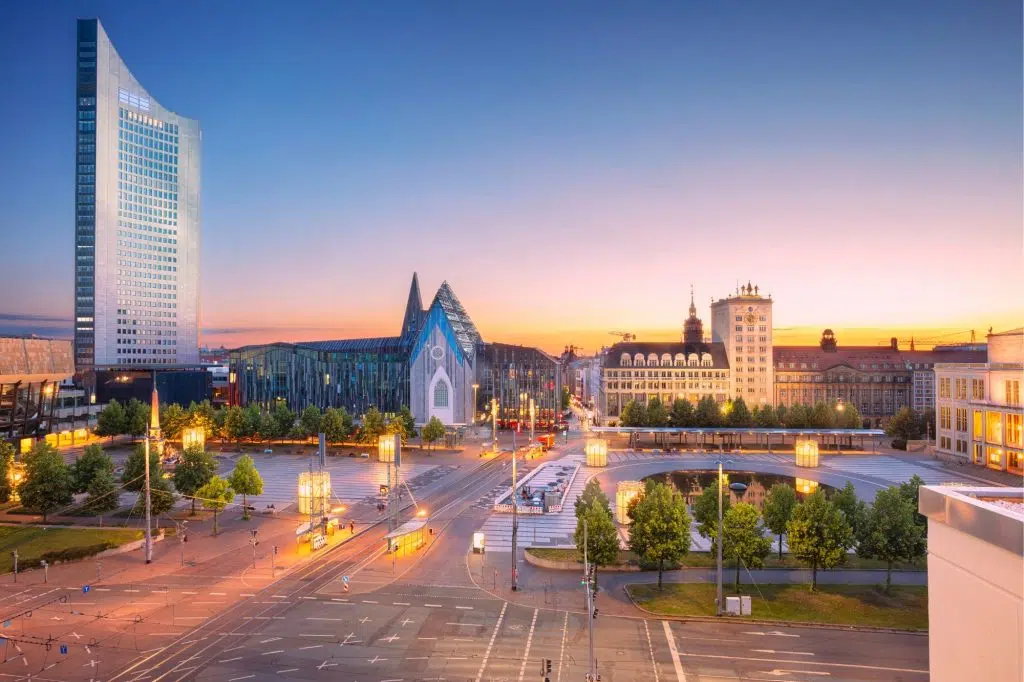
Augustusplatz is one of the largest city squares in Germany and a summary of Leipzig's last century. The Opera opened on one side in 1960 and the new Gewandhaus concert hall faces it from the other, opened in 1981. In 1968 the GDR authorities blew up the medieval University Church here; today the Paulinum, with its gabled glass front, recalls the lost church. Above it all rises the City-Hochhaus, 142.5 metres tall and completed in 1972, which locals nickname the wisdom tooth.
Cosa mangiare a Lipsia
- Leipziger Lerche: a shortcrust pastry filled with almonds and a cherry. It replaced a real lark pie after King Albert of Saxony banned lark hunting in 1876, and the cherry stands for the bird's heart.
- Leipziger Allerlei: un misto di verdure primaverili come piselli, carote e asparagi, tradizionalmente con gamberi di fiume e spugnole.
- Gose: a sour, slightly salty wheat beer brewed with coriander. It originally came from Goslar but became Leipzig's own beer.
- Leipziger Räbchen: prugne secche farcite di marzapane, passate in pastella, fritte e cosparse di zucchero.
Da sapere prima di partire
- Il Coro di San Tommaso, fondato nel 1212, canta regolarmente mottetti nella chiesa di San Tommaso quando non è in tournée. Controlla il programma prima di andare.
- Per la vista migliore sulla città, prendi l’ascensore fino alla terrazza panoramica in cima al City-Hochhaus.
- Nella chiesa di San Nicola, dove iniziò la Rivoluzione pacifica, si tengono ancora il lunedì le preghiere per la pace.
- A sud della città, ex miniere a cielo aperto allagate sono diventate una catena di laghi, il Leipziger Neuseenland, ideale per nuotare, andare in bici e in barca a vela.
Scopri Lipsia con World City Trail
La nostra caccia al tesoro a Lipsia trasforma questi luoghi in un gioco sul tuo telefono. Il percorso collega 10 tappe e dura circa due ore, con circa 30 minuti a piedi, e ti porta ad Augustusplatz, al Krochhochhaus e alla chiesa di San Nicola.
A ogni tappa risolvi un enigma e ascolti una breve storia, al tuo ritmo. Puoi iniziare quando vuoi e giocare in inglese, tedesco, francese, olandese o polacco.
Gioca alla caccia al tesoro di Lipsia →
Fatti verificati a ottobre 2026.