
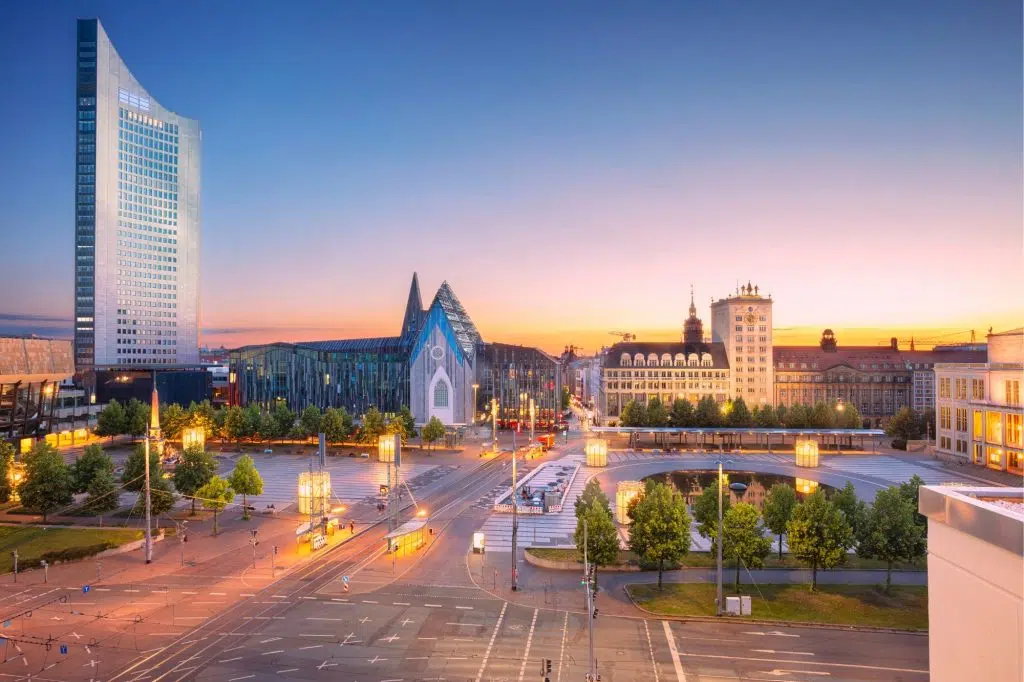
Leipzig grew rich on trade fairs, books and music, and in 1989 its citizens helped bring down the East German regime without firing a shot. The city where Bach wrote his cantatas and Goethe studied law is also one of Germany's fastest-changing, with old arcades and courtyards next to bold buildings from the 1920s and the GDR era. Here are the facts and stories that make Leipzig special.
10 leuke weetjes over Leipzig
- A fair city for over 850 years: the town charter of around 1165 already mentions Leipzig's markets. In 1497 King Maximilian I confirmed its fair privileges, and in 1895 Leipzig held the world's first sample fair, where traders ordered goods from samples instead of buying stock on the spot.
- The world's first daily newspaper: on 1 July 1650 the printer Timotheus Ritzsch launched the Einkommende Zeitungen in Leipzig, regarded as the first daily newspaper in the world.
- Een oude universiteit met een beroemde student: de Universiteit Leipzig werd in 1409 gesticht en is een van de oudste van Duitsland. Johann Wolfgang von Goethe kwam hier in 1765 rechten studeren.
- Een kelder in de wereldliteratuur: Goethe liet een scène uit Faust spelen in Auerbachs Keller, een restaurant onder de Mädlerpassage. Bij de ingang staan bronzen beelden van Faust, Mephisto en de betoverde studenten.
- Bach's city: Johann Sebastian Bach was cantor of St Thomas Church from 1723 until his death in 1750 and wrote much of his church music here. Since 1950 his grave has been inside the church.
- Een van de oudste burgerorkesten: het Gewandhausorchester gaat terug tot 1743, toen kooplieden een concertgenootschap oprichtten. Felix Mendelssohn werd in 1835 de dirigent.
- Bellmen on the roof: the Krochhochhaus on Augustusplatz, opened in 1928, was Leipzig's first high-rise. On top, two bronze bellmen 3.3 metres tall strike the bells, modelled on St Mark's Clocktower in Venice, above the motto Omnia vincit labor, work conquers all.
- Palmbomen in een kerk: aan het eind van de 18e eeuw kreeg de Nikolaikirche een classicistisch interieur waarvan de lichte zuilen bovenaan uitwaaieren in palmbladeren.
- Een monument voor een gigantische veldslag: het 91 meter hoge Völkerschlachtdenkmal werd in 1913 voltooid, een eeuw nadat Napoleon in oktober 1813 bij Leipzig werd verslagen in een van de grootste veldslagen uit de geschiedenis vóór de 20e eeuw.
- Een station voor een beursstad: het Hauptbahnhof van Leipzig opende in 1915 en is qua oppervlakte een van de grootste stations van Europa.
9 oktober 1989: de avond waarop Leipzig voor vrijheid koos
From 1982 people met for peace prayers every Monday in St Nicholas Church, and in autumn 1989 the crowds leaving the church began marching around the inner-city ring road. On 9 October, two days after the GDR celebrated its 40th anniversary, the state had police, troops and hospitals on standby, and many feared a bloodbath. About 70,000 people walked the ring anyway, carrying candles and chanting 'We are the people'. Nobody gave the order to shoot. A month later the Berlin Wall fell, and the Monday Demonstrations are remembered as a turning point of the Peaceful Revolution.
De Augustusplatz uitgelegd
Augustusplatz is one of the largest city squares in Germany and a summary of Leipzig's last century. The Opera opened on one side in 1960 and the new Gewandhaus concert hall faces it from the other, opened in 1981. In 1968 the GDR authorities blew up the medieval University Church here; today the Paulinum, with its gabled glass front, recalls the lost church. Above it all rises the City-Hochhaus, 142.5 metres tall and completed in 1972, which locals nickname the wisdom tooth.
Wat je moet eten in Leipzig
- Leipziger Lerche: a shortcrust pastry filled with almonds and a cherry. It replaced a real lark pie after King Albert of Saxony banned lark hunting in 1876, and the cherry stands for the bird's heart.
- Leipziger Allerlei: gemengde voorjaarsgroenten zoals erwten, wortels en asperges, traditioneel met rivierkreeftjes en morieljes.
- Gose: a sour, slightly salty wheat beer brewed with coriander. It originally came from Goslar but became Leipzig's own beer.
- Leipziger Räbchen: pruimen gevuld met marsepein, door beslag gehaald, gefrituurd en bestrooid met suiker.
Goed om te weten voor je gaat
- Het Thomanerkoor, opgericht in 1212, zingt regelmatig motetten in de Thomaskerk als het niet op tournee is. Check het programma voordat je gaat.
- Voor het mooiste uitzicht over de stad neem je de lift naar het uitkijkplatform boven in het City-Hochhaus.
- In de Nikolaikirche, waar de Vreedzame Revolutie begon, worden op maandag nog altijd vredesgebeden gehouden.
- Ten zuiden van de stad zijn ondergelopen voormalige bruinkoolgroeven een keten van meren geworden, het Leipziger Neuseenland, ideaal om te zwemmen, fietsen en zeilen.
Ontdek Leipzig met World City Trail
Onze schattenjacht in Leipzig maakt van deze plekken een spel op je telefoon. De route verbindt 10 stops en duurt ongeveer twee uur, met zo’n 30 minuten lopen, en brengt je langs de Augustusplatz, het Krochhochhaus en de Nikolaikirche.
Bij elke stop los je een puzzel op en hoor je een kort verhaal, in je eigen tempo. Je kunt beginnen wanneer je wilt en spelen in het Nederlands, Engels, Duits, Frans of Pools.
Speel de schattenjacht in Leipzig →
Feiten gecontroleerd in oktober 2026.