
Leipzig grew rich on trade fairs, books and music, and in 1989 its citizens helped bring down the East German regime without firing a shot. The city where Bach wrote his cantatas and Goethe studied law is also one of Germany's fastest-changing, with old arcades and courtyards next to bold buildings from the 1920s and the GDR era. Here are the facts and stories that make Leipzig special.
10 ενδιαφέροντα στοιχεία για τη Λειψία
- A fair city for over 850 years: the town charter of around 1165 already mentions Leipzig's markets. In 1497 King Maximilian I confirmed its fair privileges, and in 1895 Leipzig held the world's first sample fair, where traders ordered goods from samples instead of buying stock on the spot.
- The world's first daily newspaper: on 1 July 1650 the printer Timotheus Ritzsch launched the Einkommende Zeitungen in Leipzig, regarded as the first daily newspaper in the world.
- Ένα παλιό πανεπιστήμιο με διάσημο φοιτητή: το Πανεπιστήμιο της Λειψίας ιδρύθηκε το 1409 και είναι ένα από τα αρχαιότερα της Γερμανίας. Ο Γιόχαν Βόλφγκανγκ φον Γκαίτε ήρθε εδώ το 1765 για να σπουδάσει νομικά.
- Ένα κελάρι στην παγκόσμια λογοτεχνία: ο Γκαίτε τοποθέτησε μια σκηνή του Φάουστ στο Auerbachs Keller, ένα εστιατόριο κάτω από τη στοά Mädlerpassage. Στην είσοδο στέκονται χάλκινα αγάλματα του Φάουστ, του Μεφιστοφελή και των μαγεμένων φοιτητών.
- Bach's city: Johann Sebastian Bach was cantor of St Thomas Church from 1723 until his death in 1750 and wrote much of his church music here. Since 1950 his grave has been inside the church.
- Μία από τις αρχαιότερες αστικές ορχήστρες: η Ορχήστρα του Γκεβάντχαους ανάγεται στο 1743, όταν έμποροι ίδρυσαν μια εταιρεία συναυλιών. Ο Φέλιξ Μέντελσον έγινε διευθυντής της το 1835.
- Bellmen on the roof: the Krochhochhaus on Augustusplatz, opened in 1928, was Leipzig's first high-rise. On top, two bronze bellmen 3.3 metres tall strike the bells, modelled on St Mark's Clocktower in Venice, above the motto Omnia vincit labor, work conquers all.
- Φοίνικες μέσα σε εκκλησία: στα τέλη του 18ου αιώνα η εκκλησία του Αγίου Νικολάου απέκτησε νεοκλασικό εσωτερικό, με ανοιχτόχρωμους κίονες που στην κορυφή ανοίγουν σαν φύλλα φοίνικα.
- Ένα μνημείο για μια τεράστια μάχη: το Μνημείο της Μάχης των Εθνών, ύψους 91 μέτρων, ολοκληρώθηκε το 1913, έναν αιώνα αφότου ο Ναπολέων ηττήθηκε έξω από τη Λειψία τον Οκτώβριο του 1813, σε μία από τις μεγαλύτερες μάχες της ιστορίας πριν από τον 20ό αιώνα.
- Ένας σταθμός για μια πόλη εκθέσεων: ο Κεντρικός Σταθμός της Λειψίας άνοιξε το 1915 και είναι από τους μεγαλύτερους σιδηροδρομικούς σταθμούς της Ευρώπης σε έκταση.
9 Οκτωβρίου 1989: η νύχτα που η Λειψία διάλεξε την ελευθερία
From 1982 people met for peace prayers every Monday in St Nicholas Church, and in autumn 1989 the crowds leaving the church began marching around the inner-city ring road. On 9 October, two days after the GDR celebrated its 40th anniversary, the state had police, troops and hospitals on standby, and many feared a bloodbath. About 70,000 people walked the ring anyway, carrying candles and chanting 'We are the people'. Nobody gave the order to shoot. A month later the Berlin Wall fell, and the Monday Demonstrations are remembered as a turning point of the Peaceful Revolution.
Η Augustusplatz με λίγα λόγια
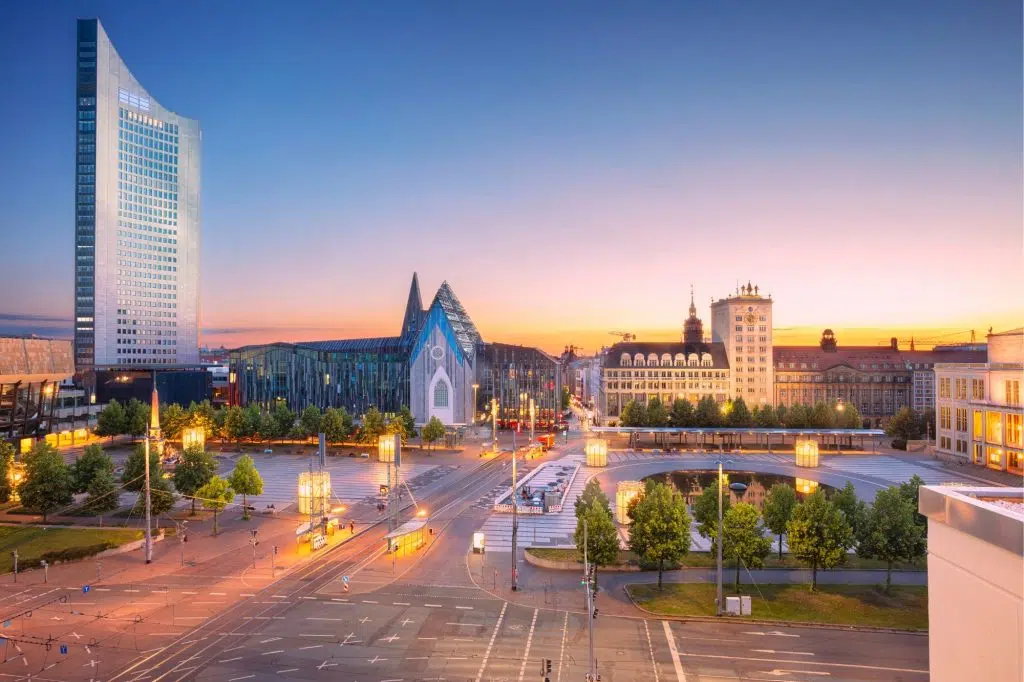
Augustusplatz is one of the largest city squares in Germany and a summary of Leipzig's last century. The Opera opened on one side in 1960 and the new Gewandhaus concert hall faces it from the other, opened in 1981. In 1968 the GDR authorities blew up the medieval University Church here; today the Paulinum, with its gabled glass front, recalls the lost church. Above it all rises the City-Hochhaus, 142.5 metres tall and completed in 1972, which locals nickname the wisdom tooth.
Τι να φάτε στη Λειψία
- Leipziger Lerche: a shortcrust pastry filled with almonds and a cherry. It replaced a real lark pie after King Albert of Saxony banned lark hunting in 1876, and the cherry stands for the bird's heart.
- Leipziger Allerlei: ανάμεικτα ανοιξιάτικα λαχανικά όπως αρακάς, καρότα και σπαράγγια, παραδοσιακά με καραβίδες του γλυκού νερού και μορχέλες.
- Gose: a sour, slightly salty wheat beer brewed with coriander. It originally came from Goslar but became Leipzig's own beer.
- Leipziger Räbchen: δαμάσκηνα γεμιστά με αμυγδαλόπαστα, βουτηγμένα σε κουρκούτι, τηγανητά και πασπαλισμένα με ζάχαρη.
Χρήσιμα πριν πάτε
- Η Χορωδία του Αγίου Θωμά, που ιδρύθηκε το 1212, ψάλλει τακτικά μοτέτα στην εκκλησία του Αγίου Θωμά όταν δεν περιοδεύει. Ελέγξτε το πρόγραμμα πριν πάτε.
- Για την καλύτερη θέα της πόλης, ανεβείτε με το ασανσέρ στην εξέδρα θέας στην κορυφή του City-Hochhaus.
- Στην εκκλησία του Αγίου Νικολάου, όπου ξεκίνησε η Ειρηνική Επανάσταση, γίνονται ακόμη κάθε Δευτέρα προσευχές για την ειρήνη.
- Νότια της πόλης, πλημμυρισμένα παλιά επιφανειακά ορυχεία έγιναν μια αλυσίδα από λίμνες, το Leipziger Neuseenland, ιδανικό για κολύμπι, ποδήλατο και ιστιοπλοΐα.
Ανακαλύψτε τη Λειψία με το World City Trail
Το κυνήγι θησαυρού μας στη Λειψία μετατρέπει αυτά τα αξιοθέατα σε παιχνίδι στο κινητό σας. Η διαδρομή συνδέει 10 στάσεις και διαρκεί περίπου δύο ώρες, με περίπου 30 λεπτά περπάτημα, και περνά από την Augustusplatz, το Krochhochhaus και την εκκλησία του Αγίου Νικολάου.
Σε κάθε στάση λύνετε έναν γρίφο και ακούτε μια σύντομη ιστορία, με τον δικό σας ρυθμό. Μπορείτε να ξεκινήσετε όποτε θέλετε και να παίξετε στα αγγλικά, γερμανικά, γαλλικά, ολλανδικά ή πολωνικά.
Παίξτε το κυνήγι θησαυρού της Λειψίας →
Τα στοιχεία ελέγχθηκαν τον Οκτώβριο του 2026.