
Leipzig grew rich on trade fairs, books and music, and in 1989 its citizens helped bring down the East German regime without firing a shot. The city where Bach wrote his cantatas and Goethe studied law is also one of Germany's fastest-changing, with old arcades and courtyards next to bold buildings from the 1920s and the GDR era. Here are the facts and stories that make Leipzig special.
10 curiosidades sobre Leipzig
- A fair city for over 850 years: the town charter of around 1165 already mentions Leipzig's markets. In 1497 King Maximilian I confirmed its fair privileges, and in 1895 Leipzig held the world's first sample fair, where traders ordered goods from samples instead of buying stock on the spot.
- The world's first daily newspaper: on 1 July 1650 the printer Timotheus Ritzsch launched the Einkommende Zeitungen in Leipzig, regarded as the first daily newspaper in the world.
- Uma universidade antiga com um aluno famoso: a Universidade de Leipzig foi fundada em 1409 e é uma das mais antigas da Alemanha. Johann Wolfgang von Goethe veio para cá estudar Direito em 1765.
- Uma cave na literatura mundial: Goethe situou uma cena de Fausto no Auerbachs Keller, um restaurante sob a galeria Mädlerpassage. À entrada há estátuas de bronze de Fausto, Mefistófeles e dos estudantes enfeitiçados.
- Bach's city: Johann Sebastian Bach was cantor of St Thomas Church from 1723 until his death in 1750 and wrote much of his church music here. Since 1950 his grave has been inside the church.
- Uma das orquestras cívicas mais antigas: a Orquestra do Gewandhaus remonta a 1743, quando comerciantes fundaram uma sociedade de concertos. Felix Mendelssohn tornou-se o seu maestro em 1835.
- Bellmen on the roof: the Krochhochhaus on Augustusplatz, opened in 1928, was Leipzig's first high-rise. On top, two bronze bellmen 3.3 metres tall strike the bells, modelled on St Mark's Clocktower in Venice, above the motto Omnia vincit labor, work conquers all.
- Palmeiras numa igreja: no final do século XVIII, a Igreja de São Nicolau recebeu um interior neoclássico cujas colunas claras se abrem em folhas de palmeira no topo.
- Um monumento a uma batalha gigantesca: o Monumento à Batalha das Nações, com 91 metros, foi concluído em 1913, um século depois de Napoleão ser derrotado às portas de Leipzig em outubro de 1813, numa das maiores batalhas da história antes do século XX.
- Uma estação à medida de uma cidade de feiras: a estação central de Leipzig abriu em 1915 e é uma das maiores estações da Europa em área.
9 de outubro de 1989: a noite em que Leipzig escolheu a liberdade
From 1982 people met for peace prayers every Monday in St Nicholas Church, and in autumn 1989 the crowds leaving the church began marching around the inner-city ring road. On 9 October, two days after the GDR celebrated its 40th anniversary, the state had police, troops and hospitals on standby, and many feared a bloodbath. About 70,000 people walked the ring anyway, carrying candles and chanting 'We are the people'. Nobody gave the order to shoot. A month later the Berlin Wall fell, and the Monday Demonstrations are remembered as a turning point of the Peaceful Revolution.
A Augustusplatz, explicada
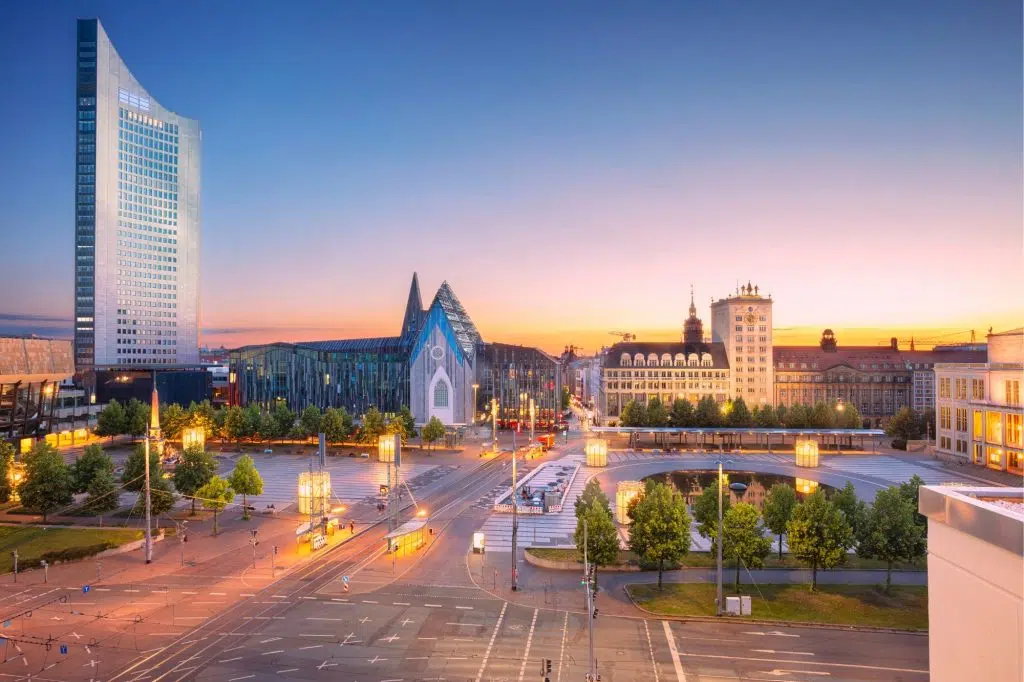
Augustusplatz is one of the largest city squares in Germany and a summary of Leipzig's last century. The Opera opened on one side in 1960 and the new Gewandhaus concert hall faces it from the other, opened in 1981. In 1968 the GDR authorities blew up the medieval University Church here; today the Paulinum, with its gabled glass front, recalls the lost church. Above it all rises the City-Hochhaus, 142.5 metres tall and completed in 1972, which locals nickname the wisdom tooth.
O que comer em Leipzig
- Leipziger Lerche: a shortcrust pastry filled with almonds and a cherry. It replaced a real lark pie after King Albert of Saxony banned lark hunting in 1876, and the cherry stands for the bird's heart.
- Leipziger Allerlei: uma mistura de legumes da primavera como ervilhas, cenouras e espargos, tradicionalmente com lagostins e cogumelos morchella.
- Gose: a sour, slightly salty wheat beer brewed with coriander. It originally came from Goslar but became Leipzig's own beer.
- Leipziger Räbchen: ameixas secas recheadas com maçapão, passadas por massa, fritas e polvilhadas com açúcar.
Antes de ires
- O Coro de São Tomé, fundado em 1212, canta regularmente motetes na Igreja de São Tomé quando não está em digressão. Consulta o programa antes de ires.
- Para a melhor vista sobre a cidade, apanha o elevador até à plataforma panorâmica no topo do City-Hochhaus.
- Às segundas-feiras continuam a realizar-se orações pela paz na Igreja de São Nicolau, onde começou a Revolução Pacífica.
- A sul da cidade, antigas minas a céu aberto inundadas formam uma cadeia de lagos, o Leipziger Neuseenland, ótima para nadar, andar de bicicleta e velejar.
Descobre Leipzig com a World City Trail
A nossa caça ao tesouro em Leipzig transforma estes locais num jogo no teu telemóvel. O percurso liga 10 paragens e demora cerca de duas horas, com uns 30 minutos a pé, e passa pela Augustusplatz, pelo Krochhochhaus e pela Igreja de São Nicolau.
Em cada paragem resolves um enigma e ouves uma pequena história, ao teu ritmo. Podes começar quando quiseres e jogar em inglês, alemão, francês, neerlandês ou polaco.
Jogar a caça ao tesouro de Leipzig →
Factos verificados em outubro de 2026.