
Leipzig grew rich on trade fairs, books and music, and in 1989 its citizens helped bring down the East German regime without firing a shot. The city where Bach wrote his cantatas and Goethe studied law is also one of Germany's fastest-changing, with old arcades and courtyards next to bold buildings from the 1920s and the GDR era. Here are the facts and stories that make Leipzig special.
10 ciekawostek o Lipsku
- A fair city for over 850 years: the town charter of around 1165 already mentions Leipzig's markets. In 1497 King Maximilian I confirmed its fair privileges, and in 1895 Leipzig held the world's first sample fair, where traders ordered goods from samples instead of buying stock on the spot.
- The world's first daily newspaper: on 1 July 1650 the printer Timotheus Ritzsch launched the Einkommende Zeitungen in Leipzig, regarded as the first daily newspaper in the world.
- Stary uniwersytet ze słynnym studentem: Uniwersytet Lipski założono w 1409 roku i jest jednym z najstarszych w Niemczech. Johann Wolfgang von Goethe przyjechał tu na studia prawnicze w 1765 roku.
- Piwnica w literaturze światowej: Goethe umieścił jedną ze scen Fausta w Auerbachs Keller, restauracji pod pasażem Mädlerpassage. Przy wejściu stoją brązowe posągi Fausta, Mefistofelesa i zaczarowanych studentów.
- Bach's city: Johann Sebastian Bach was cantor of St Thomas Church from 1723 until his death in 1750 and wrote much of his church music here. Since 1950 his grave has been inside the church.
- Jedna z najstarszych orkiestr mieszczańskich: Orkiestra Gewandhausu wywodzi się z 1743 roku, kiedy kupcy założyli towarzystwo koncertowe. W 1835 roku jej dyrygentem został Felix Mendelssohn.
- Bellmen on the roof: the Krochhochhaus on Augustusplatz, opened in 1928, was Leipzig's first high-rise. On top, two bronze bellmen 3.3 metres tall strike the bells, modelled on St Mark's Clocktower in Venice, above the motto Omnia vincit labor, work conquers all.
- Palmy w kościele: pod koniec XVIII wieku kościół św. Mikołaja otrzymał klasycystyczne wnętrze, w którym jasne kolumny rozkładają się u góry w liście palmy.
- Pomnik gigantycznej bitwy: 91-metrowy Pomnik Bitwy Narodów ukończono w 1913 roku, sto lat po tym, jak Napoleon został pokonany pod Lipskiem w październiku 1813 roku w jednej z największych bitew w historii przed XX wiekiem.
- Dworzec na miarę miasta targów: Dworzec Główny w Lipsku otwarto w 1915 roku i jest jednym z największych dworców Europy pod względem powierzchni.
9 października 1989: wieczór, w którym Lipsk wybrał wolność
From 1982 people met for peace prayers every Monday in St Nicholas Church, and in autumn 1989 the crowds leaving the church began marching around the inner-city ring road. On 9 October, two days after the GDR celebrated its 40th anniversary, the state had police, troops and hospitals on standby, and many feared a bloodbath. About 70,000 people walked the ring anyway, carrying candles and chanting 'We are the people'. Nobody gave the order to shoot. A month later the Berlin Wall fell, and the Monday Demonstrations are remembered as a turning point of the Peaceful Revolution.
Augustusplatz w pigułce
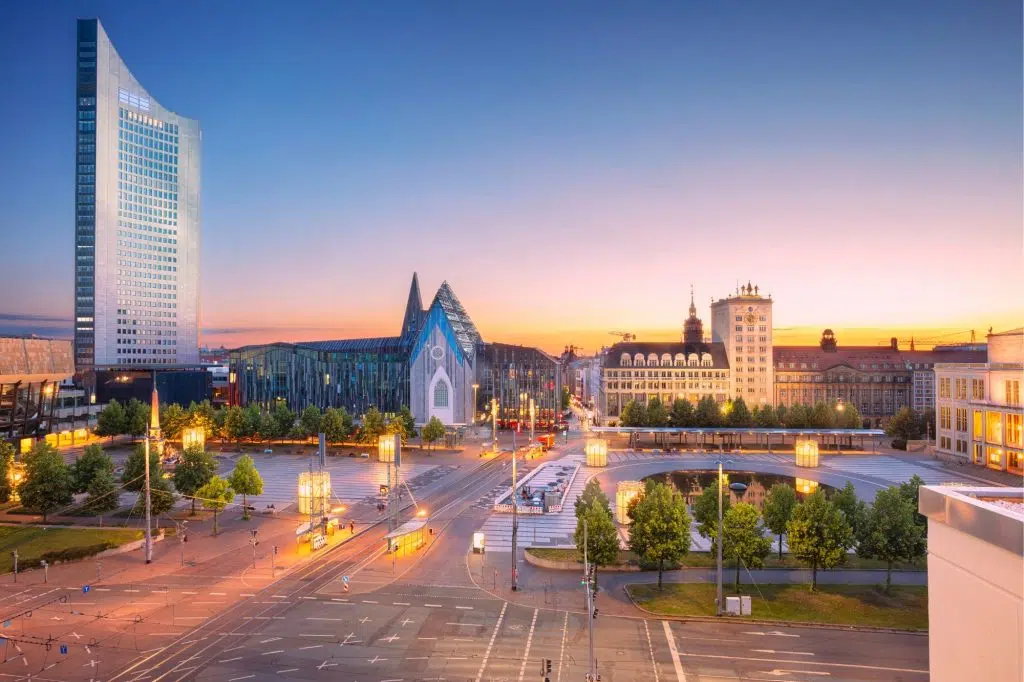
Augustusplatz is one of the largest city squares in Germany and a summary of Leipzig's last century. The Opera opened on one side in 1960 and the new Gewandhaus concert hall faces it from the other, opened in 1981. In 1968 the GDR authorities blew up the medieval University Church here; today the Paulinum, with its gabled glass front, recalls the lost church. Above it all rises the City-Hochhaus, 142.5 metres tall and completed in 1972, which locals nickname the wisdom tooth.
Co zjeść w Lipsku
- Leipziger Lerche: a shortcrust pastry filled with almonds and a cherry. It replaced a real lark pie after King Albert of Saxony banned lark hunting in 1876, and the cherry stands for the bird's heart.
- Leipziger Allerlei: mieszanka wiosennych warzyw, takich jak groszek, marchew i szparagi, tradycyjnie z rakami i smardzami.
- Gose: a sour, slightly salty wheat beer brewed with coriander. It originally came from Goslar but became Leipzig's own beer.
- Leipziger Räbchen: suszone śliwki nadziewane marcepanem, zanurzone w cieście, smażone i posypane cukrem.
Dobrze wiedzieć przed wizytą
- Chór Tomaszański, założony w 1212 roku, regularnie śpiewa motety w kościele św. Tomasza, gdy nie jest w trasie. Sprawdź program przed wizytą.
- Najlepszy widok na miasto masz z tarasu widokowego na szczycie City-Hochhaus, na który wjedziesz windą.
- W kościele św. Mikołaja, gdzie zaczęła się pokojowa rewolucja, w poniedziałki wciąż odbywają się modlitwy o pokój.
- Na południe od miasta zalane dawne kopalnie odkrywkowe zamieniły się w łańcuch jezior, Leipziger Neuseenland, idealny do pływania, jazdy na rowerze i żeglowania.
Odkryj Lipsk z World City Trail
Nasza gra miejska w Lipsku zamienia te miejsca w grę na twoim telefonie. Trasa łączy 10 przystanków i trwa około dwóch godzin, w tym około 30 minut marszu, i prowadzi przez Augustusplatz, obok Krochhochhaus i kościoła św. Mikołaja.
Na każdym przystanku rozwiązujesz zagadkę i słuchasz krótkiej historii, we własnym tempie. Możesz zacząć, kiedy chcesz, i grać po polsku, angielsku, niemiecku, francusku lub niderlandzku.
Zagraj w grę miejską w Lipsku →
Fakty sprawdzone w październiku 2026.