
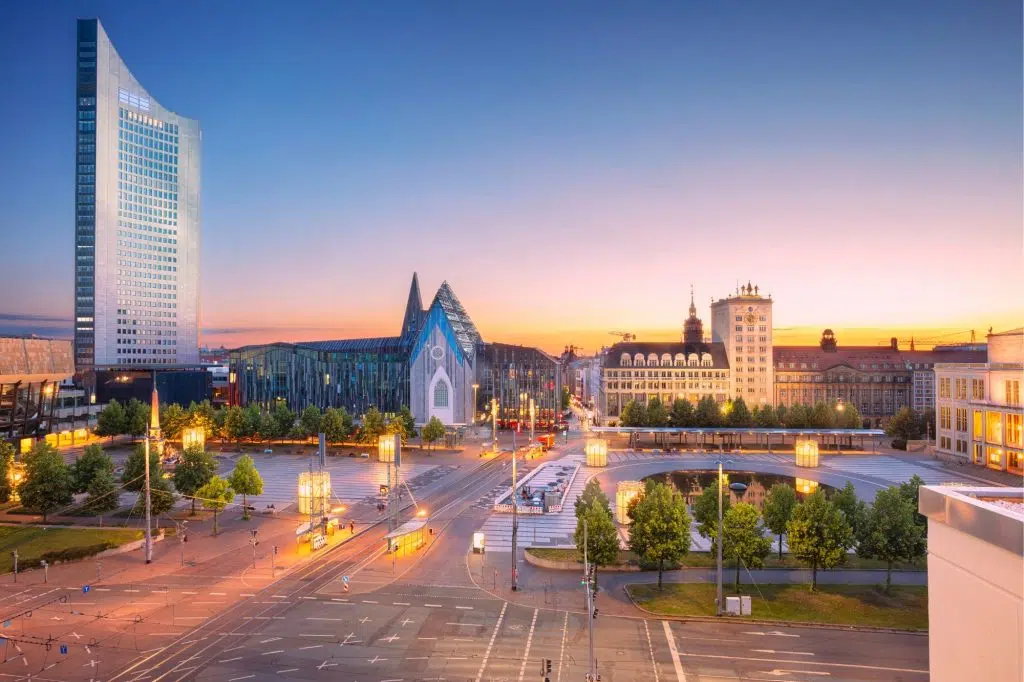
Leipzig grew rich on trade fairs, books and music, and in 1989 its citizens helped bring down the East German regime without firing a shot. The city where Bach wrote his cantatas and Goethe studied law is also one of Germany's fastest-changing, with old arcades and courtyards next to bold buildings from the 1920s and the GDR era. Here are the facts and stories that make Leipzig special.
10 curiosidades sobre Leipzig
- A fair city for over 850 years: the town charter of around 1165 already mentions Leipzig's markets. In 1497 King Maximilian I confirmed its fair privileges, and in 1895 Leipzig held the world's first sample fair, where traders ordered goods from samples instead of buying stock on the spot.
- The world's first daily newspaper: on 1 July 1650 the printer Timotheus Ritzsch launched the Einkommende Zeitungen in Leipzig, regarded as the first daily newspaper in the world.
- Una universidad antigua con un alumno famoso: la Universidad de Leipzig se fundó en 1409 y es una de las más antiguas de Alemania. Johann Wolfgang von Goethe llegó aquí en 1765 para estudiar Derecho.
- Una bodega en la literatura universal: Goethe situó una escena de Fausto en Auerbachs Keller, un restaurante bajo el pasaje Mädlerpassage. En la entrada hay estatuas de bronce de Fausto, Mefistófeles y los estudiantes hechizados.
- Bach's city: Johann Sebastian Bach was cantor of St Thomas Church from 1723 until his death in 1750 and wrote much of his church music here. Since 1950 his grave has been inside the church.
- Una de las orquestas cívicas más antiguas: la Orquesta de la Gewandhaus se remonta a 1743, cuando unos comerciantes fundaron una sociedad de conciertos. Felix Mendelssohn se convirtió en su director en 1835.
- Bellmen on the roof: the Krochhochhaus on Augustusplatz, opened in 1928, was Leipzig's first high-rise. On top, two bronze bellmen 3.3 metres tall strike the bells, modelled on St Mark's Clocktower in Venice, above the motto Omnia vincit labor, work conquers all.
- Palmeras en una iglesia: a finales del siglo XVIII la iglesia de San Nicolás recibió un interior clasicista cuyas columnas claras se abren en hojas de palmera en lo alto.
- Un monumento a una batalla gigantesca: el Monumento a la Batalla de las Naciones, de 91 metros, se terminó en 1913, un siglo después de que Napoleón fuera derrotado ante Leipzig en octubre de 1813 en una de las mayores batallas de la historia antes del siglo XX.
- Una estación para una ciudad de ferias: la estación central de Leipzig abrió en 1915 y es una de las estaciones más grandes de Europa por superficie.
9 de octubre de 1989: la noche en que Leipzig eligió la libertad
From 1982 people met for peace prayers every Monday in St Nicholas Church, and in autumn 1989 the crowds leaving the church began marching around the inner-city ring road. On 9 October, two days after the GDR celebrated its 40th anniversary, the state had police, troops and hospitals on standby, and many feared a bloodbath. About 70,000 people walked the ring anyway, carrying candles and chanting 'We are the people'. Nobody gave the order to shoot. A month later the Berlin Wall fell, and the Monday Demonstrations are remembered as a turning point of the Peaceful Revolution.
Augustusplatz, explicada
Augustusplatz is one of the largest city squares in Germany and a summary of Leipzig's last century. The Opera opened on one side in 1960 and the new Gewandhaus concert hall faces it from the other, opened in 1981. In 1968 the GDR authorities blew up the medieval University Church here; today the Paulinum, with its gabled glass front, recalls the lost church. Above it all rises the City-Hochhaus, 142.5 metres tall and completed in 1972, which locals nickname the wisdom tooth.
Qué comer en Leipzig
- Leipziger Lerche: a shortcrust pastry filled with almonds and a cherry. It replaced a real lark pie after King Albert of Saxony banned lark hunting in 1876, and the cherry stands for the bird's heart.
- Leipziger Allerlei: una mezcla de verduras de primavera como guisantes, zanahorias y espárragos, tradicionalmente con cangrejos de río y colmenillas.
- Gose: a sour, slightly salty wheat beer brewed with coriander. It originally came from Goslar but became Leipzig's own beer.
- Leipziger Räbchen: ciruelas pasas rellenas de mazapán, rebozadas, fritas y espolvoreadas con azúcar.
Antes de ir
- El Coro de Santo Tomás, fundado en 1212, canta motetes con regularidad en la iglesia de Santo Tomás cuando no está de gira. Consulta la programación antes de ir.
- Para tener la mejor vista de la ciudad, sube en ascensor a la plataforma panorámica de lo alto del City-Hochhaus.
- Los lunes se siguen celebrando oraciones por la paz en la iglesia de San Nicolás, donde empezó la Revolución pacífica.
- Al sur de la ciudad, antiguas minas a cielo abierto inundadas forman una cadena de lagos, el Leipziger Neuseenland, perfecta para nadar, ir en bici y navegar.
Descubre Leipzig con World City Trail
Nuestra búsqueda del tesoro en Leipzig convierte estos lugares en un juego en tu móvil. La ruta une 10 paradas y dura unas dos horas, con unos 30 minutos a pie, y pasa por Augustusplatz, el Krochhochhaus y la iglesia de San Nicolás.
En cada parada resuelves un acertijo y escuchas una breve historia, a tu ritmo. Puedes empezar cuando quieras y jugar en inglés, alemán, francés, neerlandés o polaco.
Juega a la búsqueda del tesoro de Leipzig →
Datos comprobados en octubre de 2026.