
Leipzig grew rich on trade fairs, books and music, and in 1989 its citizens helped bring down the East German regime without firing a shot. The city where Bach wrote his cantatas and Goethe studied law is also one of Germany's fastest-changing, with old arcades and courtyards next to bold buildings from the 1920s and the GDR era. Here are the facts and stories that make Leipzig special.
10 anecdotes sur Leipzig
- A fair city for over 850 years: the town charter of around 1165 already mentions Leipzig's markets. In 1497 King Maximilian I confirmed its fair privileges, and in 1895 Leipzig held the world's first sample fair, where traders ordered goods from samples instead of buying stock on the spot.
- The world's first daily newspaper: on 1 July 1650 the printer Timotheus Ritzsch launched the Einkommende Zeitungen in Leipzig, regarded as the first daily newspaper in the world.
- Une vieille université et un étudiant célèbre : l’université de Leipzig a été fondée en 1409, ce qui en fait l’une des plus anciennes d’Allemagne. Johann Wolfgang von Goethe vint y étudier le droit en 1765.
- Une cave entrée dans la littérature mondiale : Goethe a situé une scène de Faust dans l’Auerbachs Keller, un restaurant sous le passage Mädler. Des statues en bronze de Faust, de Méphisto et des étudiants ensorcelés en gardent l’entrée.
- Bach's city: Johann Sebastian Bach was cantor of St Thomas Church from 1723 until his death in 1750 and wrote much of his church music here. Since 1950 his grave has been inside the church.
- L’un des plus anciens orchestres civiques : l’Orchestre du Gewandhaus remonte à 1743, lorsque des marchands fondèrent une société de concerts. Felix Mendelssohn en devint le chef en 1835.
- Bellmen on the roof: the Krochhochhaus on Augustusplatz, opened in 1928, was Leipzig's first high-rise. On top, two bronze bellmen 3.3 metres tall strike the bells, modelled on St Mark's Clocktower in Venice, above the motto Omnia vincit labor, work conquers all.
- Des palmiers dans une église : à la fin du XVIIIe siècle, l’église Saint-Nicolas reçut un intérieur classique dont les colonnes claires s’épanouissent en palmes à leur sommet.
- Un monument pour une bataille gigantesque : le monument de la Bataille des Nations, haut de 91 mètres, fut achevé en 1913, un siècle après la défaite de Napoléon devant Leipzig en octobre 1813, l’une des plus grandes batailles de l’histoire avant le XXe siècle.
- Une gare à la mesure d’une ville de foires : la gare centrale de Leipzig a ouvert en 1915 et compte parmi les plus grandes gares d’Europe par sa surface.
9 octobre 1989 : le soir où Leipzig choisit la liberté
From 1982 people met for peace prayers every Monday in St Nicholas Church, and in autumn 1989 the crowds leaving the church began marching around the inner-city ring road. On 9 October, two days after the GDR celebrated its 40th anniversary, the state had police, troops and hospitals on standby, and many feared a bloodbath. About 70,000 people walked the ring anyway, carrying candles and chanting 'We are the people'. Nobody gave the order to shoot. A month later the Berlin Wall fell, and the Monday Demonstrations are remembered as a turning point of the Peaceful Revolution.
L’Augustusplatz en quelques mots
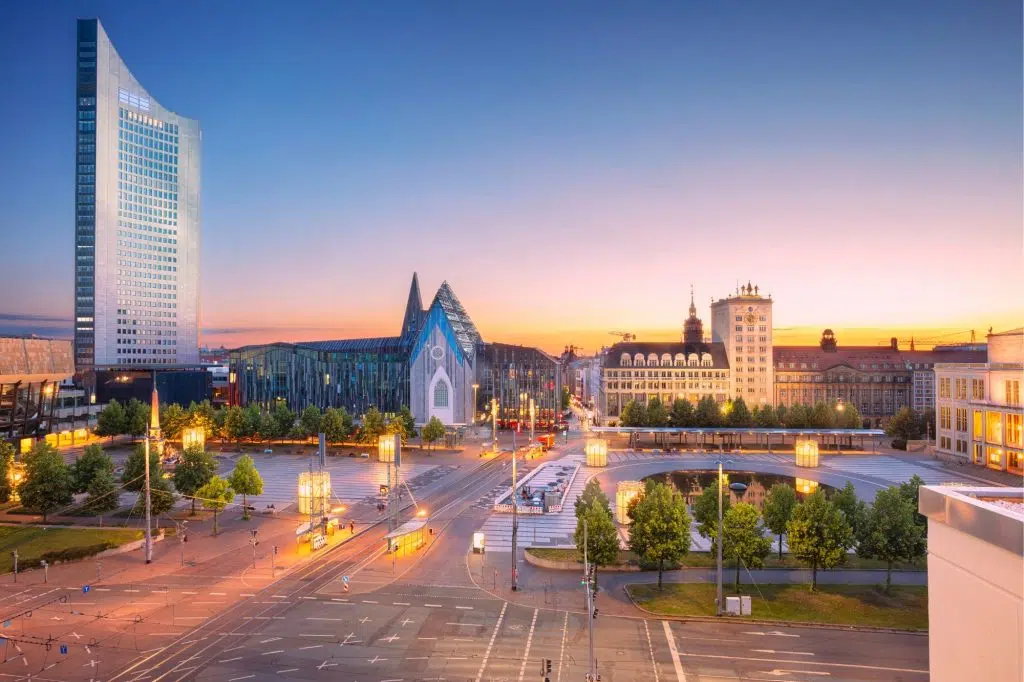
Augustusplatz is one of the largest city squares in Germany and a summary of Leipzig's last century. The Opera opened on one side in 1960 and the new Gewandhaus concert hall faces it from the other, opened in 1981. In 1968 the GDR authorities blew up the medieval University Church here; today the Paulinum, with its gabled glass front, recalls the lost church. Above it all rises the City-Hochhaus, 142.5 metres tall and completed in 1972, which locals nickname the wisdom tooth.
Que manger à Leipzig
- Leipziger Lerche: a shortcrust pastry filled with almonds and a cherry. It replaced a real lark pie after King Albert of Saxony banned lark hunting in 1876, and the cherry stands for the bird's heart.
- Leipziger Allerlei : un mélange de légumes de printemps comme petits pois, carottes et asperges, traditionnellement avec des écrevisses et des morilles.
- Gose: a sour, slightly salty wheat beer brewed with coriander. It originally came from Goslar but became Leipzig's own beer.
- Leipziger Räbchen : des pruneaux farcis de pâte d’amandes, trempés dans une pâte, frits et saupoudrés de sucre.
Bon à savoir avant de partir
- Le chœur de garçons de Saint-Thomas, fondé en 1212, chante régulièrement des motets à l’église Saint-Thomas lorsqu’il n’est pas en tournée. Consultez le programme avant d’y aller.
- Pour la plus belle vue sur la ville, prenez l’ascenseur jusqu’à la plateforme panoramique au sommet du City-Hochhaus.
- Des prières pour la paix ont toujours lieu le lundi à l’église Saint-Nicolas, là où la Révolution pacifique a commencé.
- Au sud de la ville, d’anciennes mines à ciel ouvert inondées forment une chaîne de lacs, le Leipziger Neuseenland, idéale pour la baignade, le vélo et la voile.
Découvrir Leipzig avec World City Trail
Notre chasse au trésor à Leipzig transforme ces lieux en un jeu sur votre téléphone. Le parcours relie 10 étapes et dure environ deux heures, dont environ 30 minutes de marche, et vous fait passer par l’Augustusplatz, le Krochhochhaus et l’église Saint-Nicolas.
À chaque étape, vous résolvez une énigme et écoutez une courte histoire, à votre rythme. Vous pouvez commencer quand vous voulez et jouer en français, anglais, allemand, néerlandais ou polonais.
Jouer à la chasse au trésor de Leipzig →
Faits vérifiés en octobre 2026.