
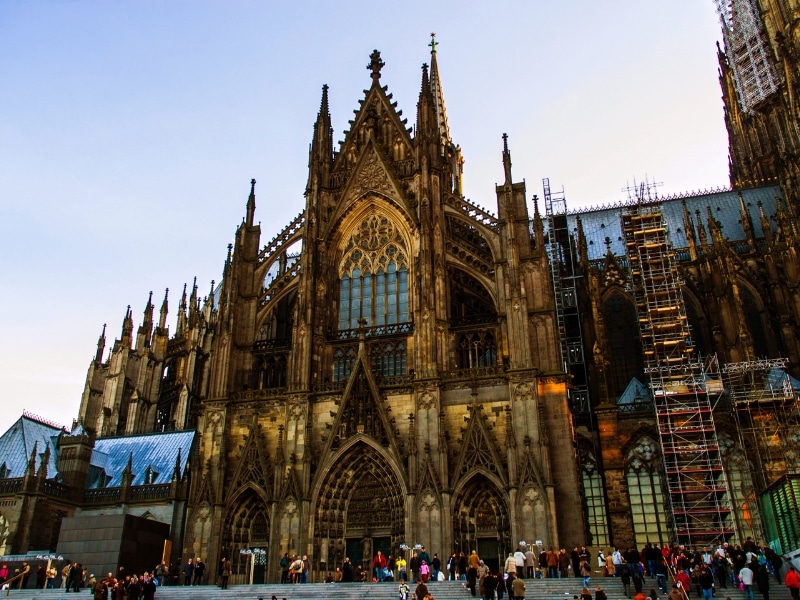
Cologne was founded by the Romans on the Rhine and is now Germany's fourth-largest city. Much of it was destroyed in the Second World War, yet its cathedral survived, and the city kept its own beer, its own dialect and a famously loud carnival. Here are the facts and stories behind it.
10 curiosità su Colonia
- 632 anni di lavori: la prima pietra del Duomo di Colonia fu posata nel 1248, ma i lavori si fermarono per secoli, e il Duomo fu completato solo nel 1880.
- Briefly the tallest building on Earth: with spires 157 metres high, the cathedral was the world's tallest building from 1880 until the Washington Monument was finished in 1884. It is still the tallest twin-spired church in the world.
- Built for three kings: in 1164 Archbishop Rainald von Dassel brought relics said to be those of the Three Wise Men from Milan to Cologne. They rest in a golden shrine in the cathedral, and the three crowns in Cologne's coat of arms stand for them.
- Colpito 14 volte e ancora in piedi: nella Seconda guerra mondiale il Duomo fu colpito da 14 bombe aeree ma non crollò, mentre gran parte della città intorno veniva distrutta.
- Un nome da Roma: intorno al 50 d.C. l’imperatore Claudio elevò la città a colonia romana su richiesta della moglie Agrippina, nata qui. Divenne Colonia Claudia Ara Agrippinensium, e da Colonia nacque Köln.
- La patria dell’acqua di Colonia: Johann Maria Farina fondò qui la sua attività di profumi nel 1709 e chiamò il suo profumo con il nome della nuova città. La Casa Farina, di fronte al Municipio, è la più antica fabbrica di profumi ancora esistente.
- A perfume named after a house number: in 1794, the year French troops occupied Cologne, the city's houses were numbered, and a building on Glockengasse became No. 4711. The Mülhens family's eau de Cologne still carries that number.
- Una testa che fa la linguaccia: il Platzjabbeck guarda dalla torre del Municipio dal XV secolo, e dal 1913 tira fuori la lingua allo scoccare di ogni ora. La torre ospita anche 124 statue di pietra.
- Un vicino sfacciato: in alto sulla facciata di Alter Markt 24 sta accovacciato il Kallendresser, una figura in rame di Ewald Mataré del 1957, che mostra il sedere alla piazza e al Municipio.
- Germany's busiest railway bridge: about 1,500 trains a day cross the Rhine on the Hohenzollern Bridge, opened in 1911, and its footpath is lined with thousands of love locks.
La leggenda degli Heinzelmännchen
Cologne's best-loved legend is about the Heinzelmännchen, little house elves who came out at night and did the townspeople's work while they slept. Then a tailor's wife grew curious and scattered peas on the floor so the elves would slip and show themselves. They tumbled, vanished in anger and never came back. The story was first written down in 1826 and made famous by August Kopisch's poem of 1836. The Heinzelmännchenbrunnen near the cathedral shows the elves at work and the tailor's wife.
Il Kölsch in breve
Kölsch is both the local dialect and the local beer. The light, top-fermented beer may only carry the name if it is brewed in and around Cologne, under a brewers' convention of 1986 and EU protection since 1997. In a Brauhaus it comes in a slim 200 ml glass called a Stange. The waiter, the Köbes, replaces each empty glass without asking and marks a tick on your beer mat. To stop, put the mat on top of your glass.
Cosa mangiare a Colonia
- Halve Hahn: nonostante il nome, che significa mezzo pollo, è un panino di segale con una fetta spessa di Gouda, senape e cipolla cruda.
- Himmel un Ääd: cielo e terra, un purè di patate e mele servito con sanguinaccio fritto e cipolle.
- Reibekuchen: frittelle di patate croccanti, da mangiare con purea di mele o su pane scuro di segale.
- Rheinischer Sauerbraten: manzo marinato per giorni in aceto e spezie, servito in una salsa agrodolce con uvetta, cavolo rosso e gnocchi di patate.
Da sapere prima di partire
- You can climb the cathedral's south tower: 533 steps lead to a viewing platform about 100 metres up. The tower needs a ticket, and visits to the nave are limited during services.
- Per la veduta classica del Duomo e del centro storico, attraversa il ponte Hohenzollern fino a Deutz, sull’altra riva.
- La stagione del carnevale si apre l’11 novembre alle 11:11, ma il carnevale di strada raggiunge il culmine nei giorni prima del Mercoledì delle Ceneri. Prenota l’hotel con anticipo per quelle date.
Scopri Colonia con World City Trail
La nostra caccia al tesoro a Colonia trasforma questi luoghi in un gioco sul tuo telefono. Il percorso collega 10 tappe e dura circa due ore, con circa 20 minuti di cammino: il Duomo, la stazione centrale, la Fontana degli Heinzelmännchen, la Laurenzplatz, il Municipio storico, l’Alter Markt, Groß St. Martin, il Fischmarkt, il Pegelturm e il Museo del Profumo nella Casa Farina.
A ogni tappa risolvi un enigma e ascolti una breve storia, al tuo ritmo. Puoi iniziare quando vuoi e giocare in italiano, inglese, tedesco, francese, spagnolo o olandese.
Gioca alla caccia al tesoro di Colonia →
Fatti verificati a ottobre 2026.