
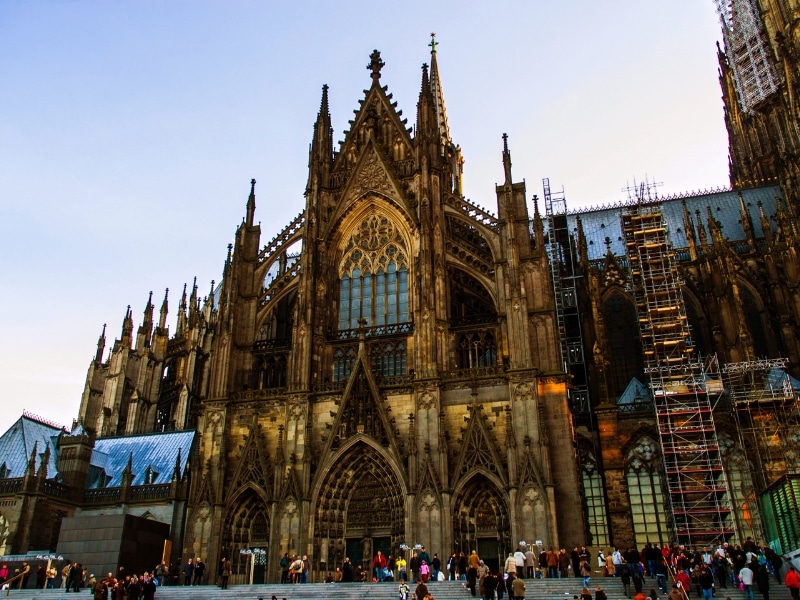
Cologne was founded by the Romans on the Rhine and is now Germany's fourth-largest city. Much of it was destroyed in the Second World War, yet its cathedral survived, and the city kept its own beer, its own dialect and a famously loud carnival. Here are the facts and stories behind it.
10 curiosidades sobre Colónia
- 632 anos em obras: a primeira pedra da Catedral de Colónia foi lançada em 1248, mas as obras pararam durante séculos, e a catedral só ficou concluída em 1880.
- Briefly the tallest building on Earth: with spires 157 metres high, the cathedral was the world's tallest building from 1880 until the Washington Monument was finished in 1884. It is still the tallest twin-spired church in the world.
- Built for three kings: in 1164 Archbishop Rainald von Dassel brought relics said to be those of the Three Wise Men from Milan to Cologne. They rest in a golden shrine in the cathedral, and the three crowns in Cologne's coat of arms stand for them.
- Atingida 14 vezes e ainda de pé: na Segunda Guerra Mundial, a catedral foi atingida por 14 bombas aéreas mas não ruiu, enquanto grande parte da cidade à sua volta era destruída.
- Um nome vindo de Roma: por volta do ano 50 d.C., o imperador Cláudio fez da cidade uma colónia romana a pedido da mulher, Agripina, que aqui nasceu. Chamou-se Colonia Claudia Ara Agrippinensium, e de Colonia nasceu Köln.
- A terra da água-de-colónia: Johann Maria Farina fundou aqui o seu negócio de perfumes em 1709 e deu à fragrância o nome da sua nova cidade. A Casa Farina, em frente à Câmara Municipal, é a fábrica de perfumes mais antiga ainda de pé.
- A perfume named after a house number: in 1794, the year French troops occupied Cologne, the city's houses were numbered, and a building on Glockengasse became No. 4711. The Mülhens family's eau de Cologne still carries that number.
- Uma cabeça que mostra a língua: o Platzjabbeck observa a praça da torre da Câmara Municipal desde o século XV, e desde 1913 mostra a língua a cada hora certa. A torre tem ainda 124 estátuas de pedra.
- Um vizinho atrevido: no alto da fachada do número 24 do Alter Markt está agachado o Kallendresser, uma figura de cobre de Ewald Mataré de 1957, que mostra o rabo à praça e à Câmara Municipal.
- Germany's busiest railway bridge: about 1,500 trains a day cross the Rhine on the Hohenzollern Bridge, opened in 1911, and its footpath is lined with thousands of love locks.
A lenda dos Heinzelmännchen
Cologne's best-loved legend is about the Heinzelmännchen, little house elves who came out at night and did the townspeople's work while they slept. Then a tailor's wife grew curious and scattered peas on the floor so the elves would slip and show themselves. They tumbled, vanished in anger and never came back. The story was first written down in 1826 and made famous by August Kopisch's poem of 1836. The Heinzelmännchenbrunnen near the cathedral shows the elves at work and the tailor's wife.
O Kölsch, explicado
Kölsch is both the local dialect and the local beer. The light, top-fermented beer may only carry the name if it is brewed in and around Cologne, under a brewers' convention of 1986 and EU protection since 1997. In a Brauhaus it comes in a slim 200 ml glass called a Stange. The waiter, the Köbes, replaces each empty glass without asking and marks a tick on your beer mat. To stop, put the mat on top of your glass.
O que comer em Colónia
- Halve Hahn: apesar do nome, que quer dizer meio frango, é um pão de centeio com uma fatia grossa de gouda, mostarda e cebola crua.
- Himmel un Ääd: céu e terra, um puré de batata e maçã servido com morcela frita e cebola.
- Reibekuchen: panquecas de batata estaladiças, com puré de maçã ou sobre pão escuro de centeio.
- Rheinischer Sauerbraten: carne de vaca marinada durante dias em vinagre e especiarias, servida num molho agridoce com passas, couve-roxa e bolinhos de batata.
Antes de ires
- You can climb the cathedral's south tower: 533 steps lead to a viewing platform about 100 metres up. The tower needs a ticket, and visits to the nave are limited during services.
- Para a vista clássica da catedral e da cidade velha, atravessa a Ponte Hohenzollern até Deutz, na outra margem.
- A época de carnaval abre a 11 de novembro às 11h11, mas o carnaval de rua atinge o auge nos dias antes da Quarta-feira de Cinzas. Reserva o hotel cedo para essas datas.
Descobre Colónia com a World City Trail
A nossa caça ao tesouro em Colónia transforma estes locais num jogo no teu telemóvel. O percurso liga 10 paragens e demora cerca de duas horas, com cerca de 20 minutos a pé: a catedral, a estação central, a Fonte dos Heinzelmännchen, a Laurenzplatz, a Câmara Municipal histórica, o Alter Markt, Groß St. Martin, o Fischmarkt, a Pegelturm e o Museu do Perfume na Casa Farina.
Em cada paragem resolves um enigma e ouves uma pequena história, ao teu ritmo. Podes começar quando quiseres e jogar em inglês, alemão, francês, italiano, espanhol ou neerlandês.
Jogar a caça ao tesouro de Colónia →
Factos verificados em outubro de 2026.