
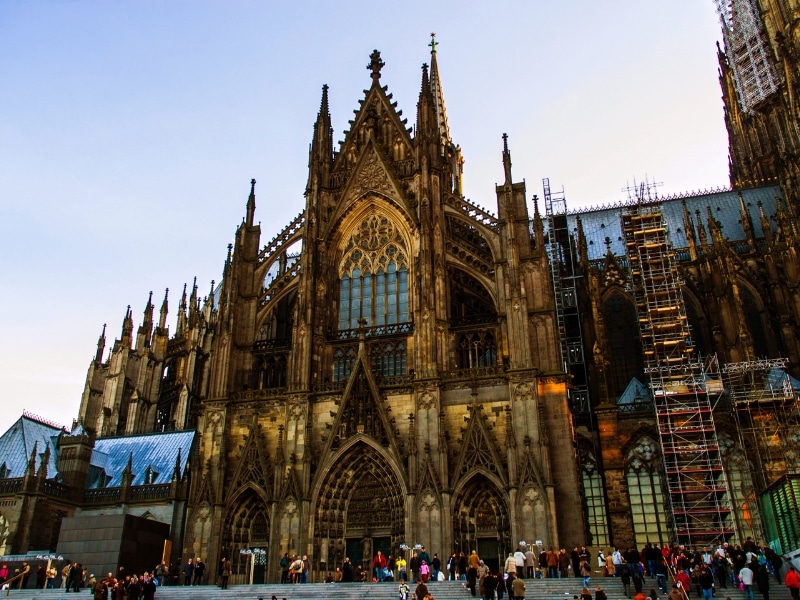
Cologne was founded by the Romans on the Rhine and is now Germany's fourth-largest city. Much of it was destroyed in the Second World War, yet its cathedral survived, and the city kept its own beer, its own dialect and a famously loud carnival. Here are the facts and stories behind it.
10 fun facts about Cologne
- 632 years in the making: the foundation stone of Cologne Cathedral was laid in 1248, but work stopped for centuries, and the cathedral was only completed in 1880.
- Briefly the tallest building on Earth: with spires 157 metres high, the cathedral was the world's tallest building from 1880 until the Washington Monument was finished in 1884. It is still the tallest twin-spired church in the world.
- Built for three kings: in 1164 Archbishop Rainald von Dassel brought relics said to be those of the Three Wise Men from Milan to Cologne. They rest in a golden shrine in the cathedral, and the three crowns in Cologne's coat of arms stand for them.
- Hit 14 times and still standing: the cathedral was struck by 14 aerial bombs in the Second World War but did not collapse, while much of the city around it was destroyed.
- A name from Rome: around 50 AD, Emperor Claudius made the town a Roman colony at the request of his wife Agrippina, who was born here. It became Colonia Claudia Ara Agrippinensium, and Colonia turned into Köln.
- The home of eau de Cologne: Johann Maria Farina founded his fragrance business here in 1709 and named his scent after his new home town. The Farina House, opposite the City Hall, is the oldest fragrance factory still standing.
- A perfume named after a house number: in 1794, the year French troops occupied Cologne, the city's houses were numbered, and a building on Glockengasse became No. 4711. The Mülhens family's eau de Cologne still carries that number.
- A head that sticks its tongue out: the Platzjabbeck has looked down from the City Hall tower since the 15th century, and since 1913 it has stuck out its tongue every hour on the hour. The tower also carries 124 stone figures.
- A cheeky neighbour: high on the facade of Alter Markt 24 squats the Kallendresser, a copper figure by Ewald Mataré from 1957, baring his bottom over the square and the City Hall.
- Germany's busiest railway bridge: about 1,500 trains a day cross the Rhine on the Hohenzollern Bridge, opened in 1911, and its footpath is lined with thousands of love locks.
The legend of the Heinzelmännchen
Cologne's best-loved legend is about the Heinzelmännchen, little house elves who came out at night and did the townspeople's work while they slept. Then a tailor's wife grew curious and scattered peas on the floor so the elves would slip and show themselves. They tumbled, vanished in anger and never came back. The story was first written down in 1826 and made famous by August Kopisch's poem of 1836. The Heinzelmännchenbrunnen near the cathedral shows the elves at work and the tailor's wife.
Kölsch, explained
Kölsch is both the local dialect and the local beer. The light, top-fermented beer may only carry the name if it is brewed in and around Cologne, under a brewers' convention of 1986 and EU protection since 1997. In a Brauhaus it comes in a slim 200 ml glass called a Stange. The waiter, the Köbes, replaces each empty glass without asking and marks a tick on your beer mat. To stop, put the mat on top of your glass.
What to eat in Cologne
- Halve Hahn: despite the name, which means half a chicken, it is a rye roll with a thick slice of Gouda, mustard and raw onion.
- Himmel un Ääd: heaven and earth, a mash of potato and apple served with fried black pudding and onions.
- Reibekuchen: crisp potato pancakes, eaten with apple sauce or on dark rye bread.
- Rheinischer Sauerbraten: beef marinated for days in vinegar and spices, served in a sweet-and-sour sauce with raisins, red cabbage and potato dumplings.
Good to know before you go
- You can climb the cathedral's south tower: 533 steps lead to a viewing platform about 100 metres up. The tower needs a ticket, and visits to the nave are limited during services.
- For the classic view of the cathedral and the old town, walk across the Hohenzollern Bridge to Deutz on the other bank.
- Carnival season opens on 11 November at 11:11, but the street carnival peaks in the days before Ash Wednesday. Book hotels early for those dates.
Explore Cologne with World City Trail
Our Cologne scavenger hunt turns these sights into a game you play on your phone. The route links 10 stops and takes around two hours, with about 20 minutes of walking: Cologne Cathedral, the Hauptbahnhof, the Heinzelmännchenbrunnen, Laurenzplatz, the Historic City Hall, the Old Market, Great St Martin, the Fischmarkt, the Pegelturm and the Fragrance Museum in the Farina House.
At each stop you solve a puzzle and hear a short story, at your own pace. You can start whenever you like and play in English, German, French, Italian, Spanish or Dutch.
Play the Cologne scavenger hunt →
Facts checked in October 2026.