
Copenhagen began as a fishing village with a bishop's castle and grew into the capital of a kingdom that once ruled Norway and much of today's southern Sweden. Its kings left it towers, palaces and a canal full of old ships, and today it is a city of bicycles, harbour swimming and long summer evenings. Here are the facts and stories that make the city special.
10 fun facts about Copenhagen
- A bishop's castle: by tradition, Copenhagen was founded in 1167, when Bishop Absalon built a castle on a small island here. Its ruins can still be seen in the basement of Christiansborg Palace.
- A tower with no stairs: the Round Tower, built by King Christian IV between 1637 and 1642, has a spiral ramp instead of steps that winds 7.5 times around its core. In 1716, Tsar Peter the Great is said to have ridden up it on horseback.
- Still looking at the stars: the Round Tower was built as an observatory for the university and is often called Europe's oldest functioning astronomical observatory.
- A clock for 25,753 years: City Hall, finished in 1905 with a 105.6-metre tower, houses Jens Olsen's World Clock. It was started in 1955, has more than 15,000 parts, and its slowest gear takes 25,753 years to turn once.
- A cathedral shot to pieces: in 1807 a British fleet bombarded Copenhagen, and the tower of the Church of Our Lady, now the cathedral, was set on fire. The church you see was consecrated in 1829, and the Crown Prince, now King Frederik X, married Mary Donaldson there in 2004.
- Thorvaldsen's apostles: inside the cathedral stand marble statues of Christ and the twelve apostles by the Danish sculptor Bertel Thorvaldsen.
- Andersen's addresses: Hans Christian Andersen lived in three houses on Nyhavn over the years, at numbers 18, 20 and 67.
- Beer money for art: Carlsberg was founded in Copenhagen in 1847 by J. C. Jacobsen. His son Carl paid for the Little Mermaid statue and founded the Ny Carlsberg Glyptotek art museum.
- A car-free street since 1962: Strøget, the long shopping street from the City Hall Square to Kongens Nytorv, was one of the first major pedestrian streets in Europe when it was closed to traffic in 1962.
- Ski on a power plant: since 2019 you can ski, hike or climb on the roof of CopenHill, a waste-to-energy plant on Amager with an artificial ski slope.
The Little Mermaid
Hans Christian Andersen published The Little Mermaid in 1837: the tale of a sea king's daughter who gives up her voice for legs and the hope of a prince's love. Seventy years later, the brewer Carl Jacobsen saw a ballet of the story and commissioned a statue from the sculptor Edvard Eriksen. Unveiled in 1913 on a rock at Langelinie, it is only about 1.25 metres tall, which surprises many visitors. The prima ballerina Ellen Price is said to have modelled for the head, and Eriksen's wife Eline for the body. The mermaid has had a hard life: her head was sawn off in 1964 and again in 1998, and both times it was replaced.
Nyhavn, explained
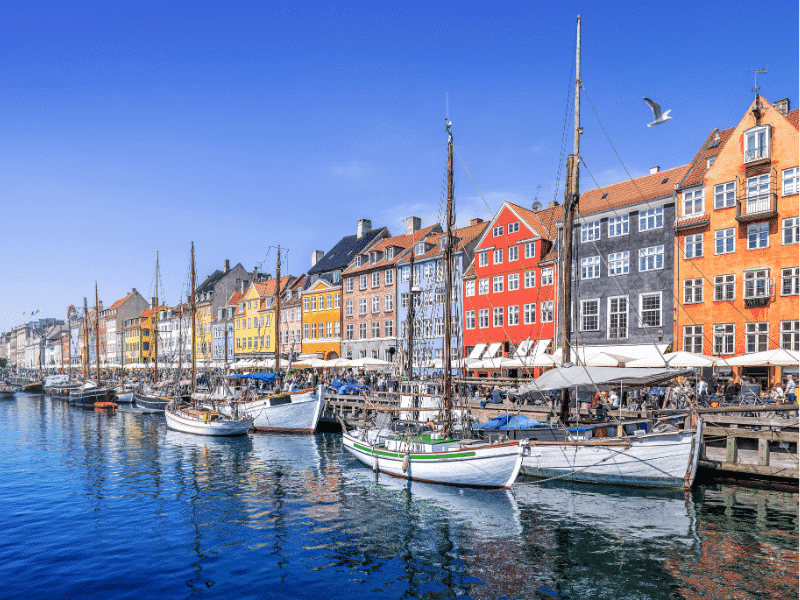
Nyhavn, the New Harbour, was dug in the 1670s under King Christian V to bring ships from the sound right into the city. For centuries it was a rough sailors' quarter of bars and boarding houses. Today its brightly painted townhouses, some from the late 17th century, are lined with restaurants, and old wooden ships are moored along the quay. At the end of the canal, a large anchor serves as a memorial to Danish sailors who died in the Second World War.
What to eat in Copenhagen
- Smørrebrød: open sandwiches on dark rye bread, topped with pickled herring, roast beef, egg and shrimp or liver pâté. Eat them with a knife and fork.
- Wienerbrød: what the rest of the world calls a Danish pastry. In Danish its name means 'Viennese bread'.
- Rød pølse: the bright red sausage sold from hot dog stands all over the city, with mustard, ketchup, raw and fried onions.
- Frikadeller: Danish meatballs, pan-fried and served with potatoes, gravy or pickled red cabbage.
- Æbleskiver: round, fluffy pancake balls served with jam and icing sugar, especially in December with mulled wine.
Good to know before you go
- Copenhagen's cycle lanes are busy and fast. Do not stand or walk in them, and look both ways before you cross.
- In summer you can swim in the harbour itself at harbour baths such as Islands Brygge, a sign of how clean the water has become.
- Malmö in Sweden is a short train ride away across the Øresund Bridge, opened in 2000.
- Kronborg Castle in Helsingør, the setting of Shakespeare's Hamlet, makes an easy day trip by train along the coast.
Explore Copenhagen with World City Trail
Our Copenhagen scavenger hunt turns these sights into a game you play on your phone. The route links 10 stops and takes around three hours, with about 48 minutes of walking, and leads you past City Hall, Copenhagen Cathedral and the Round Tower, among other sights.
At each stop you solve a puzzle and hear a short story, at your own pace. You can start whenever you like.
Play the Copenhagen scavenger hunt →
Facts checked in October 2026.