
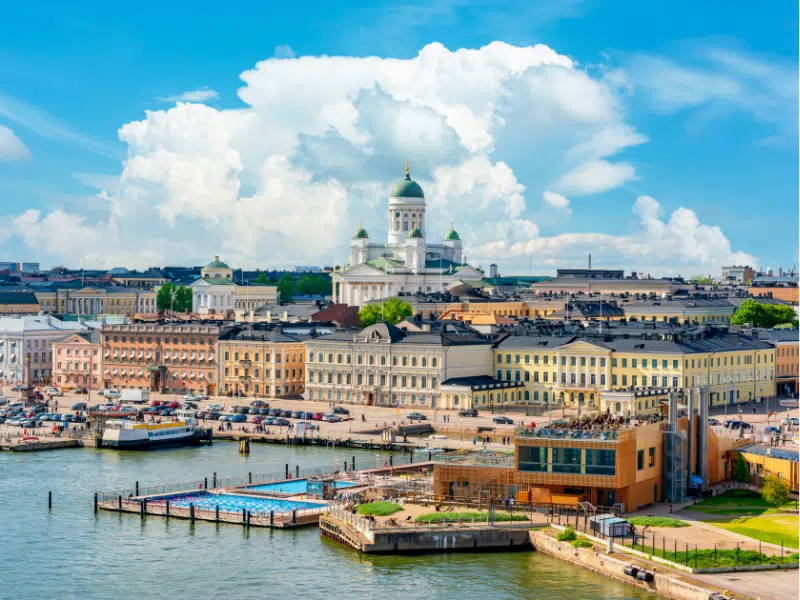
Helsinki is a young capital by European standards: a small Swedish trading town that a Russian tsar turned into a capital in 1812, and that became the heart of independent Finland after 1917. Its centre mixes neoclassical squares, granite Art Nouveau and modern design, always within sight of the sea. Here are the facts and stories that make it special.
10 fun facts about Helsinki
- Founded to rival Tallinn: King Gustav Vasa of Sweden founded Helsinki in 1550 as a trading town to compete with Tallinn, across the Gulf of Finland.
- A capital by imperial decree: after Finland passed from Sweden to Russia, Tsar Alexander I made Helsinki the capital of the Grand Duchy of Finland in 1812, in place of Turku.
- A centre drawn by one architect: Carl Ludvig Engel, from Berlin, designed the buildings around Senate Square, including the white Helsinki Cathedral. It was completed in 1852, twelve years after his death.
- A tsar in the middle of the square: the statue of Alexander II on Senate Square, unveiled in 1894, honours the tsar who reconvened the Finnish Diet in 1863 and is remembered in Finland as a reformer.
- Bricks from a ruined fortress: Uspenski Cathedral, completed in 1868, is said to be the largest Orthodox church in Western Europe. About 700,000 of its bricks came by barge from Bomarsund, a fortress on the Åland Islands demolished during the Crimean War.
- A sea fortress on the World Heritage List: Suomenlinna, built from 1748 on a group of islands off the harbour, was listed by UNESCO in 1991.
- A national stage in granite: the Finnish National Theatre, founded in 1872, moved into its National Romantic building by Onni Tarjanne in 1902. The statue of the writer Aleksis Kivi in front of it is by Wäinö Aaltonen and was unveiled in 1939.
- Finland's favourite paintings: the Ateneum art museum, founded in 1887, holds Hugo Simberg's The Wounded Angel from 1903 and Akseli Gallen-Kallela's Aino triptych from 1891, two of the best-loved works of Finnish art.
- A statue that gets a student cap: every year on the eve of Vappu, 30 April, students place a white student cap on Havis Amanda, Ville Vallgren's bronze sea nymph, unveiled at the Market Square in 1908.
- Sauna as heritage: Finnish sauna culture was added to UNESCO's list of Intangible Cultural Heritage in 2020, and Helsinki has public saunas by the sea where you can cool off in the Baltic.
How Helsinki became a capital
In 1808, during the war between Sweden and Russia, fire destroyed much of Helsinki's small wooden town. A year later Finland became an autonomous Grand Duchy under the Russian tsar, and in 1812 Alexander I made Helsinki its capital, partly because it was closer to St Petersburg than Turku and was guarded by the Suomenlinna fortress. Johan Albrecht Ehrenström drew up a new town plan, and from 1816 Carl Ludvig Engel filled it with stone buildings in the neoclassical style of St Petersburg: the Senate, the University and finally the cathedral. When Turku itself burned in 1827, the university moved to Helsinki too, and the small port became the country's political and intellectual centre.
Kauppatori, the Market Square
Helsinki's Market Square sits right on the South Harbour, between the Presidential Palace and the ferry piers. Stalls sell fresh fish, berries in summer and handicrafts, and tented cafés serve salmon soup and coffee. Next door, the Old Market Hall, opened in 1889, has food stalls and cafés under one roof, and the ferries to Suomenlinna leave from the square.
What to eat in Helsinki
- Lohikeitto: creamy salmon soup with potatoes, leeks and dill, the classic lunch at the market halls.
- Karjalanpiirakka: Karelian pies, thin rye crusts filled with rice porridge and topped with egg butter.
- Korvapuusti: cinnamon and cardamom buns, the standard partner for a Finnish coffee break.
- Muikut: small lake fish called vendace, fried until crisp and often sold at markets with garlic mayonnaise.
- Salmiakki: salty liquorice, an acquired taste that you'll find in every supermarket and kiosk.
Good to know before you go
- The Suomenlinna ferry is part of the city's public transport network, so a regular HSL ticket covers the crossing.
- Tallinn is about two hours away by ferry, which makes a day trip to Estonia easy.
- Daylight varies enormously: in midwinter it is light for only around six hours, while in June the sun barely sets.
- The steps of Helsinki Cathedral are a popular meeting place and give one of the best views over Senate Square.
Explore Helsinki with World City Trail
Our Helsinki scavenger hunt turns these sights into a game you play on your phone. The route links 11 stops and takes around three hours, with about 53 minutes of walking: the Finnish National Theatre, the Ateneum, Helsinki Cathedral and the Market Square.
At each stop you solve a puzzle and hear a short story, at your own pace. You can start whenever you like.
Play the Helsinki scavenger hunt →
Facts checked in October 2026.