
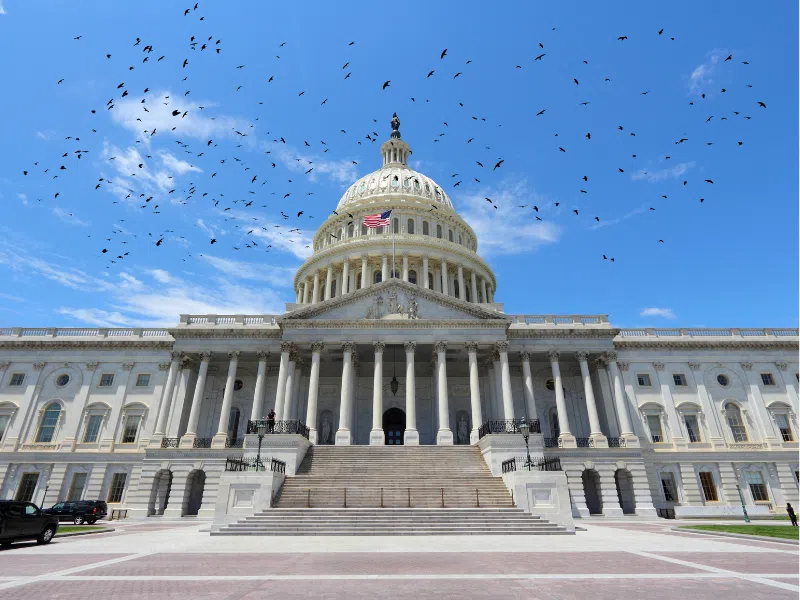
Washington, D.C. was planned from scratch to be a capital, and it shows: wide diagonal avenues, long views between monuments and a skyline kept low on purpose. Behind the white marble are stories of a burned White House, Japanese cherry trees and residents who could not vote for president until the 1960s.
10 fun facts about Washington, D.C.
- A capital that belongs to no state: the Residence Act of 1790 let George Washington choose a site on the Potomac, on land given up by Maryland and Virginia. Virginia's share, today's Arlington and Alexandria, was handed back in 1846.
- A city drawn on paper first: in 1791 the French-born engineer Pierre Charles L'Enfant planned broad diagonal avenues across a grid of streets. Many of them are named after US states.
- A monument in two shades: work on the Washington Monument began in 1848 but stopped for more than two decades. When it resumed, the marble came from a different quarry, so the stone changes colour about a quarter of the way up.
- Briefly the tallest structure on Earth: completed in 1884 at just over 555 feet, about 169 metres, it was the world's tallest structure until the Eiffel Tower of 1889.
- No skyscrapers, by law: the Height of Buildings Act of 1910 limits most buildings to the width of the street in front plus 20 feet. The idea that nothing may be taller than the Capitol is a myth.
- Freedom on top: the bronze Statue of Freedom was lifted onto the Capitol dome in December 1863, in the middle of the Civil War.
- Every president but one: John Adams moved into the unfinished White House in 1800, and every president since has lived there. George Washington chose the site but never lived in it.
- A library rebuilt from one man's books: after British troops burned the Capitol in 1814, Congress bought Thomas Jefferson's library of 6,487 books in 1815. Today the Library of Congress is one of the largest libraries in the world.
- Museums paid for by a stranger: the Smithsonian Institution was founded in 1846 with a bequest from the British scientist James Smithson, who never set foot in the United States. Most of its museums on the National Mall are free.
- A vote for president only since 1961: the 23rd Amendment gave D.C. residents a vote in presidential elections in 1961. The district still has no voting member of Congress, hence the protest slogan on its licence plates.
The day Washington burned
On 24 August 1814, during the War of 1812, British troops marched into Washington after routing American forces at Bladensburg, and set fire to the Capitol and the White House. Before they arrived, First Lady Dolley Madison insisted that the large portrait of George Washington in the dining room must be saved. Its frame was screwed to the wall, so it was broken and the canvas taken out by the household staff, as Paul Jennings, an enslaved man who worked there, later recalled. The next day a violent storm swept through the city, and the British soon left. The portrait still hangs in the White House.
The National Mall, explained
The National Mall is the long lawn running west from the Capitol, lined with museums and memorials. For much of the 19th century it was a patchwork of gardens, sheds and even a railway station, until the McMillan Plan of 1901 and 1902 cleared it. The Lincoln Memorial stands on former marsh, filled in during the late 1800s. In 1963 Martin Luther King Jr. gave his 'I Have a Dream' speech from its steps; the spot is engraved in the stone.
What to eat in Washington, D.C.
- Half-smoke: D.C.'s own smoky sausage, served in a bun with chili and onions. Ben's Chili Bowl on U Street has sold it since 1958.
- Mumbo sauce: a sweet, tangy red sauce from the city's carry-outs, poured over fried chicken wings and fries.
- Blue crab: crabs from the nearby Chesapeake Bay, steamed with Old Bay seasoning or made into crab cakes.
- Ethiopian food: the Washington area has one of the largest Ethiopian communities in the US. Try spicy stews with injera, a soft, sour flatbread.
- Senate bean soup: a simple navy bean and ham soup served in the Senate's restaurants every day for more than a century.
Good to know before you go
- Going up the Washington Monument requires a timed ticket. Book online in advance; same-day tickets are limited.
- The Smithsonian Castle, home to James Smithson's tomb, is under a long renovation and expected to stay closed into 2027. Check before you go.
- Cherry blossom season around the Tidal Basin usually peaks in late March or early April. The first trees were a gift from Tokyo in 1912.
- Arlington National Cemetery is just across the Potomac by Metro, and Mount Vernon, George Washington's estate, makes an easy half-day trip.
Explore Washington, D.C. with World City Trail
Our Washington, D.C. scavenger hunt turns these sights into a game you play on your phone. The route takes around three hours, with about 71 minutes of walking, and leads you through the main sights of the city centre.
At each stop you solve a puzzle and hear a short story, at your own pace. You can start whenever you like and play in English, German, French, Italian, Spanish or Portuguese.
Play the Washington, D.C. scavenger hunt →
Facts checked in October 2026.