
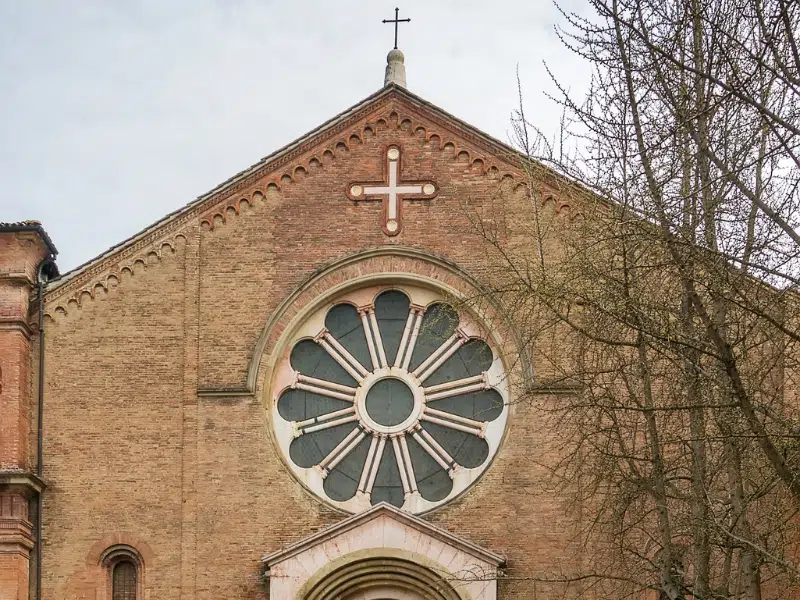
The Basilica of San Domenico is the church in Bologna where Saint Dominic, founder of the Dominican order, died in 1221 and is buried. His marble shrine, the Arca di San Domenico, was worked on by sculptors for almost five centuries, and three of its small statues were carved by Michelangelo when he was still a teenager.
San Domenico at a glance
- Where: on Piazza San Domenico, in the southern part of Bologna's historic centre, about ten minutes' walk from Piazza Maggiore.
- Built: from 1228, consecrated by Pope Innocent IV in 1251; bell tower 1313; interior remodelled in Baroque style between 1728 and 1732.
- By: the 18th-century interior is by the architect Carlo Francesco Dotti; the shrine was designed by Nicola Pisano.
- What it is today: a working Dominican basilica and convent, free to enter, with a small museum.
- Time needed: 30 to 45 minutes.
From a church in the vineyards to a Dominican prototype
Dominic arrived in Bologna in January 1218, drawn by its university and its energy. In 1219 his friars moved to the small church of San Nicolò delle Vigne, then on the edge of the city, and Dominic held the order's first two general chapters there. He died in the church on 6 August 1221 and was buried behind the altar. From 1228 the friars enlarged San Nicolò into a large basilica with a new convent, and the result became the model for Dominican churches across Europe.
For centuries the church was split in two: a part for the friars and a part for the faithful, separated by a wall that came down only in the early 17th century. Most side chapels were added in the 15th century. Between 1728 and 1732, with support from the Dominican pope Benedict XIII, Carlo Francesco Dotti gave the interior the bright Baroque look you see today. The brick facade, however, is still the Romanesque front of around 1240, restored in 1910.
What to look for
- The Arca di San Domenico: in the chapel of Saint Dominic on the right side of the nave. Nicola Pisano's workshop carved the reliefs of the saint's life from 1264, and Niccolò dell'Arca added the crowning canopy in the 15th century.
- Michelangelo's three statues: on the shrine, look for the kneeling angel holding a candlestick, Saint Petronius holding a model of Bologna, and Saint Proculus. Michelangelo carved them in 1494 and 1495, aged about 19.
- Guido Reni's ceiling: the half-dome above the shrine holds Reni's fresco of Saint Dominic in glory, painted between 1613 and 1615.
- The choir stalls: the inlaid wooden choir by Fra Damiano da Bergamo, from the 16th century, is one of the finest examples of Renaissance intarsia in Italy.
- The square: two columns stand on the pebbled piazza, one with a bronze Saint Dominic (1627) and one with the Madonna of the Rosary after a design by Guido Reni (1632), put up after a plague.
- The jurists' tombs: raised on columns in the square are the tombs of Rolandino de' Passeggeri (1305) and Egidio Foscarari (1289), law teachers of the medieval university.
The real face of Saint Dominic
In the chapel, a white marble bust by Carlo Pini, made in 1946, shows what is presented as the saint's real face. It was modelled from precise measurements of his skull, so you can compare it with the idealised Dominics painted all around it. Guido Reni, who painted the ceiling above, is himself buried in San Domenico, in the chapel of the Rosary.
Tips for your visit
- Visitors may be asked to wait during Mass, so avoid service times if you want to see the Arca up close.
- Use your phone's zoom or bring binoculars: Michelangelo's statues are small and sit high up on the shrine.
- Look at the square from the church steps first; the medieval tombs and the two columns are easy to miss if you go straight inside.
- Combine San Domenico with Piazza Santo Stefano, a short walk east.
Nearby
- Piazza Santo Stefano: a triangular square in front of the Seven Churches, a complex of linked medieval churches and cloisters; about ten minutes' walk.
- Archiginnasio: the 16th-century seat of the old university, with walls covered in student coats of arms and a wooden anatomical theatre.
- Piazza Maggiore: Bologna's main square, with the unfinished facade of San Petronio and the Fountain of Neptune just beyond.
- Two Towers: the leaning Asinelli and Garisenda towers, the symbol of the city.
See Bologna with World City Trail
Our Bologna scavenger hunt turns the old town into a game you play on your phone. The route links 10 stops and takes around 2 hours, with about 33 minutes of walking, and includes places such as the Two Towers and the Biblioteca Salaborsa.
If you prefer a different format, there is also a self-guided walking tour of Bologna and an outdoor escape game in the city.
Play the Bologna scavenger hunt →
Take the self-guided walking tour of Bologna →
Play the outdoor escape game in Bologna →
Facts checked in October 2026.