
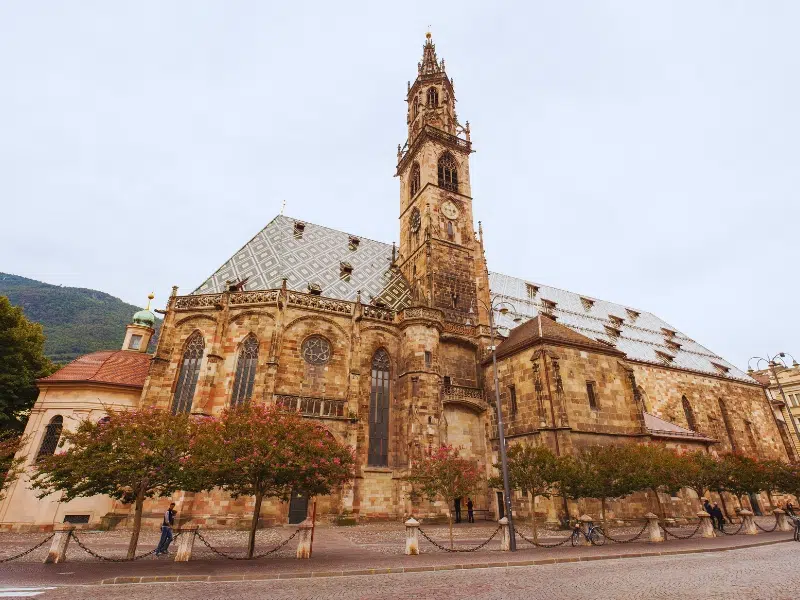
Bolzano Cathedral, the parish church of the Assumption of Mary, stands on the south side of Piazza Walther, the main square of Bolzano. You recognise it from far away by its roof of coloured glazed tiles and its 65-metre openwork spire. One of its side doors is named after wine: in 1387 the parish was allowed to sell wine right here at the church.
Bolzano Cathedral at a glance
- Where: Piazza della Parrocchia (Pfarrplatz), on the south side of Piazza Walther (Waltherplatz) at the edge of the old town.
- Built: a Romanesque church was consecrated here in 1180; the Gothic church you see was built from around 1300, and the bell tower between 1501 and about 1519.
- By: the tower was designed by Burkhard Engelberg of Augsburg and completed by Hans Lutz von Schussenried, who also carved the stone pulpit in 1514.
- What it is today: Bolzano's parish church and, since the bishop moved to Bolzano in 1964, the co-cathedral of the Diocese of Bolzano-Brixen, alongside Brixen Cathedral.
- Time needed: 20–30 minutes for the outside and the interior.
From Romanesque parish church to co-cathedral
People have prayed on this spot for a very long time: beneath the floor lie the remains of an early Christian basilica from around the 6th century. A Romanesque parish church was consecrated here in 1180. From around 1300 builders from Lombardy and Swabia rebuilt it as a Gothic hall church, with three naves of equal height, and work on the choir began in 1380. When the old bell tower burned in 1499, a new one was started in 1501. Hans Lutz von Schussenried finished it around 1519 (some sources say 1517), with a filigree stone spire that became the emblem of the town.
The Baroque period added the marble high altar (1710–1720) by Giambattista Ranghieri and, behind the choir, the Chapel of Grace (1743–1745). Allied air raids in 1943 and 1944 badly damaged the church: the roof, many frescoes, the stained-glass windows and the altarpiece were lost, and the pulpit was partly destroyed. The tower came through undamaged. The roof was rebuilt to its original pattern and the pulpit was pieced together again in 1949. When the diocese was reorganised in 1964 as Bolzano-Brixen, the bishop moved his residence to Bolzano and the church became a co-cathedral.
What to look for
- The roof: a pattern of coloured glazed tiles that shines in the sun. Some tiles came loose in December 2008, and the roof was restored by 2010.
- The spire: 65 metres of Gothic stonework, with a hexagonal upper section and an openwork top. Look for the small carved figures and gargoyles on the balustrades.
- The Wine Door (Leitacher Törl) on the side wall: a Gothic portal with a pointed arch and small statues under canopies. One of them is a farmer with a hoe and a pruning knife, a nod to the wine trade.
- The main portal: a Romanesque doorway flanked by two lions, closed by bronze doors made by Michael Defner in 1989.
- The pulpit: Hans Lutz carved it in sandstone in 1514, with reliefs of the four Fathers of the Church (Augustine, Jerome, Gregory and Ambrose) and the symbols of the Evangelists.
- The frescoes: surviving Gothic paintings include scenes from the life of St Christopher by Friedrich Pacher (1498) near the entrance and 14th-century frescoes by Italian painters in the nave.
The Madonna of the Marsh
In the Chapel of Grace behind the high altar stands a medieval marble statue of the Virgin nursing the Child, known as the Madonna of the Marsh. According to legend, it was found by a carter in the marshy ground near the town, and it has been an object of popular devotion ever since. Nearby in the choir hangs a painting of the Sacred Heart by Carl Henrici, venerated as a protector of Tyrol since the wars against Napoleon.
Tips for your visit
- Come on a sunny morning or late afternoon: the glazed roof only really shines in direct light. The best view of the spire is from the middle of Piazza Walther.
- This is a working church. Dress respectfully, and avoid walking around during Mass.
- In Advent, Piazza Walther hosts Bolzano's Christmas market, so the cathedral forms its backdrop; come early in the day if you want photos without the crowds.
Nearby
- Piazza Walther: Bolzano's main square, with the statue of the medieval poet Walther von der Vogelweide by Heinrich Natter (1889). It is right outside the cathedral.
- Dominican Church: a few minutes' walk west, known for the Chapel of St John and its 14th-century frescoes from the school of Giotto.
- Via dei Portici (Laubengasse): the arcaded medieval merchants' street of the old town, a short walk north, still lined with shops.
- South Tyrol Museum of Archaeology: the museum of Ötzi, the Iceman who lived about 5,300 years ago, on the far side of the old town.
See Bolzano with World City Trail
Our Bolzano scavenger hunt turns the old town into a game you play on your phone. The route links 10 stops and takes around 2 hours, with about 33 minutes of walking. Bolzano Cathedral is one of the stops, and so is the South Tyrol Museum of Archaeology with Ötzi.
If you prefer a different format, there is also a self-guided walking tour and an outdoor escape game in Bolzano.
Play the Bolzano scavenger hunt →
Take the self-guided walking tour of Bolzano →
Play the outdoor escape game in Bolzano →
Facts checked in October 2026.