
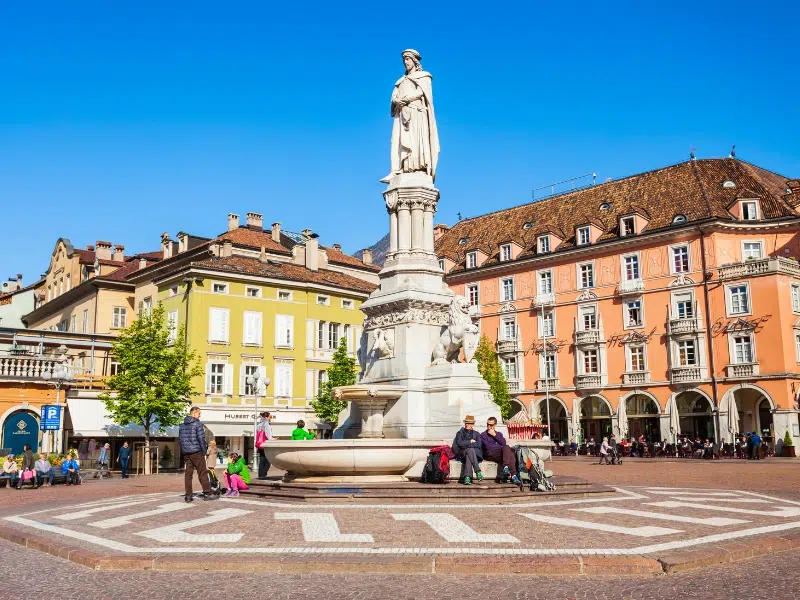
Piazza Walther (Waltherplatz) is the main square of Bolzano, a wide open space between the old town arcades and the Gothic cathedral. It is named after Walther von der Vogelweide, the greatest German-language lyric poet of the Middle Ages, whose white marble statue stands in the middle. Its history mirrors the city's own: in barely two centuries it changed its name four times and its statue was sent away for half a century.
Piazza Walther at a glance
- Where: in the centre of Bolzano, between the cathedral to the south and the old town with Via dei Portici to the north.
- Created: laid out in 1808, during the short period of Bavarian rule, as a square for the growing town.
- What it is today: Bolzano's main square and meeting point, with café terraces, hotels and, in winter, the city's well-known Christmas market.
- Time needed: 15 minutes to look around, longer with a coffee on one of the terraces.
Four names in a century and a half
When Napoleon's ally Bavaria ruled Tyrol, King Maximilian I Joseph had a new square laid out here in 1808 and named it Maximiliansplatz after himself. After the Habsburgs returned in 1814 it became Johannsplatz, after Archduke John of Austria. In 1889 the statue of Walther von der Vogelweide by the sculptor Heinrich Natter was unveiled, and in 1901 the square itself took the poet's name. The statue faces south, which many read as a German-speaking answer to the statue of Dante put up in Trento a few years later.
After South Tyrol became part of Italy, the Fascist authorities saw the statue as a symbol of German culture. In 1935 they removed it and renamed the square after King Victor Emmanuel III. The name Piazza Walther came back after the Second World War, but the statue only returned to the square in the 1980s. Many of the buildings around the square were damaged in the bombing raids of 1943–1945 and rebuilt afterwards, which is why the square mixes older façades with post-war ones.
What to look for
- The white marble statue of Walther von der Vogelweide by Heinrich Natter, with the poet holding a harp-like instrument and looking south.
- The cathedral's openwork Gothic spire and colourful glazed roof tiles, rising at the southern corner of the square.
- Palazzo Campofranco on the west side, an 18th-century building whose courtyard hosts part of the Christmas market and a summer bar.
- Hotel Città on the north side, built in 1913, with its café terrace looking across the square.
- The view north towards the Catinaccio (Rosengarten) mountains at the end of some of the streets on a clear day.
Who was Walther von der Vogelweide?
Walther lived around 1170 to 1230 and wrote love songs and political poems that are still read in German schools. Almost nothing certain is known about where he was born. A tradition long placed his birth in the area of Lajen (Laion) near Chiusa in South Tyrol, which is why Bolzano chose him for its main square, but most scholars now consider this unproven. He is buried, according to tradition, in Würzburg in Germany.
Tips for your visit
- Come in the morning when the light falls on the cathedral front and the terraces are quiet, or in the early evening for an aperitivo.
- From late November to early January the square fills with the Christmas market's wooden stalls; expect crowds at weekends.
- Use the square as your starting point: the cathedral, the arcades and the fruit market are all a few minutes away.
- Look at the statue from the south side, with the old town behind it, for the best photo.
Nearby
- Bolzano Cathedral: the Gothic church with its lace-like spire and patterned roof, right on the corner of the square.
- Via dei Portici (Laubengasse): the medieval arcaded shopping street, a couple of minutes north.
- Piazza delle Erbe: the fruit and vegetable market square with the Neptune fountain, at the west end of the arcades.
- South Tyrol Museum of Archaeology: home of Ötzi the Iceman, a short walk west of the old town.
See Bolzano with World City Trail
Our Bolzano scavenger hunt turns the old town into a game you play on your phone. The route links 10 stops and takes around two hours, with about 33 minutes of walking. It includes places such as Bolzano Cathedral and the South Tyrol Museum of Archaeology, home of Ötzi.
If you prefer a different format, Bolzano also has a self-guided walking tour and an outdoor escape game.
Play the Bolzano scavenger hunt →
Take the self-guided walking tour of Bolzano →
Play the outdoor escape game in Bolzano →
Facts checked in October 2026.