
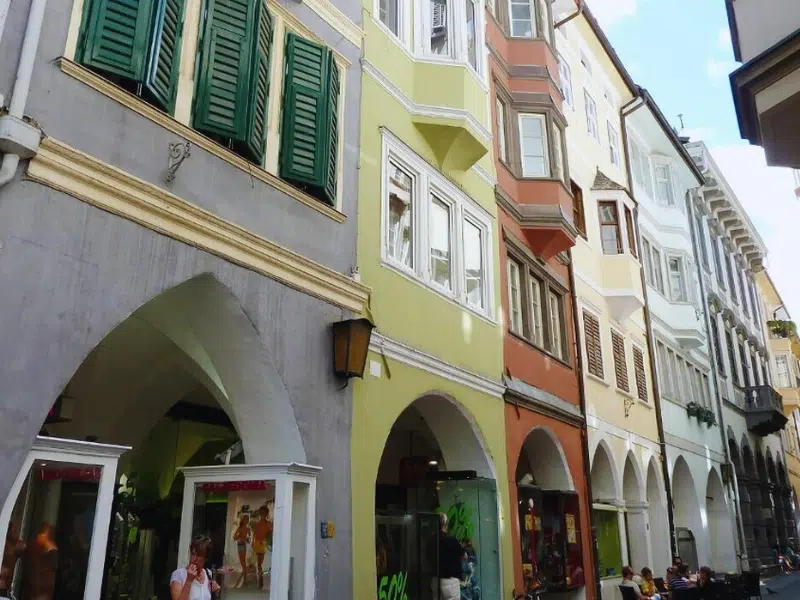
Via dei Portici, the Laubengasse in German, is Bolzano's arcaded main street, about 300 metres long, running through the old town from Piazza delle Erbe to Piazza del Municipio. It was laid out in the 12th century by the Prince-Bishops of Trento as a market street, and its narrow merchant houses, only about 4 metres wide, reach back as much as 50 metres from the arcades.
Via dei Portici at a glance
- Where: in the old town of Bolzano, between Piazza delle Erbe (the fruit market square) and Piazza del Municipio.
- Built: laid out in the 12th century, when the Prince-Bishops of Trento founded the market town around 1180.
- By: planned by the Prince-Bishops of Trento; the Mercantile Palace on the street was designed by the Veronese architect Francesco Perotti.
- What it is today: Bolzano's main shopping street, open at all times, with long-established family shops, chain stores, two historic pharmacies and cafés under the arches.
- Time needed: 20–30 minutes to walk it slowly, longer with shopping or the Mercantile Museum.
A trading street between north and south
Bolzano grew up where the routes over the Alps met, halfway between the German-speaking lands and Italy. Around 1180 the Prince-Bishops of Trento founded a planned market town here, and the arcaded street was its spine. The plots were cut very narrow and very deep: each Laubenhaus had a shop under the arches at the front, storage vaults behind it, and living quarters on the upper floors arranged around an inner light well. Goods came in at one end, were stored, sold and sent on, and merchants from both sides of the Alps met at Bolzano's fairs.
Those fairs made the town rich. In 1635 Archduchess Claudia de' Medici, then ruling Tyrol, granted Bolzano a mercantile tribunal that settled disputes between merchants from different cities quickly, during the fairs themselves. Its seat, the Mercantile Palace, was built between 1708 and 1727 to designs by Francesco Perotti, with its main entrance on Via Argentieri and a second one under the arcades. The palace later housed the Chamber of Commerce and today contains the Mercantile Museum, which tells the story of the fairs and the merchants who came to them.
What to look for
- The arches themselves: low, heavy vaults on both sides of the street, so you can walk its whole length under cover.
- The oriel windows (Erker) jutting out from the upper floors and the wrought-iron railings, typical of Tyrolean town houses.
- The depth of the houses: look through an open shop or passage and you can sometimes see how far back the building runs.
- The Old Town Hall on the street, with remains of 15th-century wall paintings by Conrad Waider on its façade.
- The Mercantile Palace at number 39, the stately Baroque building among the narrow medieval houses.
Two names for one street
Bolzano is a bilingual city, and almost every place has two official names: Bozen and Bolzano, Laubengasse and Via dei Portici, Obstplatz and Piazza delle Erbe. Most people in the city switch between German and Italian without thinking, and you will see both on every street sign. Many of the shops under the arcades have been run by the same families for generations, and two of the oldest businesses are pharmacies known in German as Madonna and Schwarzer Adler (Black Eagle).
Tips for your visit
- Come in the morning, when the fruit and vegetable stalls on Piazza delle Erbe are open at one end of the street.
- On a rainy day the arcades are the best place in town: you can shop and walk without an umbrella.
- Look up as well as into the shop windows: the oriels, painted façades and old house signs are easy to miss.
Nearby
- Piazza delle Erbe: Bolzano's open-air fruit and vegetable market, with a bronze Neptune fountain in the middle.
- Piazza Walther: the city's main square, named after the medieval poet Walther von der Vogelweide, whose statue stands in the middle.
- Bolzano Cathedral: the Gothic church with a patterned tiled roof and an openwork spire, a few minutes' walk away.
- South Tyrol Museum of Archaeology: the museum where Ötzi, the Iceman found in the Alps in 1991, is kept.
See Bolzano with World City Trail
Our Bolzano scavenger hunt turns the old town into a game you play on your phone. The route links 10 stops and takes around 2 hours, with about 33 minutes of walking. Via dei Portici is not one of the stops, but the route includes Bolzano Cathedral and the South Tyrol Museum of Archaeology, home of Ötzi.
If you prefer a different format, there is also a self-guided walking tour and an outdoor escape game in Bolzano.
Play the Bolzano scavenger hunt →
Take the self-guided walking tour of Bolzano →
Play the outdoor escape game in Bolzano →
Facts checked in October 2026.