
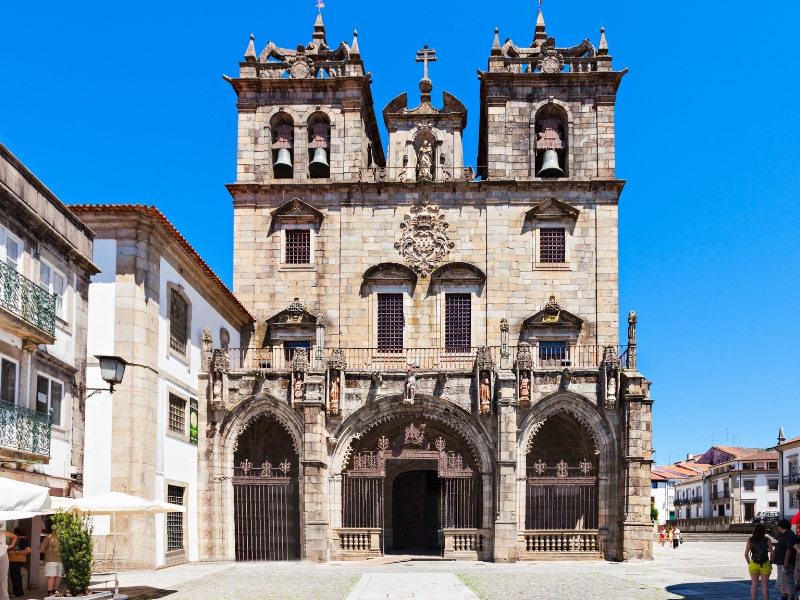
Braga Cathedral, the Sé de Braga, is the oldest cathedral in Portugal: building began in the late 11th century and the church was consecrated in 1089, decades before Portugal became a kingdom. It stands in the middle of Braga's old town, a patchwork of Romanesque, Gothic, Manueline and Baroque work. Inside lie the parents of Portugal's first king, and two gilded 18th-century organs face each other high above the nave.
Braga Cathedral at a glance
- Where: in the old town of Braga, a few minutes' walk west of Praça da República.
- Built: from the late 11th century under Bishop Pedro, on the remains of an earlier church; consecrated on 28 August 1089, with major additions up to the 18th century.
- What it is today: the cathedral of the Archdiocese of Braga, still in use for worship and the home of its own ancient liturgy, the Rite of Braga, with chapels and a Treasury Museum open to visitors.
- Time needed: 20 minutes for the church; 1–1.5 hours with the chapels, the upper choir and the Treasury Museum.
Older than the kingdom
Braga was already an important city in Roman times, as Bracara Augusta, and the seat of a bishop long before the cathedral you see. When the diocese was restored after the Reconquista, Bishop Pedro began a new Romanesque cathedral on the site of an older church, and consecrated it in 1089. Portugal did not yet exist as a kingdom: the County of Portugal was ruled by Henry of Burgundy and his wife Teresa of León, and it was their son, Afonso Henriques, who became the first King of Portugal in the 12th century. Henry and Teresa are buried in the cathedral, in the Chapel of the Kings.
Over the next centuries every age added something. Gothic chapels were built in the 14th and 15th centuries, among them the Chapel of Glory with the tomb of Archbishop Gonçalo Pereira. A Gothic porch, the Galilee, was added at the main entrance in the late 15th century, and in the early 16th century Archbishop Diogo de Sousa had the chancel rebuilt in the Manueline style. The 18th century brought Baroque gilded woodwork and the two great organs. The result is not a single style but a building you read like a timeline, which is why the Portuguese say of anything ancient that it is 'mais velho que a Sé de Braga', older than Braga Cathedral.
What to look for
- The two organs: facing each other across the nave in the upper choir, the Gospel-side organ dates from 1737 and the Epistle-side organ from 1739, both in richly carved and gilded cases.
- The Chapel of the Kings: the tombs of Henry of Burgundy and Teresa of León, parents of Afonso Henriques, Portugal's first king.
- The Chapel of Glory: a Gothic chapel with the tomb of Archbishop Gonçalo Pereira, whose carved effigy lies on the tomb.
- The tomb of Infante Afonso, a son of King João I and Philippa of Lancaster.
- Our Lady of the Milk (Nossa Senhora do Leite): outside, at the east end, a Renaissance statue of the Virgin nursing the Child under a stone canopy.
- The Treasury Museum: sacred art of the archdiocese, including the cross that, according to tradition, was used at the first Mass celebrated in Brazil in 1500 by Pedro Álvares Cabral's expedition.
The Primate of the Spains
Braga is often called the 'Portuguese Rome' for its many churches, and its archbishop still holds the old title of Primate of the Spains, a claim to precedence over the other bishops of the Iberian Peninsula that goes back to the Middle Ages and was long disputed with Toledo. The cathedral also kept its own form of the Latin Mass, the Rite of Braga, which survived the reforms that standardised Catholic liturgy elsewhere and is still used on special occasions.
Tips for your visit
- The organs are best seen from the upper choir, which you reach on the visit to the chapels and museum; it is worth the extra time.
- Walk around the outside to the east end to find Our Lady of the Milk; most visitors leave through the main door and miss it.
- It is a working cathedral: dress modestly and avoid wandering during Mass. During Holy Week, Braga's biggest festival, the cathedral is at the centre of processions and very busy.
Nearby
- Praça da República: Braga's main square with its fountain and the arcades of the old cafés, a few minutes' walk east.
- Jardim de Santa Bárbara: a small formal flower garden beside the medieval wing of the Archbishop's Palace, a few minutes' walk away.
- Arco da Porta Nova: the 18th-century ceremonial gate on the west side of the old town, a short walk away.
- Palácio dos Biscainhos: a Baroque noble house turned museum, with painted ceilings and formal gardens, a short walk west.
See Braga with World City Trail
Our Braga scavenger hunt turns the old town into a game you play on your phone. The route links 10 stops and takes around 2 hours, with about 23 minutes of walking. Its stops include the fountain in Praça da República and the historic Café A Brasileira. You can play in English, German, French, Italian, Spanish and Portuguese.
If you prefer a different format, there is also a self-guided walking tour and an outdoor escape game in Braga.
Play the Braga scavenger hunt →
Take the self-guided walking tour of Braga →
Play the outdoor escape game in Braga →
Facts checked in October 2026.