
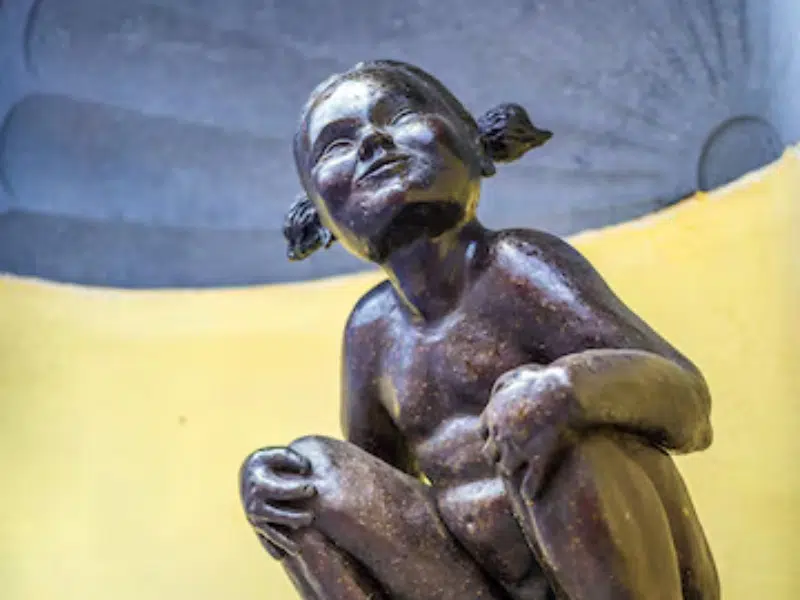
Jeanneke Pis is a small fountain statue of a girl squatting to pee, tucked away at the end of a narrow dead-end alley off Rue des Bouchers, a couple of minutes from the Grand-Place in Brussels. She was made in 1985 as a female counterpart to the city's famous Manneken Pis and sits behind iron railings. The odd detail: the alley she lives in is called Impasse de la Fidélité, Fidelity Alley.
Jeanneke Pis at a glance
- Where: Impasse de la Fidélité (Getrouwheidsgang in Dutch), a dead-end alley off Rue des Bouchers in the Îlot Sacré quarter, north of the Grand-Place.
- Created: 1985; put up in the alley in 1987.
- By: Denis-Adrien Debouvrie, a local restaurant owner who came up with the idea and commissioned the statue.
- What it is today: a small working fountain behind railings and one of the city's three peeing statues, along with Manneken Pis and the dog Zinneke Pis.
- Time needed: 5–10 minutes, longer if you stop for a beer in the alley.
A little sister for Manneken Pis
Brussels has had a peeing boy for centuries. The bronze Manneken Pis on the corner of Rue de l'Étuve and Rue du Chêne was made in 1619 by the sculptor Jérôme Duquesnoy the Elder, replacing an older figure, and over time he turned into the city's mascot, with hundreds of costumes and a place in every souvenir shop. The statue on the corner today is a copy; the original is kept in the Brussels City Museum on the Grand-Place.
In 1985 Denis-Adrien Debouvrie, who owned restaurants in the area, came up with a girl to keep him company and had a sculptor make her; in 1987 she was set up at the end of Impasse de la Fidélité. Jeanneke is a Brussels diminutive of Jeanne, just as Manneken means 'little man'. She is much younger and far less famous than her brother, and she is not to everyone's taste, but she draws a steady stream of visitors who come to see whether she really exists. In 1998 the family grew again with Zinneke Pis, Tom Frantzen's bronze dog lifting its leg against a bollard.
What to look for
- The figure itself: a little girl with short pigtails, squatting with a grin on her face while water runs into the basin below.
- The iron railings around her niche, which keep visitors at arm's length. Coins thrown into the basin are collected for charity.
- The street sign at the entrance of the alley: Impasse de la Fidélité in French and Getrouwheidsgang in Dutch, as every street name in Brussels is bilingual.
- Delirium Café, the beer bar in the same alley with its pink elephant sign, known for a beer list running into the thousands.
Three statues, three stories
Manneken Pis comes with several legends, none of them proven. One says a small boy saved the city by peeing on the burning fuse of a bomb; another that a nobleman lost his son and found him peeing in this spot, and had the statue made in gratitude. Today the boy is regularly dressed in costumes sent from around the world, more than a thousand of which are kept in a small museum, the GardeRobe MannekenPis. Jeanneke has no old legend: she is a modern joke that Brussels adopted, although tossing a coin into her basin has become a pledge of fidelity, in keeping with the alley's name. Zinneke, the dog, takes his name from the Brussels word for a mongrel, which locals also use for themselves.
Tips for your visit
- Come in daylight or early evening. Late at night the alley fills with people heading to the bars and it can be hard to get near the railings.
- Photograph her through the bars from close up; from the alley entrance she is too small to see.
- Rue des Bouchers is lined with restaurants whose staff try to wave you in. Look at the menu before you sit down and decide in your own time.
- Make a small circuit of all three statues: Jeanneke, Manneken Pis south of the Grand-Place and Zinneke Pis near the Bourse.
Nearby
- Grand-Place: the city's main square with its guild houses and Town Hall, a couple of minutes' walk away.
- Royal Saint-Hubert Galleries: the glass-roofed shopping arcades of 1847, just across Rue des Bouchers, with chocolate shops and cafés.
- Toone Theatre: a traditional puppet theatre in an alley off Petite Rue des Bouchers, with shows often performed in the Brussels dialect.
- Manneken Pis: the bronze boy on the corner of Rue de l'Étuve and Rue du Chêne, a short walk south past the Grand-Place.
See Brussels with World City Trail
Our Brussels scavenger hunt turns the old town into a game you play on your phone. The route links 10 stops and takes around 3 hours, with about 60 minutes of walking. It includes the Grand Place, the Manneken Pis and the Cathedral of St Michael and St Gudula.
If you prefer a different format, there is also a self-guided walking tour and an outdoor escape game in Brussels.
Play the Brussels scavenger hunt →
Take the self-guided walking tour of Brussels →
Play the outdoor escape game in Brussels →
Facts checked in October 2026.