
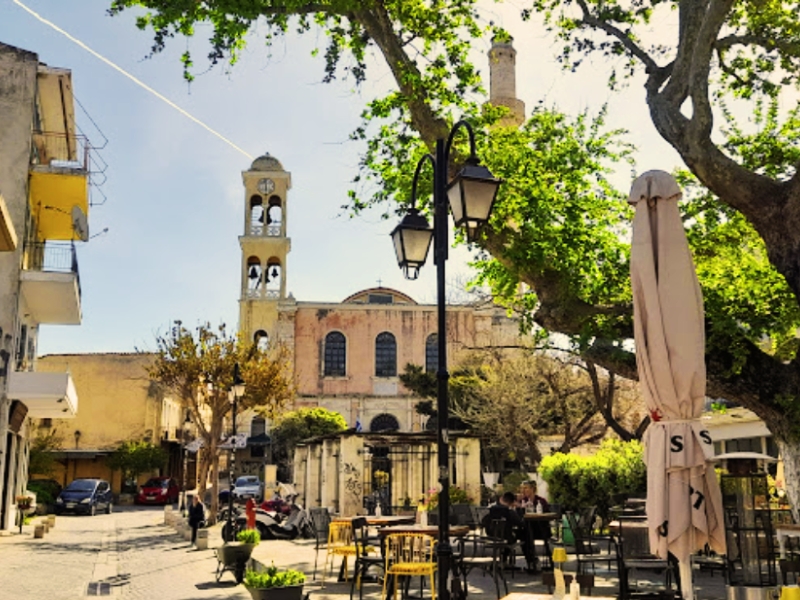
Agios Nikolaos (St Nicholas) is the large church on Splantzia Square in the eastern part of Chania's Old Town. Dominican friars built it around 1320, the Ottomans turned it into the city's main mosque, and in 1918 it became a Greek Orthodox church. It is often described as the only church in Greece with both a minaret and a bell tower.
Agios Nikolaos at a glance
- Where: Splantzia Square, also known as 1821 Square, in the Splantzia quarter in the east of the Old Town, a few minutes' walk from the Venetian harbour.
- Built: around 1320 as the church of a Dominican monastery; converted into a mosque after 1645; consecrated as an Orthodox church in 1918.
- What it is today: a working Greek Orthodox church dedicated to St Nicholas, the patron saint of sailors.
- Time needed: 15–20 minutes, plus time for a coffee under the plane tree on the square.
From Dominican friary to the Sultan's mosque
Chania was ruled by Venice for more than four centuries, and around 1320 Dominican friars from Candia, today's Heraklion, built a large monastery here. Its church was a basilica with a single central nave and a tall bell tower, with a two-storey arcade and the monks' cells on the north side. After the Ottomans captured Chania in 1645, the church became the city's main mosque. It was named in honour of Sultan Ibrahim and known as the Hünkar Mosque, the Sovereign's Mosque. A minaret was built against the south-west corner, and a mihrab and a minbar were added inside.
Under Ottoman rule Splantzia was the Turkish quarter of the town, and the square in front of the mosque had a fountain for ritual washing. Crete became part of Greece in 1913, and in 1918 the Orthodox community of Chania took over the building and dedicated it to St Nicholas. A semicircular apse was added on the east side, as Orthodox churches require. The original Venetian bell tower had not survived, so a new one was built, and the minaret lost its conical top. The Muslim population left Crete in the Greek-Turkish population exchange of 1923.
What to look for
- The minaret: tall and slender, with two circular balconies rather than the usual one. The pointed cap that once topped it is gone.
- The bell tower on the opposite side of the church. Find a spot on the square where you can see it and the minaret together.
- The long, high nave of the Venetian basilica, and the rounded Orthodox apse added on the east end after 1918.
- Inside, if it is open: Orthodox icons and an iconostasis in a building that still shows its Gothic and Ottoman past.
- The old plane tree in the middle of the square and the memorial plaque beneath it. On 19 May 1821, at the start of the Greek War of Independence, Melchisedek Despotakis, Bishop of Kissamos, was hanged here by the Ottoman authorities.
The legend of the dervish's sword
According to legend, when the Ottomans took the city in 1645, a dervish who had been the first to enter Chania climbed the old bell tower with a sacred sword and turned it towards the four horizons, calling the faithful to prayer. The sword was kept in the mosque for almost three centuries, and the story goes that the departing Muslim community took it with them in 1923.
Tips for your visit
- Come in the late afternoon or early evening, when the cafés around the square fill with locals and the light softens on the stone.
- If you go inside, dress modestly with shoulders and knees covered, keep your voice down and avoid photos during services.
- Step back to the far side of the square to fit the minaret and the bell tower into one photo, then explore the quiet lanes of Splantzia around it.
Nearby
- The Venetian harbour: a few minutes' walk north-west, with its lighthouse and the domed Mosque of the Janissaries on the waterfront.
- The Venetian shipyards (Neoria): the great vaulted boat sheds on the eastern side of the harbour, built under Venetian rule in the 15th and 16th centuries.
- San Rocco: a small Venetian church close to the square, dedicated to the saint believed to protect people from the plague.
- Kastelli Hill: the oldest part of Chania, between Splantzia and the harbour, where excavations have uncovered remains from the Minoan period.
See Chania with World City Trail
Our Chania scavenger hunt turns the old town into a game you play on your phone. The route links 10 stops and takes around 2 hours, with about 42 minutes of walking. It takes you through the alleys of the Old Town and along the Venetian harbour. You can play in English, German, French, Italian, Dutch and Greek.
If you prefer a different format, there is also a self-guided walking tour and an outdoor escape game in Chania.
Play the Chania scavenger hunt →
Take the self-guided walking tour of Chania →
Play the outdoor escape game in Chania →
Facts checked in October 2026.