
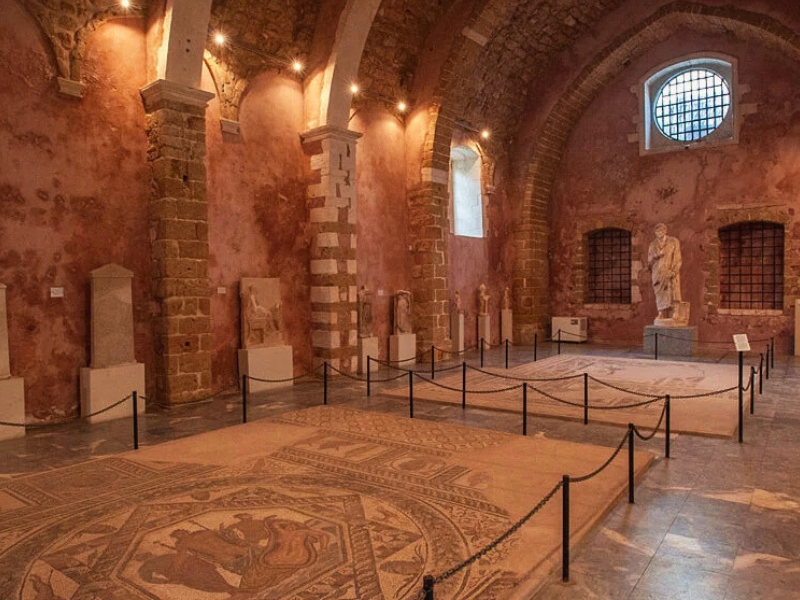
For almost sixty years the Archaeological Museum of Chania filled the nave of a Venetian church: Agios Frangiskos, the church of the Franciscan monastery on Chalidon Street, a few steps from the old harbour. The collection moved to a new building in the Chalepa district in 2022, but the old church is still there, one of the largest Venetian buildings in the old town, with a history that runs from friars to an Ottoman mosque, a cinema and an army storehouse.
The old Archaeological Museum at a glance
- Where: Chalidon Street, in the old town of Chania, a short walk up from the Venetian harbour.
- Built: by the Franciscans in the Venetian period, probably in the 14th century; the exact date is unknown.
- What it is today: the former museum building, no longer regularly open to visitors; the collection is now in the new Archaeological Museum of Chania in Chalepa.
- Museum years: from the early 1960s until it closed in 2020; the new museum opened in April 2022.
- Time needed: 5 to 10 minutes from outside; allow one to two hours for the new museum.
From Franciscan church to museum
The Franciscans built their monastery in Chania while Crete was ruled by Venice. Its church was the largest in the city, and records show it was already standing when a strong earthquake struck in 1595. Little of the original medieval church survives, but later rebuildings in the Venetian period added late Gothic elements, chapels along the north side and an extended east end. The friars' cloister on the south side has long since disappeared into the houses and shops around it.
After the Ottomans took Chania in 1645, the church became a mosque named after Yusuf Pasha, the commander of the conquest, and a fountain was built in its courtyard. In the 20th century the building had several very different lives: it housed a cinema, and after the Second World War the army used it as a storehouse. In the early 1960s it was turned into the Archaeological Museum, and for decades visitors walked between Minoan pottery, Roman mosaics and sculptures under its long roof. In 2020 the museum closed here, and in April 2022 the collection reopened in a large new building in Chalepa.
What to look for
- The long stone flank of the church along Chalidon Street, which shows how big the Franciscan church was compared with the houses around it.
- The base of the old bell tower on the east side, one of the few surviving pieces of the original medieval building.
- The Ottoman fountain in the former garden, a reminder of the building's years as a mosque, if the gate is open.
- The houses and shops on the south side, built over the area of the monks' former cloister.
- In the new museum at Chalepa, the pieces that once stood here: the Roman floor mosaic of Dionysus and Ariadne, a bust of Emperor Hadrian found at the Diktynnaion sanctuary, and a Late Minoan sarcophagus from Armeni.
Five lives of one building
Few buildings in Chania have changed role as often as Agios Frangiskos. In the space of about seven centuries it has been a Catholic church, an Ottoman mosque, a cinema, a military storehouse and a museum. Plans have been discussed to give it a new cultural use now that the archaeological collection has moved, so its next chapter is still open. Check locally before you go to see whether the building is hosting an exhibition or event.
Tips for your visit
- See the building from outside in the morning, when Chalidon Street is still quiet and the light falls along the stone wall.
- If you want to see the archaeological finds, plan a separate trip to the new museum in Chalepa, a short taxi or bus ride from the old town.
- Combine Chalidon Street with the Venetian harbour at its northern end and the lanes of the old town behind it.
- Look up the building's current status before your visit, as opening for exhibitions or events is irregular.
Nearby
- Venetian harbour: the curved old port with its lighthouse, cafés and evening promenade, a short walk downhill.
- Mosque of Küçük Hasan: the domed Ottoman mosque on the harbour front, now used for exhibitions.
- Cathedral of the Three Martyrs: Chania's Orthodox cathedral on a small square off Chalidon Street, a couple of minutes' walk.
- Firkas fortress and the Maritime Museum: the Venetian bastion at the western end of the harbour, a few minutes' walk.
See Chania with World City Trail
Our Chania scavenger hunt turns the old town into a game you play on your phone. The route links 10 stops and takes around 2 hours, with about 42 minutes of walking. It takes you through the alleys of the old town and along the Venetian harbour, and at each stop you solve a puzzle and hear a story about the city. You can play in English, German, French, Italian, Dutch or Greek.
If you prefer a different format, there is also a self-guided walking tour of Chania and an outdoor escape game.
Play the Chania scavenger hunt →
Take the self-guided walking tour of Chania →
Play the outdoor escape game in Chania →
Facts checked in October 2026.