
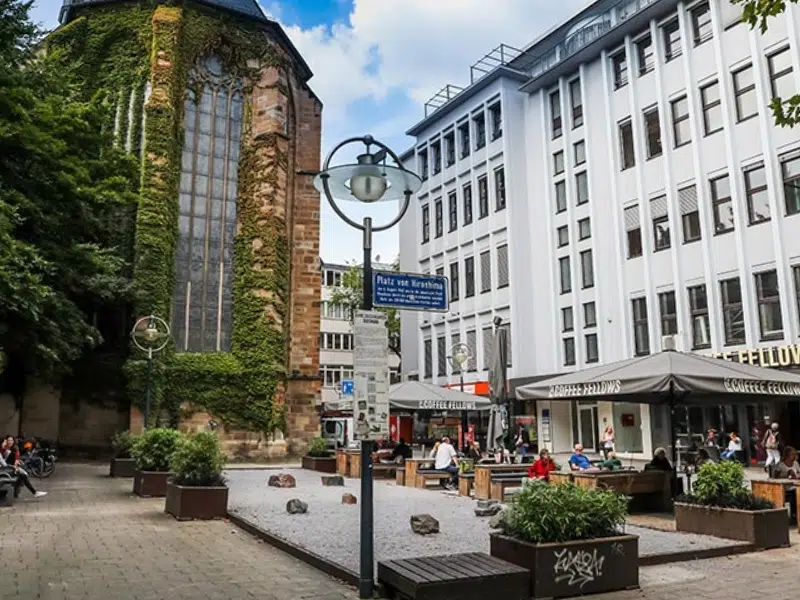
Platz von Hiroshima is a small, quiet square beside the Propsteikirche in Dortmund's city centre, a few steps from the shopping crowds of the Westenhellweg. At its centre sits Mutter Hiroshima (Mother Hiroshima), a bronze of a seated woman holding a dead child on her lap, made by the Dortmund sculptor Anselm Treese in 1958. The square is named after the Japanese city destroyed by an atomic bomb on 6 August 1945, and it is where Dortmund gathers to remember that day.
Platz von Hiroshima at a glance
- Where: beside the Propsteikirche (St John the Baptist), the Catholic church in Dortmund's city centre, just off the Westenhellweg shopping street.
- Created: the sculpture in 1958; it has stood on this spot since 1999, and the square was given its name soon afterwards.
- By: Anselm Treese (1930–2004), a sculptor from Dortmund.
- What it is today: a small memorial square dedicated to peace, and the setting for the city's Hiroshima Day commemoration on 6 August.
- Time needed: 10 to 15 minutes, longer if you also go inside the church.
From a 1958 bronze to a square for peace
Anselm Treese was born in 1930 and lived and worked in Dortmund-Loh, on the southern side of the city. He made Mutter Hiroshima in 1958, thirteen years after the bombing. It was the year West Germany saw large protests against plans to equip its new army with nuclear weapons, and the danger of the bomb was a subject few could ignore. Treese borrowed an old image from European art, the mother holding her dead son known from the Pietà, and gave it to an ordinary woman in a city on the other side of the world.
The bronze was moved to its present place beside the Propsteikirche in 1999, and the space around it was named Platz von Hiroshima soon afterwards. In 2010, when the Ruhr was European Capital of Culture, trainees from the city administration laid out a small Zen-style garden on the square as part of a local volunteering week. On 6 August the square becomes the meeting point for Dortmund's Hiroshima Day commemoration. In 2025, for the 80th anniversary, it was organised by the German-Japanese Society of Dortmund and the local group of IPPNW, the international physicians' organisation against nuclear war, in memory of the victims of Hiroshima and Nagasaki and the survivors, the hibakusha.
What to look for
- The pose of the figure: the woman sits with the child lying across her lap, a composition that recalls the Pietà in Christian art. Walk round it and look at it from the side as well as from the front.
- The garden: the small Zen-style garden added in 2010 is a deliberate nod to Japan, and it gives the square a calm that the surrounding streets lack.
- The Propsteikirche behind it: the Gothic church was begun in 1331 for Dominican friars and is today the only Catholic church in the city centre.
- The contrast with the street: the memorial lies only a few steps from the city's main shopping street, so you move from noise to near silence within a minute.
Why a Pietà for Hiroshima?
The sculpture shows no ruins and no mushroom cloud, only one woman and one child. That choice makes the memorial personal rather than technical: it is about loss, not about the weapon. Standing next to a medieval church whose high altar tells the story of the Passion and the Crucifixion, it invites you to compare two kinds of mourning that are centuries apart.
Tips for your visit
- Come in the morning or early evening, when the city centre is calmer and the square is quiet enough to stop for a moment.
- This is a memorial: keep your voice low, and don't climb on or lean against the sculpture.
- Step inside the Propsteikirche to see its late-Gothic high altar by Derick Baegert. The left panel shows, in the background, the oldest known depiction of Dortmund.
- If you are in Dortmund around 6 August, check whether a Hiroshima Day commemoration is planned on the square.
Nearby
- Westenhellweg: Dortmund's main shopping street begins right on the square's doorstep, if you want to combine the visit with a stroll through the centre.
- St Reinold's Church (Reinoldikirche): the city's main Protestant church, named after Dortmund's patron saint, a short walk east.
- St Mary's Church (Marienkirche): opposite St Reinold's, with Romanesque parts going back to the 12th century and fine medieval altarpieces.
- Dortmund U: the former brewery building crowned with a giant golden U, now a centre for art and creativity, a short walk west.
See Dortmund with World City Trail
Our Dortmund scavenger hunt turns the city centre into a game you play on your phone. The route links 10 stops and takes around 2 hours, with about 42 minutes of walking. Platz von Hiroshima and its Mother Hiroshima sculpture are one of the stops, along with the Dortmund U, the German Football Museum, St Reinold's Church and the Altes Stadthaus.
If you prefer a different format, there is also a self-guided walking tour and an outdoor escape game in Dortmund.
Play the Dortmund scavenger hunt →
Take the self-guided walking tour of Dortmund →
Play the outdoor escape game in Dortmund →
Facts checked in October 2026.