
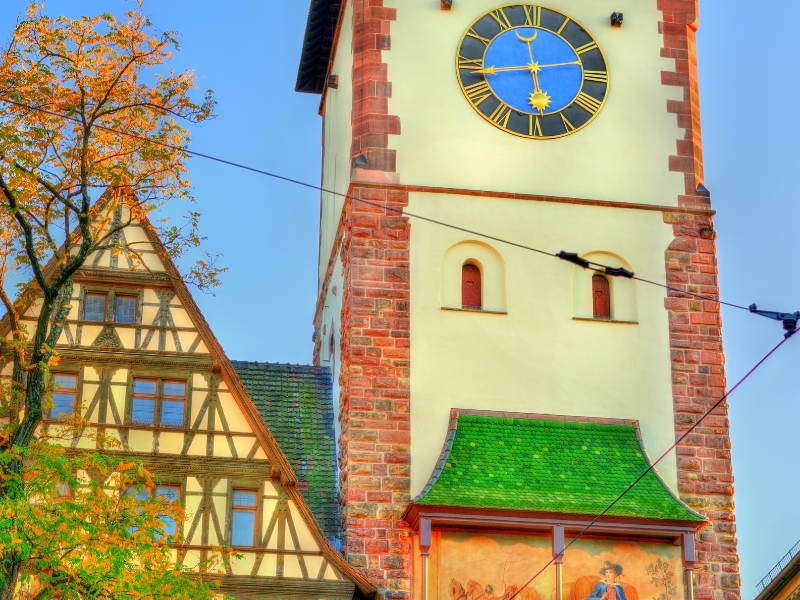
The Schwabentor (Swabian Gate) is one of the two medieval city gates still standing in Freiburg im Breisgau, at the eastern edge of the old town where Salzstraße ends below the Schlossberg. It was built around 1250 for traffic coming from Swabia and the east, and trams still run through it today. Look for a painted dragon-slayer, a tiny Romanesque thorn-puller and a legend about barrels of sand.
The Schwabentor at a glance
- Where: at the east end of Salzstraße, beyond the little square of Oberlinden, at the foot of the Schlossberg.
- Built: around 1250, when it was called the Obertor (upper gate); raised around 1900 and simplified again in 1954.
- By: the original builders are not known; the rebuild around 1900 was designed by the architect Carl Schäfer.
- What it is today: a working city gate with a tram line through it, and a small tin-figure museum, the Zinnfigurenklause, in the rooms upstairs.
- Time needed: 10–15 minutes outside, about an hour if you visit the museum.
From the upper gate to the Swabian Gate
The gate was part of the wall that enclosed the young town in the 13th century. In the Middle Ages it was called the Obertor, the upper gate, and it guarded the road that ran east along the Dreisam valley towards Swabia. Salt from Swabia came in this way and was sold on Salzstraße, the street that still leads from the gate into town. It was first open on the town side; a stone wall closed it in 1547. On Easter Monday 1848, revolutionary volunteers from Baden were defeated near the gate by government troops.
For more than three centuries the tower hardly changed. Around 1900 the architect Carl Schäfer almost doubled its height, taking north German town towers as his model, and in 1903 the painter Fritz Geiges added St George, Freiburg's patron saint, to the outer face. Annexes in a historical style followed by 1913, including a side passage for trams. In 1954 part of the rebuild was reversed: the tower received a simpler pyramid roof, closer to the original, and a small bell turret with an onion dome. Since 1969 the upper rooms have held the Zinnfigurenklause, where nearly 10,000 tin figures, cast and painted by volunteers, fill 21 scenes from the history and legends of Baden.
What to look for
- St George and the dragon: the large painting on the outer side, facing away from the old town, shows the patron saint killing the dragon.
- The thorn-puller: above the inner arch sits a small Romanesque relief of a boy with an oversized head pulling a thorn from his foot. It is usually read as a warning about sin.
- The merchant and his cart: on the town side, a painted merchant with a wagon, a motif that has decorated the gate for centuries and that people connect with the legend below.
- The onion dome: look up for the bell turret added in 1954 on top of the tall upper storeys from around 1900.
- The tram: a Freiburg tram line passes through the gateway on its way out of the old town, so you may catch a modern tram framed by a 13th-century arch.
The legend of the Swabian and his barrels
The name most likely comes from the road to Swabia, but a legend that grew up in the 19th century tells it differently. A rich Swabian merchant, the story goes, liked Freiburg so much that he decided to buy the whole town, and arrived with two barrels of gold. When he opened them in front of the townspeople, they held only sand and pebbles: his thrifty wife had swapped the contents before he set off, to stop him wasting their money on a town. The people of Freiburg laughed at him, and the gate he came through kept his name. It is a good story, but only a story.
Tips for your visit
- Walk through the gate both ways: the thorn-puller and the merchant are on the town side, St George is on the outside.
- Traffic still uses the gate and its side passage, including trams, bikes and delivery vans, so take your photos from the pavement.
- The tin-figure museum is reached by a spiral staircase of about 50 steps, is not step-free and opens only in the warmer months, as the rooms are unheated.
- The Schlossberg rises right behind the gate. From its paths and viewpoints you look down on the Schwabentor, the old town roofs and the Minster.
Nearby
- Oberlinden: the small square just inside the gate, with a fountain and the inn Zum Roten Bären, often described as one of the oldest inns in Germany.
- Augustinermuseum: a former Augustinian monastery on Salzstraße, a few minutes' walk away, with medieval sculpture and painting from the Upper Rhine.
- Freiburg Minster: the red sandstone Gothic church on Münsterplatz, with its openwork spire, a short walk west through the old town.
- Martinstor: Freiburg's other surviving medieval gate, on Kaiser-Joseph-Straße at the other side of the old town.
See Freiburg with World City Trail
Our Freiburg scavenger hunt turns the old town into a game you play on your phone. The route links 10 stops and takes around 2 hours, with about 24 minutes of walking. The Schwabentor is one of the stops, along with Freiburg Minster and the Old Town Hall.
If you prefer a different format, there is also a self-guided walking tour and an outdoor escape game in Freiburg.
Play the Freiburg scavenger hunt →
Take the self-guided walking tour of Freiburg →
Play the outdoor escape game in Freiburg →
Facts checked in October 2026.