
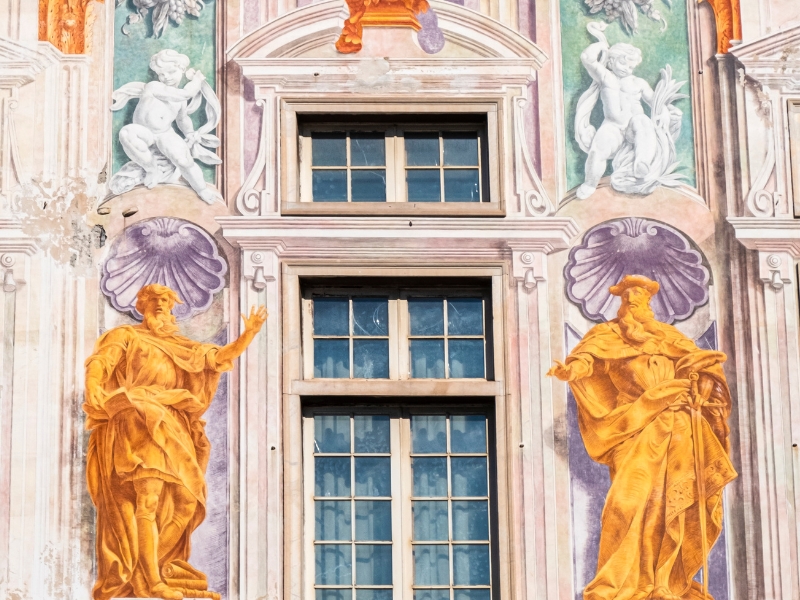
Palazzo San Giorgio is the palace on the old harbour of Genoa with a huge painted St George slaying the dragon on its sea front. Built in the 1260s as the first town hall, it later became the seat of the Bank of St George, one of the oldest banks in Europe, which for centuries ran the Republic's debt and even governed Corsica. Tradition says Marco Polo was held prisoner here and dictated his travels in its rooms.
Palazzo San Giorgio at a glance
- Where: Via della Mercanzia, between Piazza Caricamento and Piazza Cavour, facing the Porto Antico.
- Built: 1257–1260 for the capitano del popolo Guglielmo Boccanegra; enlarged with a Renaissance wing towards the sea in 1570.
- By: designed by Friar Oliverio, a Cistercian monk; restored in the late 19th century by Alfredo d'Andrade.
- What it is today: the headquarters of the port authority of the Western Ligurian Sea; the interior is usually open only on special occasions.
- Time needed: 10 to 15 minutes to see both façades from outside.
From town hall to bank to port authority
Guglielmo Boccanegra built the palace to give Genoa's civic government a seat separate from the bishop's power around the cathedral. It stood on the waterfront, with the sea right against its foundations, which is why it was first called the sea palace. Boccanegra was overthrown in 1262, so it served as town hall for only two years. It then housed prisons and, from 1340, customs offices and the Compere, the bodies that managed loans made by citizens to the state. In 1407 these were merged into the Bank of St George, and from 1451 the whole building was theirs.
As the bank grew richer and took on political roles, it added a grand wing facing the port in 1570, designed to impress anyone arriving by sea. Its façade was frescoed in 1606–1608 by Lazzaro Tavarone. The bank closed under Napoleon in 1805, and the palace decayed so badly that in the 1830s there were plans to demolish it. Citizens protested, the medieval wing was restored, and in 1903 the building was given to the new port authority, which still uses it. The sea front fresco was repainted in 1912–1914 by Lodovico Pogliaghi.
What to look for
- St George and the dragon: the large painted saint in the middle of the sea front, surrounded by figures of famous Genoese.
- The two faces of the building: the medieval stone-and-arcade wing facing the city and the Sottoripa arcades, and the painted Renaissance wing facing the harbour.
- The clock in the centre of the sea façade, added in the 17th century.
- The plaque on the city side recording Friar Oliverio as the designer.
- The Sopraelevata: the elevated road opened in 1965 runs right in front of the sea façade and cuts the palace off visually from the harbour.
Marco Polo's prison
After the naval battle of Curzola in 1298, the Venetian Marco Polo was captured by the Genoese. According to tradition he was held in this palace, and during almost a year in prison he told the stories of his journeys to a fellow prisoner, Rustichello da Pisa, who wrote them down as the book known in English as The Travels of Marco Polo. Historians debate exactly where he was held, but the palace is the place Genoa has always pointed to.
Tips for your visit
- Look at the sea front from Piazza Caricamento or the Porto Antico promenade, where you can see the whole fresco in one view.
- Then walk round to the city side under the Sottoripa arcades to see the much older medieval front.
- The palace occasionally opens for cultural events; it is worth checking if one is on when you visit.
- Late afternoon sun lights up the painted façade nicely.
Nearby
- Porto Antico: the old harbour redesigned by Renzo Piano, with the Aquarium and the Bigo lift.
- Sottoripa: the long medieval arcades along the waterfront, full of shops selling fried fish and focaccia.
- Piazza Banchi: the old merchants' square with the Loggia dei Mercanti, a few minutes' walk away.
- Cathedral of San Lorenzo: Genoa's black-and-white striped cathedral, a short walk uphill.
See Genoa with World City Trail
Our Genoa scavenger hunt turns the old town into a game you play on your phone. The route links 10 stops and takes around two hours, with about 30 minutes of walking. It includes places such as the Basilica of San Siro, Palazzo Grimaldi della Meridiana and Piazza Fontane Marose.
If you prefer a different format, Genoa also has a self-guided walking tour and an outdoor escape game.
Play the Genoa scavenger hunt →
Take the self-guided walking tour of Genoa →
Play the outdoor escape game in Genoa →
Facts checked in October 2026.