
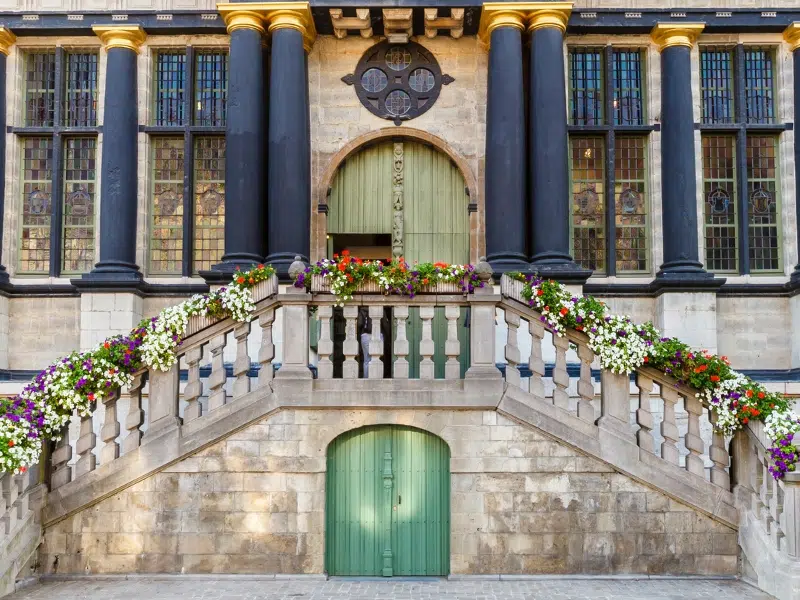
Ghent City Hall fills a whole block between the Botermarkt and the Hoogpoort, and it looks like two different buildings joined at the corner. On one side is a lacy late-Gothic façade from the early 16th century; on the other, a sober Renaissance front with rows of classical columns. The reason is a mix of politics, money and changing fashion over almost a century of building.
Ghent City Hall at a glance
- Where: on the Botermarkt in the historic centre, bounded by the Hoogpoort, the Poeljemarkt and the Stadhuissteeg, a few minutes from the Belfry.
- Built: the Gothic wing between 1519 and 1539; the Renaissance wing between 1595 and 1618; other parts from 1482 to the 19th century.
- By: Rombout II Keldermans and Domien de Waghemakere designed the Gothic wing; the 19th-century restoration involved Adolphe Pauli and Eugène Viollet-le-Duc.
- What it is today: the working seat of Ghent's city council, with the interior mostly seen on guided tours.
- Time needed: 15 minutes to look at the façades, longer if you join a tour inside.
Two councils, two buildings
Medieval Ghent was governed by two separate boards of aldermen: the Keure, which handled administration, finances and criminal justice, and the Gedele, which dealt with inheritance and guardianship. Each had its own house on this block. The oldest part above ground, an earlier Keure house of 1482, stands hidden in the middle of the complex, and a cellar on the corner of the Hoogpoort and Botermarkt is older still. In the early 16th century the city commissioned Rombout II Keldermans and Domien de Waghemakere to design a vast new Keure house in flamboyant Gothic. Work ran from 1519 to 1539, but political and financial trouble meant that only around a quarter of the plan was built.
By the time building resumed, Gothic was out of fashion. The Gedele wing on the Botermarkt, built between 1595 and 1618, follows Italian Renaissance palazzi, with Doric, Ionic and Corinthian columns stacked floor by floor. Later centuries added offices and the old Poor House, and in the 1870s the building was restored with input from Viollet-le-Duc. Inside, the Pacification Hall recalls the Pacification of Ghent of 1576, an alliance of the provinces of the Low Countries against Spanish troops.
What to look for
- The corner of the Botermarkt and the Hoogpoort, where you can see Gothic and Renaissance meet in a single view.
- The Gothic façade on the Hoogpoort, with its tracery, pinnacles and empty niches that were meant for statues of the Counts of Flanders.
- The Renaissance façade on the Botermarkt, nineteen bays long, with three orders of columns from bottom to top.
- The Bollaertskamer on the Hoogpoort, a Renaissance extension added to the Gothic wing in 1580.
- The quieter Poeljemarkt side, where later additions show how the complex grew piece by piece.
The Pacification of Ghent
In 1576 Spanish troops, unpaid and out of control, sacked Antwerp. In response, the provinces of the Low Countries, Catholic and Protestant alike, agreed in Ghent to unite to drive the soldiers out and to suspend the persecution of Protestants. The agreement is known as the Pacification of Ghent, and the hall in the city hall where it was proclaimed still carries its name. The unity did not last, but the moment is remembered as an early step towards the later Dutch Republic.
Tips for your visit
- Stand on the far side of the Botermarkt to take in the whole Renaissance front, then walk round to the Hoogpoort for the Gothic side.
- Come in the late afternoon, when the sun lights the Gothic stonework on the Hoogpoort.
- Ask at the tourist office about guided tours if you want to see the council chamber and the Pacification Hall.
- The building is a working town hall and wedding venue, so be discreet near the entrances.
Nearby
- Belfry of Ghent: the 14th-century bell tower with its dragon on top, a couple of minutes' walk south.
- St Bavo's Cathedral: home to the Ghent Altarpiece by the van Eyck brothers, a few minutes' walk away.
- St Michael's Bridge: the bridge with the classic view of Ghent's three towers, about ten minutes' walk west.
- Graslei and Korenlei: the guild houses along the river Leie, a short walk west.
See Ghent with World City Trail
Our Ghent scavenger hunt turns the old town into a game you play on your phone. The route links 11 stops and takes around 3 hours, with about 30 minutes of walking. It includes the Belfry, St Bavo's Cathedral, St Michael's Church and St Michael's Bridge.
If you prefer a different format, there is also a self-guided walking tour and an outdoor escape game in Ghent.
Play the Ghent scavenger hunt →
Take the self-guided walking tour of Ghent →
Play the outdoor escape game in Ghent →
Facts checked in October 2026.