
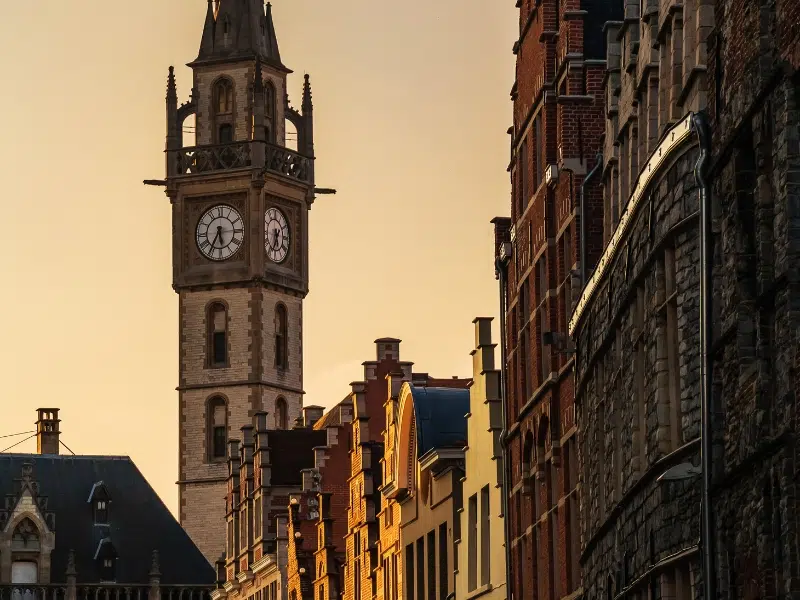
The Korenmarkt (Corn Market) is the busy square in the centre of Ghent between St Nicholas' Church and the Leie. For centuries grain shipped up the river was unloaded nearby and sold here, and in 1340 the English king Edward III announced his claim to the French throne on this square. Today it is Ghent's main meeting point, framed by café terraces and the turreted former post office.
The Korenmarkt at a glance
- Where: in the old town, between St Nicholas' Church and St Michael's Bridge, where the shopping streets Veldstraat and Kortemunt meet.
- Created: the grain market dates back to the 10th or 11th century; the square was renovated and made largely car-free in recent decades.
- What it is today: a pedestrian square with café terraces, trams and the former main post office, now shops and a hotel.
- Time needed: 15–20 minutes to look around, longer with a drink on a terrace.
From grain landing to café square
The square takes its name from grain. Wheat and rye were the staple food of medieval Ghent, which had more than 60,000 mouths to feed in the 14th century, and grain came in by boat along the Leie and the Scheldt. It was stored in warehouses on the quays and sold on this square, whose oldest name, Korenaard, suggests a landing place where grain ships tied up. Ghent and Douai were the only cities in Flanders with a grain staple right: a fixed share of all grain passing through, at least a quarter, had to be offered on the local market first. The privilege was abolished in 1761, but grain and seed were traded here until the Second World War.
The square also saw history being made. On 26 January 1340, Edward III of England, allied with the Flemish cities, proclaimed himself King of France here, a claim that set off the Hundred Years' War. Later the Korenmarkt became a stop for post coaches, and around 1900 the city began a new main post office on its west side, designed by Louis Cloquet and built in time for the World's Fair held in Ghent in 1913. Postal services left the building in 2001; it now houses shops on the ground floor and a hotel above.
What to look for
- The Old Post Office: an eclectic mix of neo-Gothic and neo-Renaissance with a richly carved façade and a clock tower, on the side of the square facing the Leie.
- St Nicholas' Church: the grey Gothic church closing the east side, one of the city's three towers, built in the local Scheldt Gothic style.
- The view east: from the middle of the square you see St Nicholas', the Belfry and St Bavo's Cathedral lined up behind each other.
- The terraces: the rows of houses around the square are now almost all cafés and restaurants, which spill out onto the cobbles in good weather.
- The trams: Ghent's trams still cross the square, so keep an eye out when you cross the rails.
Little Turkey and Donkersteeg
Two side streets open off the Korenmarkt. Klein Turkije (Little Turkey), a lane of cafés, is said to take its name not from the country but from an old Ghent expression for going bankrupt, because auctions of goods from bankruptcies were once held there. Donkersteeg, the dark alley, is a narrow shopping street with jewellers, leather goods and chocolate. Each year in July the square is also one of the main stages of the Gentse Feesten, the ten-day city festival.
Tips for your visit
- Walk up to St Michael's Bridge, a minute away, for the classic view back over the Korenmarkt and the three towers.
- Come early in the morning for photos of the post office without crowds, or in the evening when the façades are lit.
- During the Gentse Feesten in July the square is packed with stages and crowds: great for the festival, less so for sightseeing.
- Use the Korenmarkt as your starting point: the Graslei, the Belfry and the Gravensteen are all within a short walk.
Nearby
- Graslei and Korenlei: the two river quays just west of the square, with guild houses and old grain warehouses facing each other across the Leie.
- St Michael's Bridge: the bridge at the west end of the square, with the best-known view in Ghent.
- Belfry of Ghent: the medieval bell tower behind St Nicholas', part of the UNESCO-listed belfries of Belgium and France, which you can climb.
- Gravensteen: the castle of the Counts of Flanders, a short walk north past Kortemunt and the Groentenmarkt.
See Ghent with World City Trail
Our Ghent scavenger hunt turns the old town into a game you play on your phone. The route links 11 stops and takes around 3 hours, with about 30 minutes of walking. It includes St Michael's Church, St Michael's Bridge, the Belfry and St Bavo's Cathedral.
If you prefer a different format, there is also a self-guided walking tour and an outdoor escape game in Ghent.
Play the Ghent scavenger hunt →
Take the self-guided walking tour of Ghent →
Play the outdoor escape game in Ghent →
Facts checked in October 2026.