
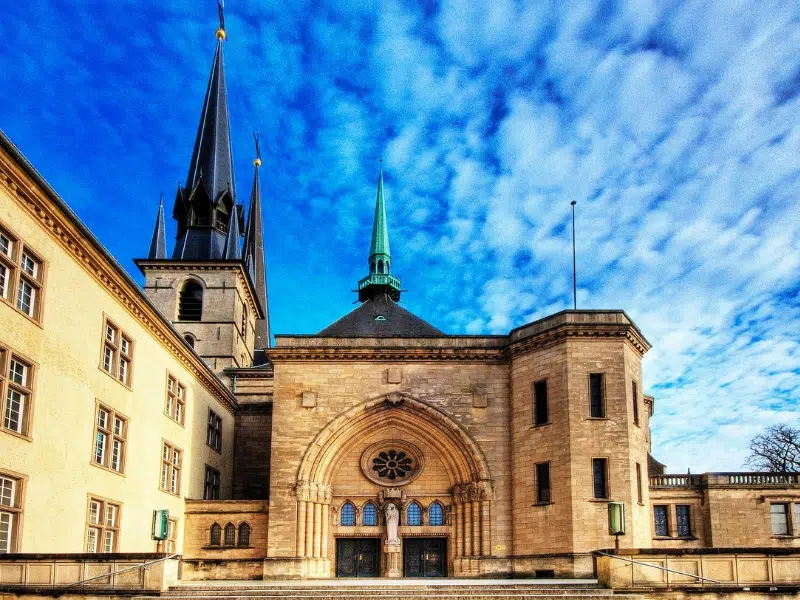
Notre-Dame Cathedral is the only cathedral in Luxembourg, standing in the upper town just off the Place de la Constitution. It was built in 1613–1621 as the church of the Jesuit college, a late-Gothic building with Renaissance and Baroque details, and became a cathedral only in 1870. Below the choir, guarded by two bronze lions, lie the tomb of John the Blind and the burial vault of the grand ducal family.
Notre-Dame Cathedral at a glance
- Where: Rue Notre-Dame and Boulevard Roosevelt, in the upper town (Ville Haute), a few minutes' walk from the Place de la Constitution and the Grand Ducal Palace.
- Built: 1613–1621 as a Jesuit church; a cathedral since 1870; enlarged with a new choir, transept and crypt in 1935–1938.
- By: the Jesuit brother Jean du Blocq designed the original church; the Luxembourg architect Hubert Schumacher planned the 20th-century extension.
- What it is today: the cathedral of the Archdiocese of Luxembourg, burial place of the grand ducal family and the setting for national ceremonies such as grand ducal weddings and funerals.
- Time needed: 20–30 minutes, plus 10 minutes for the crypt.
From Jesuit chapel to national cathedral
The Jesuits settled in Luxembourg in 1594 and opened a school in 1603. The foundation stone of their college church was laid in 1613, and the building was finished in 1621. After the Jesuit order was dissolved in 1773, Empress Maria Theresa, then ruler of the Austrian Netherlands, gave the church to the city in 1778, and it became the parish church of St Nicholas and St Theresa. It took the name Notre-Dame in 1844, and in 1870, when Pope Pius IX created the diocese of Luxembourg, it became the cathedral.
The church owes its name and much of its importance to a small wooden statue of the Virgin, Our Lady Comforter of the Afflicted (Consolatrix Afflictorum), venerated since 1624. She was chosen as patron of the city in 1666 and of the whole country in 1678, and the statue has been kept here since 1794. Every spring, from the third to the fifth Sunday after Easter, the Octave pilgrimage brings pilgrims from all over the country, and the statue is carried through the streets in a procession. The growing crowds were one reason for the extension of 1935–1938.
What to look for
- The north portal on Rue Notre-Dame, carved by the sculptor Daniel Müller in the Jesuit period, with statues of the Virgin Mary and Saints Peter and Paul.
- The nave: late-Gothic rib vaults resting on columns covered in Renaissance ornament, a mix of styles typical of early 17th-century Jesuit churches.
- The statue of Our Lady, about 70 cm tall, at the back of the choir. She is dressed in rich robes, following a tradition that goes back to the late Middle Ages.
- The two bronze lions by Auguste Trémont that guard the entrance to the crypt, and inside, the tomb of John the Blind and the vault of the grand ducal family.
- The stained-glass windows of the 19th and 20th centuries, including works by Louis Barillet and Emile Probst, which show the Virgin and the saints venerated in Luxembourg.
The blind king in the crypt
John the Blind, Count of Luxembourg and King of Bohemia, had lost his sight years before the Battle of Crécy in 1346. According to the chroniclers, he asked his knights to lead him into the fight, their horses tied to his, and he was killed there. His remains travelled a long way over the centuries before they were laid in this crypt, in the 20th century. A long tradition, not proven, says the Prince of Wales took the motto 'Ich dien' and the three ostrich feathers from John after the battle.
Tips for your visit
- The cathedral is a working church: visits are welcome outside services, but keep quiet and dress respectfully.
- During the Octave in spring the cathedral is at its busiest and most atmospheric; come then for the processions, or avoid those weeks if you want a quiet visit.
- Combine the visit with the Place de la Constitution, a few minutes away, for the view over the Pétrusse valley.
Nearby
- Monument of Remembrance (Gëlle Fra): the war memorial with its golden woman on an obelisk, above the Pétrusse valley on the Place de la Constitution.
- Grand Ducal Palace: the official city palace of the Grand Duke, with its richly decorated Renaissance facade, a few minutes' walk away.
- Place Guillaume II: the city's large square, known locally as the Knuedler, with the equestrian statue of King-Grand Duke William II.
- Place d'Armes: the tree-lined square with café terraces and a bandstand, once the parade ground of the fortress garrison.
See Luxembourg with World City Trail
Our Luxembourg scavenger hunt turns the old town into a game you play on your phone. The route links 10 stops and takes around 2 hours, with about 30 minutes of walking, and includes the Monument to Dicks and Lentz, the Place d'Armes and the Place Guillaume II.
If you prefer a different format, there is also a self-guided walking tour and an outdoor escape game in Luxembourg.
Play the Luxembourg scavenger hunt →
Take the self-guided walking tour of Luxembourg →
Play the outdoor escape game in Luxembourg →
Facts checked in October 2026.