
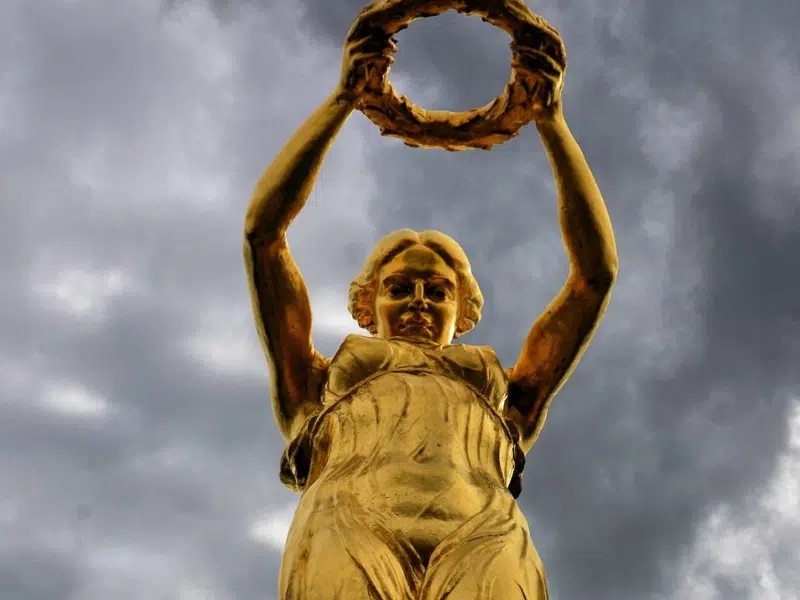
The Monument of Remembrance, known to everyone in Luxembourg as the Gëlle Fra (Golden Lady), is the tall obelisk with a gilded woman on top on Place de la Constitution, above the Pétrusse valley. It was unveiled in 1923 in honour of the Luxembourgers who volunteered to fight for the Allies in the First World War. The Nazis tore it down in 1940, and the golden statue was lost for 40 years until it turned up under the stands of the national stadium.
The Gëlle Fra at a glance
- Where: Place de la Constitution, on the old Beck bastion at the southern edge of the upper town, overlooking the Pétrusse valley and the Adolphe Bridge.
- Unveiled: 27 May 1923; put back up in its present form in 1985.
- By: the Luxembourg sculptor Claus Cito.
- What it is today: the national memorial to Luxembourgers who died in the two World Wars and the Korean War, and a symbol of the country's freedom.
- Time needed: 15–20 minutes, more if you stay for the view or visit the casemates beneath the square.
From a war memorial to a symbol of resistance
Luxembourg was neutral and occupied by Germany in the First World War, but thousands of Luxembourgers living abroad, many of them in France, joined the Allied armies, and a large share of them never came home. After the war a public committee raised money for a memorial to them. Claus Cito's design, a slender granite obelisk crowned by a gilded bronze woman holding out a laurel wreath, was unveiled in 1923 on Place de la Constitution, where it could be seen from across the valley.
In 1940 Germany occupied Luxembourg again and set out to erase the country's identity. On 21 October 1940 the occupiers dismantled the monument. Crowds gathered in protest, and young Luxembourgers who tried to stop the demolition were arrested. The obelisk was broken up and the Golden Lady vanished. After the war, pieces of the monument turned up, but the statue itself seemed lost until 1980, when it was found buried under the grandstand of the national stadium. Restored and placed back on a rebuilt obelisk, the Gëlle Fra returned to her square in 1985.
What to look for
- The Golden Lady: the gilded bronze figure at the top, leaning forward and holding a laurel wreath over the country, as if crowning the fallen.
- The two soldiers at the base: bronze figures of a dead soldier lying down and a comrade sitting beside him, keeping watch. They are by Cito too, and they are easy to miss if you only look up.
- The inscriptions: the plaques on the base name the wars the memorial now covers. The First World War dedication was later joined by the Second World War and the Korean War.
- The obelisk itself: a tall, plain granite shaft. Most of it is a reconstruction, which is why the stone looks so much newer than the bastion walls around it.
- The view behind the monument: the Pétrusse valley, the arches of the Adolphe Bridge and, on the far side, the State Bank building with its clock tower.
The Golden Lady's travels
The Gëlle Fra has become such a national symbol that she is sometimes used to make a point. In 2001 the Croatian artist Sanja Iveković put up a pregnant version of the statue, called Lady Rosa of Luxembourg, nearby as part of an exhibition, which caused a public row about art and memory. In 2010 the original statue was taken down and sent to the World Expo in Shanghai, where it stood in the Luxembourg pavilion before returning home.
Tips for your visit
- Come early in the morning or around sunset, when the light is soft and the viewpoint behind the monument is quieter.
- For the best photo, stand at the edge of the bastion with the obelisk on one side and the Adolphe Bridge on the other.
- It is a war memorial: on national days and remembrance ceremonies, wreaths are laid at the base. Do not climb on the base or sit on the soldiers.
Nearby
- Notre-Dame Cathedral: Luxembourg's cathedral, with its slender spires, a few minutes' walk north of the square.
- Pétrusse Casemates: underground passages of the old fortress, entered from Place de la Constitution itself.
- Adolphe Bridge: the great stone arch bridge over the Pétrusse valley, built at the start of the 20th century, with a suspended cycle and footbridge added underneath.
- Pétrusse valley: the green park in the valley below, reached by paths and steps from the edge of the upper town, good for a walk at the foot of the fortress walls.
See Luxembourg with World City Trail
Our Luxembourg scavenger hunt turns the old town into a game you play on your phone. The route links 10 stops and takes around 2 hours, with about 30 minutes of walking. It includes Place d'Armes, Place Guillaume II and the monument to the poets Dicks and Lentz.
If you prefer a different format, there is also a self-guided walking tour and an outdoor escape game in Luxembourg.
Play the Luxembourg scavenger hunt →
Take the self-guided walking tour of Luxembourg →
Play the outdoor escape game in Luxembourg →
Facts checked in October 2026.