
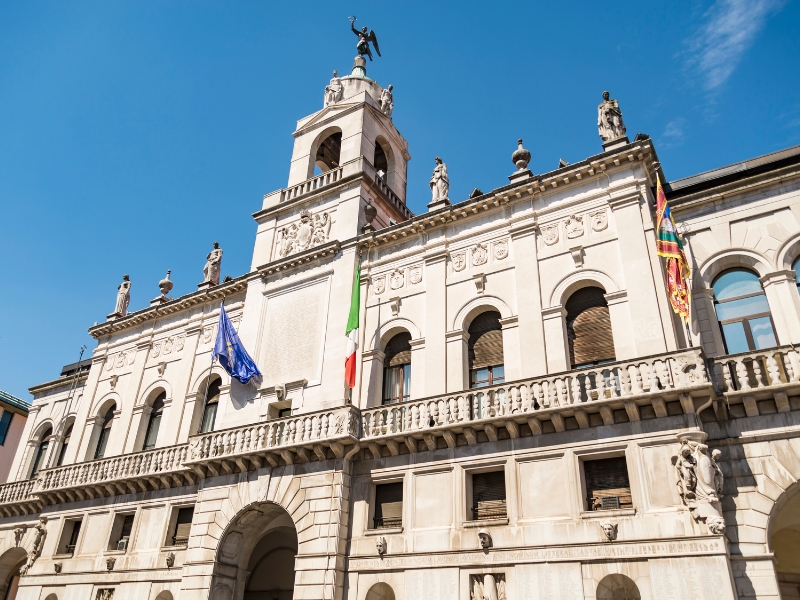
The University of Padua was founded in 1222, which makes it one of the oldest universities in the world, and its historic seat is Palazzo Bo, opposite Caffè Pedrocchi in the centre of town. Galileo taught here for 18 years, the first permanent anatomical theatre was built here, and in 1678 Elena Lucrezia Cornaro Piscopia became the first woman known to have received a university degree. Walk past on a weekday and you will probably see a new graduate in a laurel wreath.
Padua University at a glance
- Where: Palazzo Bo, Via VIII Febbraio, in the centre between Piazza Cavour and the market squares, opposite Caffè Pedrocchi and the city hall.
- Founded: 1222, by teachers and students who left Bologna; the university has used Palazzo Bo since the late 15th century.
- What it is today: one of Italy's largest universities, with its students spread across the city. Palazzo Bo is the rector's seat and the ceremonial centre.
- Time needed: 10–15 minutes for the courtyard; about an hour for a guided tour of the interior.
Scholars from Bologna and a free republic of learning
In 1222 a group of law teachers and students left Bologna and set up their own school in Padua. The city came under Venice in 1405, and the Republic protected the university, which was open to students from all over Europe, Protestants included. Its motto, Universa universis patavina libertas, roughly 'Padua's freedom, whole and for everyone', comes from that time. Copernicus studied medicine here in the early 1500s, Andreas Vesalius taught anatomy here before publishing his great anatomy book in 1543, and Galileo held the chair of mathematics from 1592 to 1610, later calling them the best years of his life.
The name Bo comes from an inn with the sign of an ox (bò in Venetian) that stood on the site. In 1594 the university built a wooden anatomical theatre inside it, the oldest permanent one in the world. On 25 June 1678 Elena Lucrezia Cornaro Piscopia, a Venetian noblewoman, received a degree in philosophy; the crowd was so large that the ceremony was moved to the cathedral. The street outside is named after 8 February 1848, when students and townspeople rose against Austrian rule, and the university later became the only Italian university awarded the gold medal for military valour, for its part in the Resistance.
What to look for
- The Old Courtyard (Cortile Antico): two floors of Renaissance arcades whose walls and vaults are covered with hundreds of coats of arms of former students and rectors.
- The statue of Elena Cornaro Piscopia at the foot of the staircase in the courtyard, a reminder of the first woman graduate.
- The Anatomical Theatre of 1594: steep, oval wooden galleries around a small dissecting table, where students stood to watch. You can see it on a guided tour.
- The Hall of the Forty (Sala dei Quaranta), named after its 40 portraits of famous foreign students. It holds a plain wooden lectern that, by tradition, Galileo lectured from.
- The Aula Magna, the great hall used for ceremonies, its walls and ceiling also crowded with coats of arms.
Laurel wreaths and papiri
A degree in Italian is a laurea, from the laurel, and in Padua new graduates still wear a laurel wreath for the day. Friends often put up a papiro, a large poster with a caricature of the graduate and cheeky verses about their student years, on the walls around the Bo, and the graduate may be asked to read it aloud in the street. On busy graduation days the area fills with families, flowers and prosecco. It is all part of the tradition; enjoy it, but leave the posters where they are.
Tips for your visit
- The Anatomical Theatre, the Hall of the Forty and the Aula Magna can only be seen on guided tours, which are popular, so book ahead.
- Weekday afternoons in graduation season are the liveliest time to pass by; for a calm look at the courtyard, come earlier in the day.
- Pair the visit with a coffee across the street at Caffè Pedrocchi, and then the markets at Piazza delle Erbe and Piazza della Frutta, both a short walk away.
Nearby
- Caffè Pedrocchi: the neoclassical café right opposite, opened in 1831 and long a meeting place for students and professors.
- Palazzo della Ragione: the medieval hall of justice between Piazza delle Erbe and Piazza della Frutta, with one of the largest suspended roofs of its age, a few minutes' walk away.
- Botanical Garden (Orto Botanico): founded by the university in 1545 for growing medicinal plants and now a UNESCO World Heritage Site, near the Basilica of Saint Anthony.
- Scrovegni Chapel: the chapel covered with Giotto's frescoes, a short walk north past Piazza Garibaldi.
See Padua with World City Trail
Our Padua scavenger hunt turns the old town into a game you play on your phone. The route links 10 stops and takes around 2 hours, with about 42 minutes of walking. It includes the Scrovegni Chapel, with Giotto's frescoes, and Piazza Garibaldi.
If you prefer a different format, there is also a self-guided walking tour and an outdoor escape game in Padua.
Play the Padua scavenger hunt →
Take the self-guided walking tour of Padua →
Play the outdoor escape game in Padua →
Facts checked in October 2026.